
Take a look at the essential events, concepts, terms, quotes, or phenomena every day and brush up your knowledge. Here’s your UPSC Current Affairs knowledge nugget for today on Antimicrobial resistance.
(Relevance: Antimicrobial resistance is an important topic for the UPSC CSE Exam. Previously, a question was asked in Mains 2014 on the emergence of drug-resistant diseases in India. Also in Prelims 2019, a question appeared on multi-drug resistance. Thus, it becomes crucial to understand this issue in detail.)
A first-of-its-kind study mapping antimicrobial resistance (AMR) in urban wastewater across four Indian metros has found that bacteria, despite differing by city, are evolving similar ways to evade antibiotics—raising concerns for public health surveillance. In this context, let’s know the finding of this study and understand the issue of AMR.
Key Takeaways:
1. The landmark study by researchers from the CSIR-Centre for Cellular and Molecular Biology (CCMB), Hyderabad, and partner institutions, published in its latest edition in the peer-reviewed journal Nature Communications, provides the first comprehensive AMR map in Indian urban wastewater.
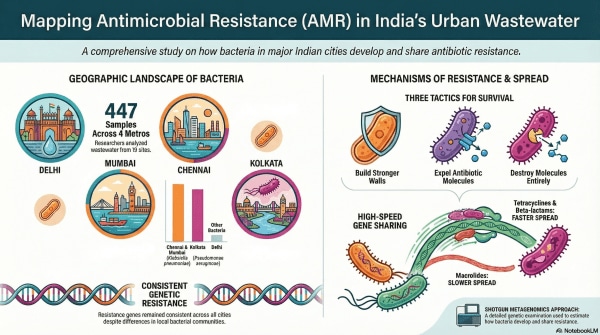
2. Conducted between March 2022 and March 2024, the study analysed 447 samples from 19 sites across Delhi, Mumbai, Kolkata, and Chennai. The findings reveal a complex landscape—different bacteria are abundant in different cities, but they follow similar mechanisms to resist antibiotics.
3. The researchers used a shotgun metagenomics approach to examine bacterial genes in detail, allowing them to estimate how bacteria develop resistance.
4. According to the study, bacteria become resistant due to certain genes. These genes either help them build stronger cell walls that antibiotics cannot penetrate, enable them to metabolise or expel antibiotic molecules, or even destroy these molecules. Bacteria can share these genes not only with their offspring but also with neighbouring microbes.
Story continues below this ad
5. The study finds that microbial communities shift based on local environmental factors. For example, Klebsiella pneumoniae is more abundant in Chennai and Mumbai, while Pseudomonas aeruginosa is more prevalent in Kolkata. However, the genes conferring resistance to various antibiotics remained consistent across all four metro cities.
 (Image; Google NotebookLM generated)
6. Antibiotics belong to different chemical classes, such as tetracyclines, beta-lactams, and macrolides. The researchers found that bacteria can share resistance genes against tetracyclines and beta-lactams more easily than against macrolides.
7. Beyond identifying threats, the researchers propose wider use of wastewater-based pathogen surveillance across the country, outlining a practical path forward for public health despite infrastructural challenges.
What is antimicrobial resistance?
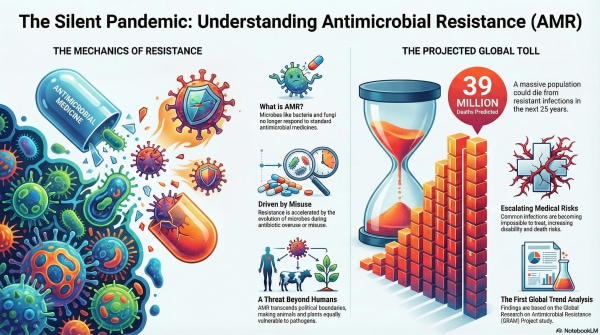
1. Antimicrobial resistance is a condition in which bacteria, viruses, fungi and parasites no longer respond to antimicrobial medicines, which include antibiotics, antivirals, antifungals and antiparasitics. As a result, infections become difficult or impossible to treat, increasing the risk of disease spread, severe illness, disability and death. It is the result of evolution of microbes in a situation where there is a misuse or overuse of antibiotics.
Story continues below this ad
2. AMR has emerged as a global concern as it transcends the political boundaries and poses a threat to all of humanity. Animals and plants are also susceptible to diseases caused by pathogens, making them vulnerable to AMR.
 (Image: Google NotebookLM generated)
3. AMR is anticipated to worsen in the coming decades with Lancet predicting that more than 39 million people around the world could die from antibiotic-resistant infections over the next 25 years.The report, based on a new study by the Global Research on Antimicrobial Resistance (GRAM) Project, is the first global analysis of antimicrobial resistance trends over time.
Key factors contributing to the rise of AMR in India
1. Excessive use of Antimicrobial Drugs: The irrational excessive use of antimicrobial drugs is the key reason for the rise of AMR as it leads to the creation of resistant or extremely resistant superbugs, which can circulate in hospitals, through drinking water, or sewers.
SuperbugsSuperbugs are microorganisms—bacteria, viruses, fungi, and parasites—that have evolved to resist medications, including antibiotics, antivirals, antifungals, and antiparasitic drugs. These organisms develop resistance through genetic mutations, often accelerated by the overuse or misuse of these medications. |
2. Lack of Hygiene Practices: Another reason for the increase in AMR is the inadequate hygiene practices and the lack of proper infection control in hospitals and clinics, which facilitate the spread of resistant bacteria.
Story continues below this ad
3. Pharmaceutical waste: “Pharmaceutical waste from antibiotic manufacturing can facilitate the emergence of new drug-resistant bacteria, which can spread globally and threaten our health. Controlling pollution from antibiotic production contributes to keeping these life-saving medicines effective for everyone,” Dr Yukiko Nakatani, WHO Assistant Director-General for AMR ad interim, said.
4. Lack of Proper Diagnostics: A significant factor contributing to the rise in AMR is the prescription of antibiotics by doctors without proper diagnostics of the patient, relying solely on symptoms to determine the likely cause of the infection.
5. Unregulated Access to Antibiotics: An area of great concern is the unregulated access to antibiotics in the animal husbandry, dairy, and poultry sectors. While we are rightfully aware and concerned about the sale of antibiotics without prescription to humans, the regulation of antibiotic sales for non-human consumption generally goes unnoticed.
Factor 01
Excessive Drug Use
Irrational overuse of antibiotics accelerates the creation of resistant superbugs that spread via hospitals, water, and sewers.
Factor 02
Poor Hygiene Practices
Inadequate infection control in hospitals and clinics enables rapid spread of resistant bacteria among patients.
Factor 03
Pharmaceutical Waste
Antibiotic manufacturing waste facilitates new drug-resistant bacteria that can spread globally, per WHO warnings.
Factor 04
Lack of Proper Diagnostics
Doctors prescribing antibiotics based on symptoms alone — without lab diagnostics — fuels resistant strains.
Factor 05 · Overlooked Risk
Unregulated Antibiotic Access in Livestock
Antibiotic use in animal husbandry, dairy, and poultry is largely unregulated — a hidden but significant driver of AMR that goes unnoticed compared to human drug sales.
Indian Express InfoGenIE
BEYOND THE NUGGET: Government initiatives to combat AMR
1. National Programme on AMR Containment: It was launched during the 12th Five Year Plan (2012-17). The main objectives of this program are:
Story continues below this ad
— Establish a laboratory-based antimicrobial resistance (AMR) surveillance system in the country to generate high-quality data on antimicrobial resistance.
— Conduct surveillance of antimicrobial usage in different healthcare settings.
— Strengthen infection control practices and promote the rational use of antimicrobials through antimicrobial stewardship activities.
— Raise awareness among healthcare providers and the community about antimicrobial resistance and the rational use of antimicrobials.
2. National Action Plan (NAP) on AMR: India was among the first countries to develop a comprehensive NAP on Antimicrobial Resistance in 2017. The plan focuses on a One Health approach, involving various stakeholder ministries and departments.
Story continues below this ad
One Health ApproachThe environment plays a crucial role in the development, transmission, and spread of AMR. Therefore, the response must be based on a One Health approach, recognizing that humans, animals, plants, and the environment are interconnected and indivisible at the global, regional, and local levels. |
Post Read Question
Which of the following are the reasons for the occurrence of multi-drug resistance in microbial pathogens in India? (UPSC CSE 2019)
1. Genetic predisposition of some people
2. Taking incorrect doses of antibiotics to cure diseases
3. Using antibiotics in livestock farming
4. Multiple chronic diseases in some people
Select the correct answer using the code given below.
(a) 1 and 2 only
(b) 2 and 3 only
(c) 1, 3 and 4 only
(d) 2, 3 and 4 only
(Sources: Hidden threat in city sewers: Study finds bacteria in Indian metros are evolving to defy antibiotics, UPSC Issue at a Glance | Antimicrobial Resistance and India)
Subscribe to our UPSC newsletter. Stay updated with the latest UPSC articles by joining our Telegram channel – Indian Express UPSC Hub, and follow us on Instagram and X.
Story continues below this ad
🚨 Click Here to read the UPSC Essentials magazine for March 2026. Share your views and suggestions in the comment box or at manas.srivastava@indianexpress.com🚨