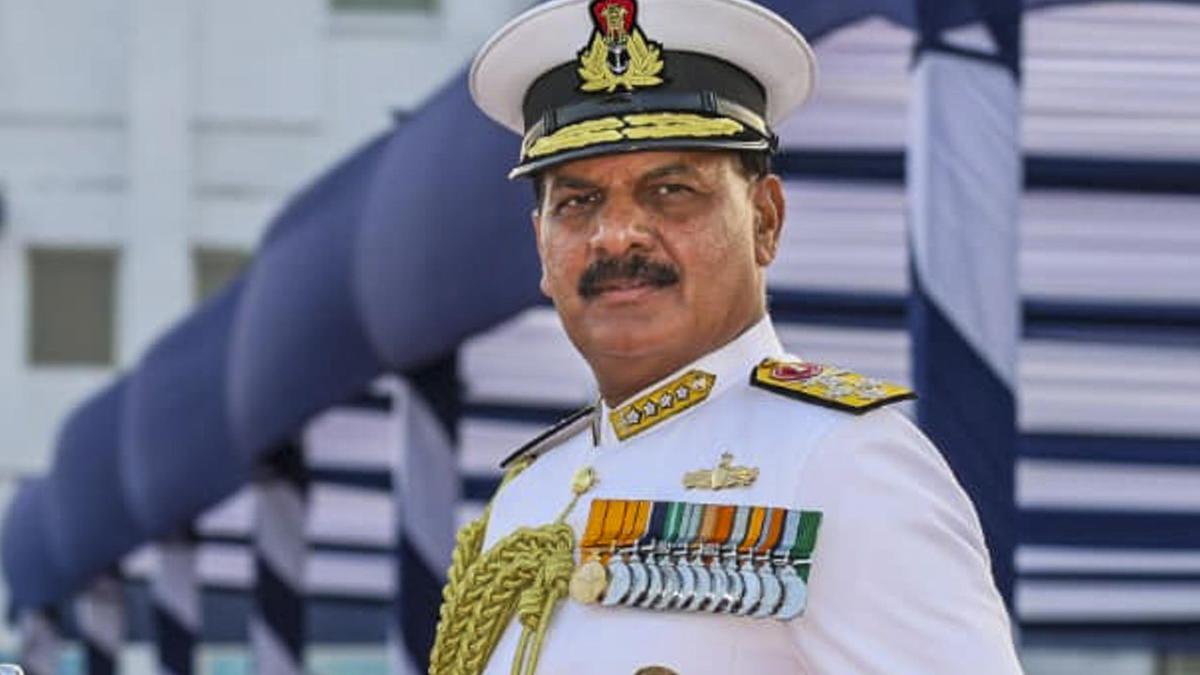
Chief of the Naval Staff Admiral Dinesh K. Tripathi. File| Photo: Defence PRO via PTI Photo
The Indian Navy was minutes away from striking Pakistan from the sea during Operation Sindoor, when Islamabad requested stoppage of kinetic actions, Navy Chief Admiral Dinesh K. Tripathi said on Wednesday (April 1, 2026).
The Navy Chief was speaking at the naval investiture ceremony here, where he awarded Yudh Seva Medals to two top naval officers for their distinguished service during Operation Sindoor conducted last year after the Pahalgam terror attack.
Operation Sindoor demonstrated exemplary readiness and resolve of the Indian Navy, as its units undertook swift deployment and maintained a highly aggressive posture throughout the period, he said.
“It is not a hidden fact anymore that we were just minutes away from striking Pakistan from the sea, when they requested stoppage of kinetic actions,” Admiral Tripathi said on the Navy’s role in the operation.
Through swift and resolute actions during Operation Sindoor, the Indian Navy reinforced the nation’s confidence and trust in its capabilities, he added.
“Besides Operation Sindoor and the relentless operational tempo through the year, we were also very proud to showcase the breadth and depth of our operational capabilities to the Prime Minister during a historic 17-hour overnight embarkation with the Indian Navy on the western seaboard,” said Admiral Tripathi.
Talking about the West Asia conflict, he said that ever since the war involving the U.S., Israel, and Iran broke out, more than 20 merchant vessels have been attacked in the region.
Nearly 1,900 vessels remain stranded amid the hostilities, he said, adding that the daily traffic through the Strait of Hormuz has fallen sharply to six-seven transits, compared with a pre-conflict average of about 130.
“At a time when the global order is marked by increasing fragmentation and friction, the seas are no longer secondary theatres where continental conflicts spill over. Instead, they are becoming the first arena where strategic intent is signalled and contested, often with disproportionate consequences,” the Navy chief added.
He said that at the same time, evolving technology and tactics have not only reshaped how conflicts are planned, initiated, and sustained, but also made non-traditional challenges more complex and less predictable to counter.
“As a result, the prevailing maritime environment demands a careful alignment of functional agility and farsightedness at the organisational level, combat readiness and operational effectiveness at the unit level, and professional excellence anchored in boldness and judgement at the individual level,” said Admiral Tripathi.
He said the Indian Navy upheld the country’s commitment as a first responder in the region, through various Humanitarian Assistance and Disaster Relief (HADR) missions undertaken at short notice and in challenging conditions, from Operation Brahma in Myanmar to Operation Sagar Bandhu in Sri Lanka.
“Sustained focus on Atmanirbharta not only enabled us to complete our transformation to a builders Navy, but also helped us gain strong momentum in capability induction with commissioning of 12 ships and submarines in a single year,” Admiral Tripathi added.
Published – April 02, 2026 02:43 am IST