


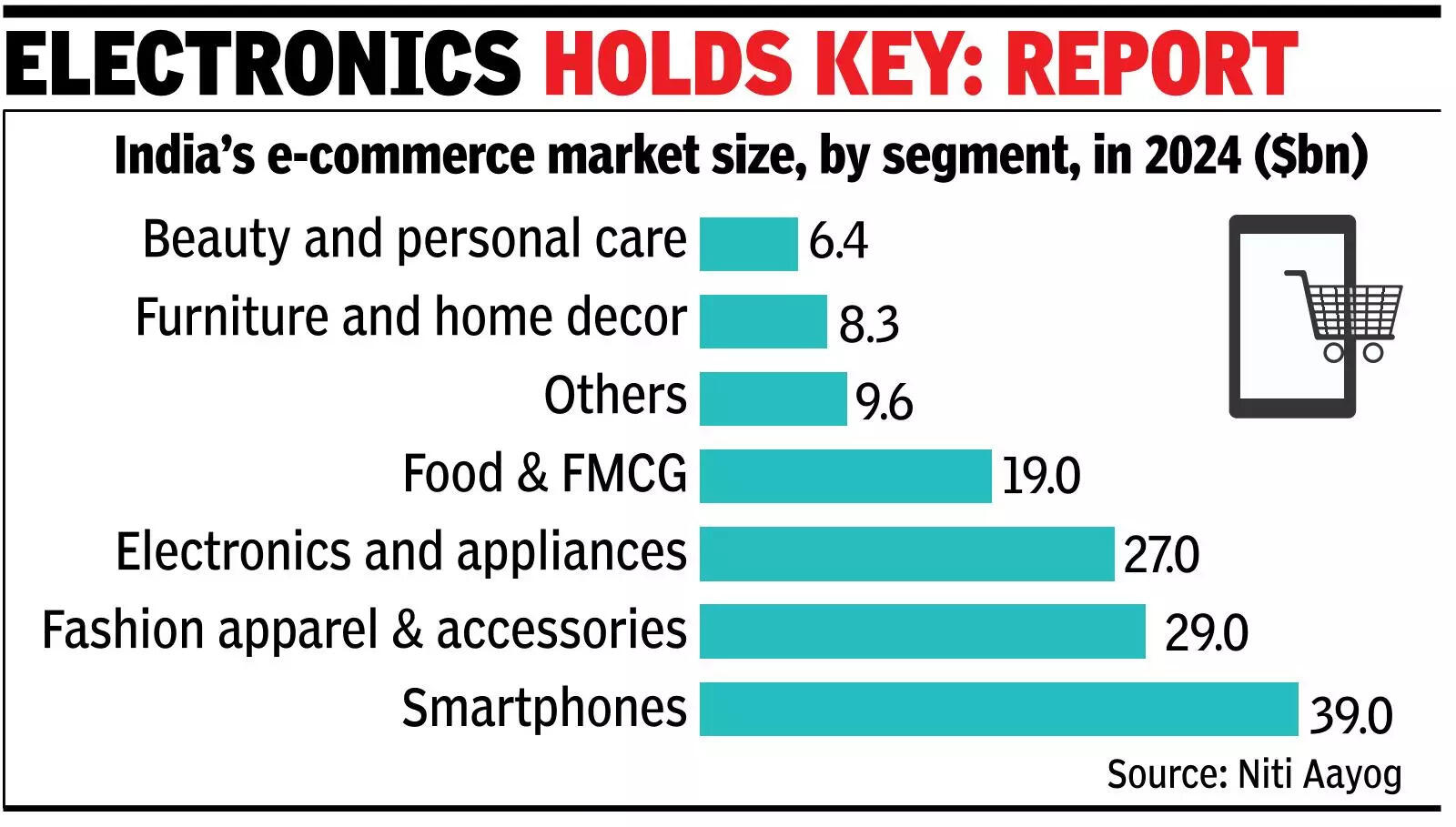
NEW DELHI: Supporting e-commerce, particularly electronics-oriented exports, can contribute to export diversification, job creation, and overall economic growth, govt think tank Niti Aayog has said and called for coordinated policy and regulatory reforms to advance cross-border e-commerce.The report released on Friday said that with growing global demand for Indian products, wider adoption of digital platforms, improved logistics, and supportive policy measures, e-commerce exports are projected to rise significantly.It said electronics-related segments – smartphones, electronics and appliances – together account for nearly $65 billion, or about half of total e-commerce market, making it the largest segment of India’s online retail market.
“Electronics e-commerce presents an opportunity to leverage scale, productivity gains, formal employment, and closer linkages with India’s growing electronics manufacturing ecosystem,” said the report. The think tank said that as India targets $1 trillion in merchandise exports by 2030 under the Viksit Bharat vision, e-commerce exports are projected to scale rapidly to $200-300 billion.“This expansion could raise their share in India’s total exports to 20-30% and their contribution to GDP to 2.9-4.3%, underscoring the potential of e-commerce to emerge as a key pillar of India’s export strategy and broader economic growth,” said the Aayog’s quarterly Trade Watch.“Given India’s 500 million-strong labour force and 63 million MSMEs contributing 29% of GDP and 43% of exports, e-commerce exports hold the potential to unlock new growth opportunities,” said the report.It identified several challenges and constraints in the country’s e-commerce ecosystem which include complex regulatory and compliance framework, absence of dedicated customs codes for e-commerce exports, inefficient reverse logistics and duty treatment of returns, lack of coordinated ecosystem support, absence of international cooperation framework and low awareness and institutional support.The report said global best practices show countries that have streamlined e-commerce such as China have introduced 24-hour digital customs clearance, dedicated cross-border pilot zones with tax incentives, and distinct supervision codes to simplify compliance, while also enabling platform-led logistics and a single-window duty-free returns system. It also cited the example of South Korea, which supports MSMEs through relaxed export declaration thresholds, consolidated packaging, and its export e-room model, reducing procedural burdens.The report also said that the US complements this with institutional backing through its e-commerce solutions centre and offering training, financing, and market linkages.