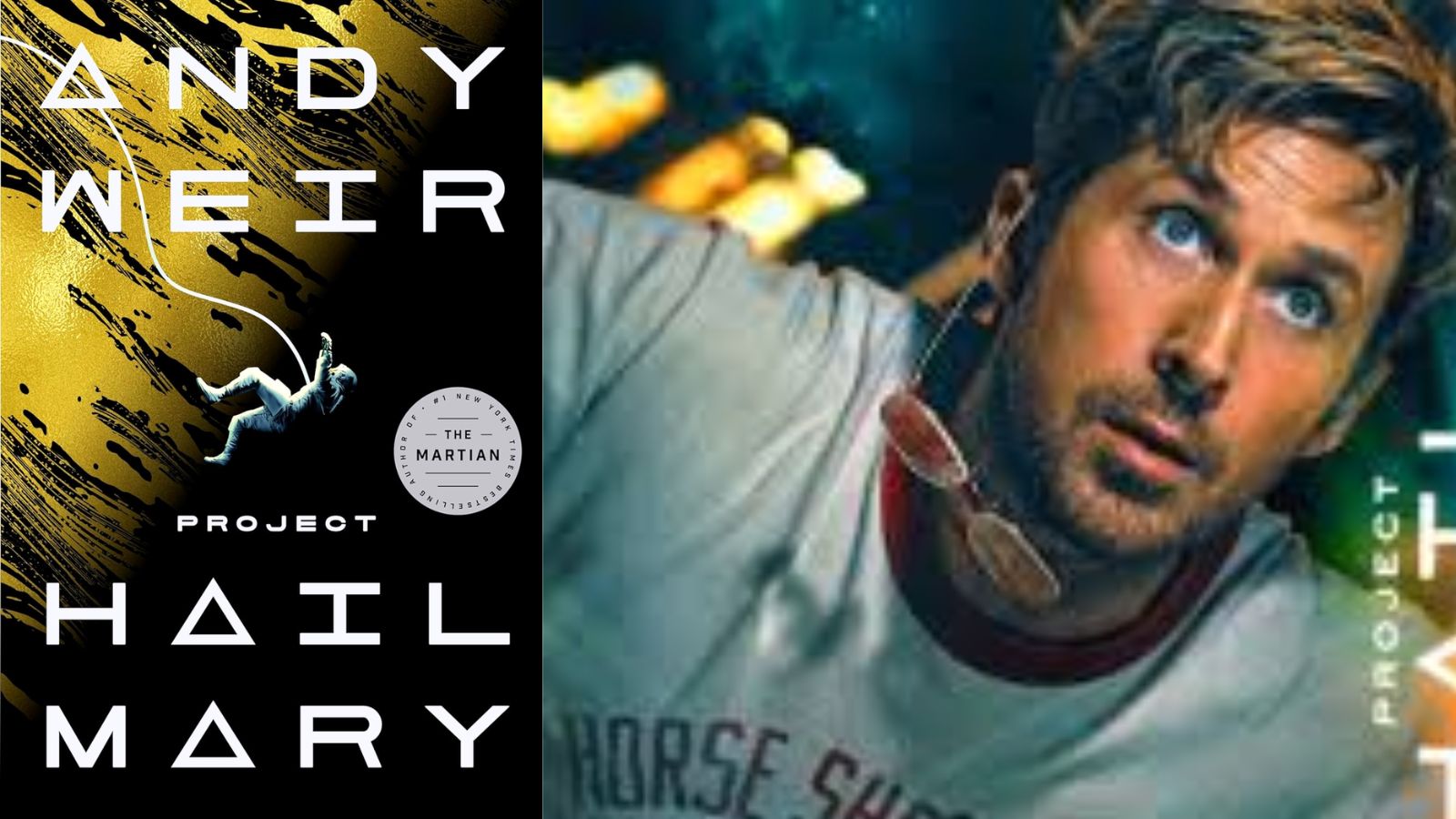
On its surface, Andy Weir’s 2021 sci-fi novel, Project Hail Mary–whose Ryan Gosling-starrer film adaptation is having a fabulous run at box offices worldwide–is the story of an amnesiac schoolteacher waking up alone on a spaceship and saving the Sun from a microbe with the help of an alien, Rocky.
Beneath it, it is also a reckoning with a dystopian doomsday scenario where laws and human rights collapse in the face of an existential threat. The moral ambiguities, the friction between what is right and what is necessary is almost ironed away in the breezy adaptation.
While the bones of the plot remain the same, where the film veers far right is in its characterisation of Eva Stratt, head of the Petrova Taskforce, an international body given unprecedented authority to save humanity from extinction.
Who is Stratt
Running against the clock to prevent the dawn of a new Ice Age, Stratt is above any protocol, in fact, in such tenuous circumstances, her word is the law. The irony is that she knows that she will have to face the music, but only if her extreme actions end up saving humanity, and yet she is doing everything–either by hook, but mostly by crook–to save the Sun from dying.
In an Emergency, rights are the first things to be suspended. When we first meet her, she is in a courtroom as she is being sued for copying every book, every song, every piece of software ever made onto the mission ship’s hard drives. One is reminded of the present-day copyright battles over the training of large language models (AI). But, Stratt is above the law, she overrides the judge with a presidential sanction, and when the bailiff steps forward, five officers of the US Army back her up.
In the film, we meet a softer Stratt, who sings karaoke to encourage her team, and is almost apologetic for what it has come to. She is someone you might want to have a drink with, the novel Stratt is one you hope you never have to cross.
One wonders why her role essayed by the wonderful Sandra Hüller was flattened in the film. Was it because her moral complexity would undercut the hilarity or because the makers struggled with the idea of an unapologetic woman, who exercises her will with an iron fist without a redeeming backstory or without an iota of regret.
Story continues below this ad
History has produced women who have governed with an iron fist–Golda Meir, Indira Gandhi, Sirimavo Bandaranaike, Margaret Thatcher–one imagines the book Stratt joining their ranks.
Book versus Film: The Conscription
In the film, Stratt is a stern mother, who apologetically tells Grace that he must martyr himself for the greater good, but her voice is laced with gentle soothing concern, and she is comfortingly touching Grace’s arm.
How Grace is coerced is where the film diverges from the book. Stratt conscripts Dr Ryland Grace, a middle-school science teacher and former molecular biologist, for this suicide mission, not because he is the only expert surviving the explosion, as shown in the film, but because he carries a genetic marker enabling survival of a years-long deep-space coma.
When Grace refused to volunteer for what is essentially a Hail Mary shot, she does not cajole him like her film version, Stratt has him physically detained by a Russian soldier named Private Meknikov, who frog-marches him out of her trailer and detains him in a cell at the Baikonur Cosmodrome. “It wasn’t a dingy jail cell or anything. If anything, it looked kind of like a college dorm room. Painted brick walls, desk, chair, bed, en-suite bathroom, et cetera. But the door was steel and the windows were barred,” Weir writes.
Story continues below this ad
‘God damn you, Stratt’
When Stratt visits him in his cell, she dispassionately informs him of what will happen. “First, you’re to be held in a cell for the next few days until the launch. You’ll have no communication with anyone. Right before launch, you’ll be given a very strong sedative to knock you out and we’ll load you into the Soyuz.”
When he says that he will not help humanity if they take away his liberty and free-will, she calmly informs him that they will next take his memory. She tells him that the French intelligence service, the DGSE, has perfected a drug that causes retrograde amnesia lasting weeks. The med-bed will inject him with it before he wakes up, so that he remembers nothing of his forced conscription. “By the time your amnesia wears off,” she tells him, “you’ll be too far invested in the project to give up.”
When Grace finally recovers his memory, light-years from home, the deepest friendship of his life has already formed with Rocky. He is sitting alone in the control room when he says, out loud, to no one: “God damn you, Stratt.”
A Hail Mary shot
Grace’s friendship with Rocky, an Eridian engineer encountered in an orbit around a distant star, is the novel’s argument about what gets built in the rubble of what is taken. Grace and Rocky construct a shared language from nothing. They use musical chords mapped to concepts, a waveform analyser, a base-six Eridian clock that Grace spends hours taping to the divider wall, pointing at numbers, building a spreadsheet of every chord Rocky produces. It is painstaking, unglamorous work, and the film, which is racing to accommodate multitudes in a 2 hours, 36 minute runtime, abbreviates it with a voice-over and Rocky speaking English.
Story continues below this ad
The beauty of the novel lies in the effort behind meeting of the minds, and the sustained willingness to be wrong, a rarity in today’s polarised world. Science, which is just a backdrop in the film, is the lifeblood of the novel. Possessed of a scientific temperament, Grace just does not just sit around waiting for Rocky to wake–or not (the horror!), he tries to help him, and upon noticing debris clogging his wounds, he blasts it clear with high-pressure air. Later, Rocky tells him the debris was his body’s repair mechanism, and had Grace acted earlier, Rocky would have died for sure.
The near-miss sits beside Stratt forcefully conscripting Grace. Everyone in this story is trying to save something, and every act of salvation nearly destroys something else.
Nuking Antarctica
The Antarctica sequence, cut from the film, is where this pattern becomes haunting. To release methane trapped beneath the ice and trigger a greenhouse effect, Stratt arranges the detonation of 241 nuclear weapons along an Antarctic fissure. However, Stratt herself does not make the announcement.
The order is formally given by Dr Leclerc, an anti-war climatologist. “I’m ordering a nuclear strike on Antarctica,” Leclerc says, and then buries his face in his hands and weeps. Stratt places a hand on his shoulder and says nothing. When the shockwave reaches the carrier, it sounds like distant thunder.
Story continues below this ad
Weir does not weigh Stratt’s culpability against Leclerc’s, or either against the billions who will survive in ignorance of what was done on their behalf. In an extinction-level event, moral weight disperses. Everyone benefits and so everybody is complicit. The reader, who wants humanity to survive, also find themselves complicit in such an irrevocable action.
Stratt as scapegoat
When Grace asks whether she fears the consequences, she shrugs and says that someone has to be the world’s whipping boy, and it might as well be her. She has absorbed the grammar of a world with no word for what she is–a woman who exercises hard power without dynasty, mandate, or declared enemy–without any permission structure at all, but she acts nonetheless, unafraid of being scapegoated for all the tough decisions she made if the civilisation gets to go on.
Ending book versus film
The novel ends with Grace old, his body worn by Erid’s crushing gravity, walking a gravel path with a cane inside a xenonite dome–the only human on an alien planet, the Hail Mary sitting fully fuelled in orbit above him. He could go home, but he would rather not.
His last line is a question to the twelve small alien children in front of him: “Who here can tell me the speed of light?” Twelve sets of claws go up. Grace has returned, at enormous expense and across an unimaginable distance, to what Stratt took him from.
Story continues below this ad
In the novel, Stratt does not appear in the ending. She is presumably in a cell somewhere, or dead. The film ends on a beach with Gosling still young and upright, and Stratt smiling indulgently at the materials he sent in the probes. You leave the cinema precisely as unburdened as the film intended.