

The Indian equity market has been rather volatile against the backdrop of Trump 2.0 tariff tantrums, Iran-US tensions over the nuclear deal, massive build-up of US firepower in West Asia, the ongoing Russia-Ukraine war, geopolitical tensions in other parts of the world and their potential ramifications on the global economy.
But what’s interesting is that fund houses don’t seem deterred from launching equity-oriented new fund offers.
In 2025, which was a challenging year for the market, a total of 128 equity funds were launched – the highest compared to the preceding three years – and three were small-cap funds, which cumulatively raised Rs 2,643 crore during the NFO period.
The total inflows into small-cap funds reached a record high of Rs 52,321 crore in 2025 despite it being a period of heightened volatility and muted returns. In other words, the small-cap segment remained a focal point for investors.
In 2026, too, equity NFOs continue to flood the market, and among a variety of them, two have been small-cap funds – one from Groww Mutual Fund (founded by Lalit Keshre, Harsh Jain, Ishan Bansal and Neeraj Singh) and the other from Abakkus Mutual Fund (founded by star fund manager Sunil Singhania, and former CIO of Equities at Reliance Mutual Fund).
The Abakkus Small Cap Fund will be available for subscription during the NFO period from February 26, 2026, to March 12, 2026. Thereafter, the scheme opens for subscription from 20 March 2026.
However, the question is whether it’s a good time to invest in small-cap funds. Let’s understand this well with some data and facts.
The Nifty Smallcap 250 Index from its peaks of 19,298.50, on closing, made on September 23, 2024, is down 17.18% as of February 23, 2026.
PE of Nifty Smallcap 250 Below Five-Year Median
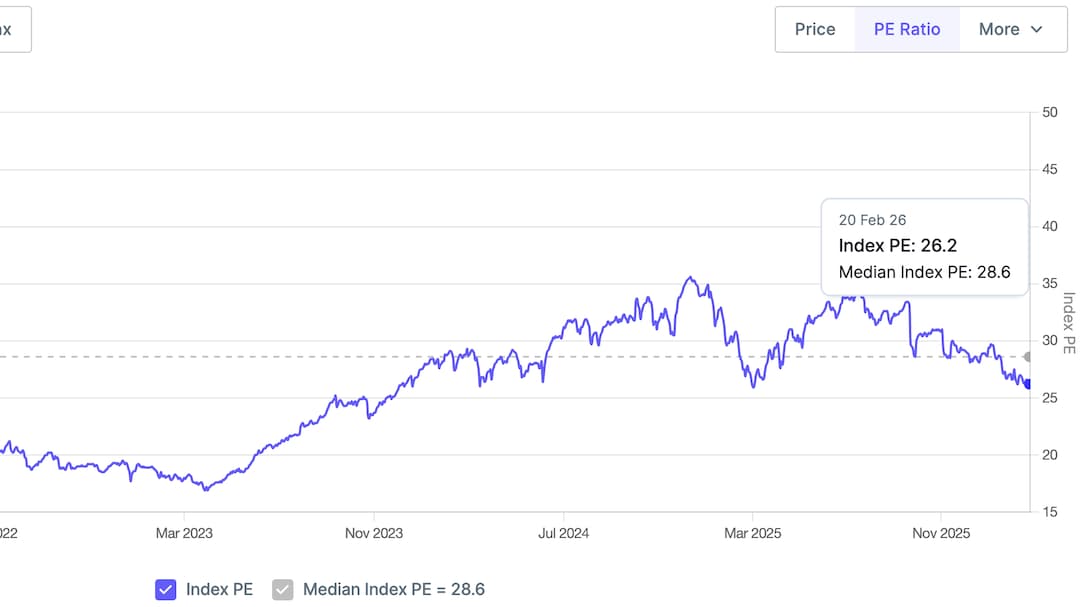
Data of February 20, 2026 Source: www.screener.in
The graph above shows that the trailing PE of the Nifty Smallcap 250 Index is also now at 26, a little below the five-year median of 29. These levels are much below the peak of 35 seen in 2024. In other words, the froth in small caps has somewhat settled, offering a margin of safety to an extent.
The encouraging earnings of small cap companies have also been a factor behind improving valuations of the Nifty Smallcap 250 index.
Over the past three years, the earnings of small-cap companies in India have followed a “V-shaped” trajectory. Even in 2025, when the revenue growth of small caps slowed to around 10-11%, the profit growth was resilient, in the range of 14-29%, as companies focused on improving their operational efficiency. Many small caps even outperformed the mid cap companies.
It is because of this that the Nifty Smallcap 250 Total Return Index has clocked an appealing compounded average growth rate of 21.2% and 19.6% over three years and five years respectively as of February 23, 2026.
That being said, you need to approach this market cap segment carefully, whether you are investing in small cap stocks or small cap mutual funds.
Risk in Small Caps
You see, investing in small-caps is inherently high risk – they can swing from thrilling highs to dangerous lows, akin to a roller coaster ride.
While it is true that small companies today are participating in India’s growth story, they are also susceptible to economic cycles and demand. If the economy faces pressures due to whatever reasons, or say, potentially interest rates are increased to counter inflation, the impact will be seen on small caps as most of them heavily depend on credit or borrowing for their growth.
Similarly, the slowdown in capex also weighs down on small cap companies. For a country that aspires to grow and industrialise faster, in reality, it is private capex that is supposed to do the heavy lifting.
But sadly, over the last decade and more, private investments have steadily lost their share, both in the economy and within total investment, while the public sector has taken a bigger role. Private capex has been stuck at around 12% of the GDP for more than a decade, while its share of total investment (Gross Fixed Capital Formation, or GFCF) fell to 34.4% in 2023–24, one of the lowest readings in more than a decade.
A small cap company – or any company for that matter – when it invests its own money or borrowed funds, its debt-to-equity ratio also needs to be in check. If it’s very high, then it means it is highly leveraged, which may not be sustainable if it isn’t making adequate revenues to service the debt. In the case of uncertain economic conditions and a rising interest rate environment, its survival could come under threat.
In addition, what you need to watch out for is high promoter pledge when investing in small caps. A lot of smaller companies need to fund growth, have higher promoter pledge, which again is risky.
Also, what you need to be careful about is that while the earnings of many small-cap companies may seem encouraging, that alone may not be enough. This is because there may be some stocks where profits only appear on paper but aren’t cash-flow positive. If there is a huge gap between cash flow from operations and earnings, you need to be cautious.
Apart from the above, the corporate governance practices also matter. Ideally, companies with poor work ethics, corporate governance lapses, low regard for stakeholder interests, and a lack of transparency in operations, among other such factors, should be clearly avoided.
Against the backdrop of geopolitical tensions and macroeconomic uncertainty, you need to be mindful of these risks before investing in small caps.
ALSO READ: Investing A Rs 10-Lakh Inheritance: SIP, FD Or Stocks — What Maximises Returns?
Instead of chasing momentum or choosing based on historical returns, focus on quality small-cap names that have earnings and robust business models to support sustainable long-term growth.
Keep in mind that while you endeavour to earn high returns with small caps, the risk is high. Small cap investing isn’t for the fainthearted. You need to have a very high risk appetite and an investment horizon of seven-eight years or more. This is because small caps are volatile, and the drawdowns during market corrections or bear phases could be greater.
When investing in small-caps, risk and returns both need to be well-managed.
“The essence of investment management is the management of risks, not the management of returns,” said Benjamin Graham (the father of value investing and the author of the famous book, The Intelligent Investor.
As a prudent approach, a small cap fund and/or stock may be held in your satellite portfolio, with the allocation to it not more than 10-15% of the total equity portfolio.
If you are making fresh investments in small caps at the current juncture, consider the systematic-investment-plan route as opposed to investing a lump sum, whereby you would be able to mitigate the risk (with rupee-cost averaging) while you endeavour to compound wealth.
Happy investing!
Disclaimer: The views expressed in this article are solely those of the author and do not necessarily reflect the opinion of NDTV Profit or its affiliates. Readers are advised to conduct their own research or consult a qualified professional before making any investment or business decisions. NDTV Profit does not guarantee the accuracy, completeness, or reliability of the information presented in this article.
ALSO READ: Mutual Fund Boom To Continue: Managed Fund AUM To Double To Rs 455 Lakh Crore By 2030, Says Crisil
Essential Business Intelligence,
Continuous LIVE TV,
Sharp Market Insights,
Practical Personal Finance Advice and
Latest Stories — On NDTV Profit.