

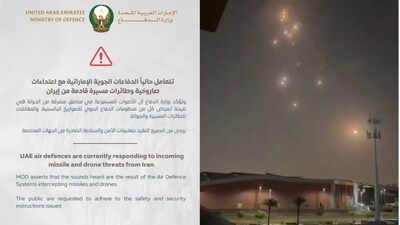
Residents across the UAE received an alarming notification, an emergency alert warning of a potential missile threat and urging people to immediately seek safety. Within minutes, confusion turned into concern as loud sounds echoed across parts of Dubai, prompting widespread speculation online but authorities quickly stepped in with clarification.Dubai authorities clarified that the sounds were not explosions from impact but the result of successful air defence interception operations. As tensions from the ongoing Iran vs US–Israel war spill deeper into the Gulf, this incident marks one of the most direct moments yet when regional conflict has been felt inside the UAE.
Emergency alerts sent to UAE residents amid Iran vs US-Israel war
The sequence unfolded rapidly. Residents received mobile alerts from the UAE’s Ministry of Interior, warning of a “potential missile threat” and advising them to stay indoors, move to safe locations and avoid open areas. Such alerts are part of the UAE’s national emergency system but are rarely activated at this scale, making the message particularly striking. Shortly after, multiple residents reported hearing loud booms across Dubai, fuelling fears that something had landed within the city.
The blast sounds explained by Dubai: Missile interceptions, not impact
Authorities, including the Dubai Media Office, quickly clarified the situation that the sounds were caused by air defence systems intercepting incoming threats mid-air and no direct missile impact occurred in Dubai. Taking to their official X (formerly Twitter) handle, Dubai Media Office tweeted, “Authorities in Dubai confirm that the sounds heard across parts of the city were the result of successful air defence interception operations. Please rely on official sources for updates.” This aligns with official updates confirming that multiple aerial threats were neutralised, ensuring public safety. In modern warfare scenarios, such interceptions often produce loud sonic booms, flash-like visuals and echoing sounds across wide areas. These are typically mistaken for explosions on the ground but are, in fact, mid-air neutralisations.
What was intercepted in Dubai amid Iran vs US-Israel war?
According to defence updates and regional reports, the UAE’s air defence systems were actively responding to ballistic missiles and drones (UAVs). In fact, the UAE reportedly intercepted 10 ballistic missiles and 45 drones in a single wave. Since the conflict began, hundreds of such threats have been neutralised, highlighting both the scale of the attacks and the intensity of defensive operations.Even though no missile directly struck central Dubai, the city still experienced the impact of the situation because interceptions happen in airspace above or near cities. Air defence systems are designed to neutralise threats before they reach populated areas, meaning interceptions can occur over or near major cities. The sonic boom from interception can travel across large distances, especially in dense urban environments like Dubai. In a tense geopolitical climate, even routine defence actions are felt more intensely by civilians. This explains why multiple explosions were reported simultaneously, even though no direct strike occurred in the city.
The real risk in the UAE: Falling debris amid Iran vs US-Israel war
While interceptions prevent direct hits, they don’t eliminate all risk. One of the most serious dangers is falling debris from destroyed missiles or drones. Recent incidents have already shown this risk as missile debris has caused damage in parts of Dubai. A fatality was reported in Abu Dhabi after debris fell from an intercepted missile. This is why authorities advise residents to stay indoors during alerts, avoid windows and open spaces and follow only official updates.
Dubai airspace closures and disruptions across the UAE amid Iran vs US-Israel war
As a precaution, the UAE temporarily shut down its airspace during the threat window. Flights were delayed, cancelled or diverted. Operations later resumed once authorities confirmed that the situation had stabilised. This reflects a standard global protocol that when missile threats are detected, civil aviation is halted immediately to avoid catastrophic risk.The alert across UAE cannot be viewed in isolation. It comes amid a rapidly escalating regional conflict involving Iran, the United States and Israel. The UAE has increasingly found itself within the extended threat zone, particularly due to its strategic and economic importance. Recent developments include drone strikes on energy facilities, missile interceptions across Gulf countries and explosions reported in multiple cities. Explosions and alerts in Dubai are part of this broader escalation, not isolated incidents.While the UAE has previously dealt with regional tensions, this incident stands out for several reasons. Hearing interception sounds in a global hub like Dubai brings the conflict closer to everyday life. Within minutes, videos, voice notes and speculation flooded platforms, making the event trend globally. People are now more aware of terms like “interception,” “air defence” and “missile threat”, concepts once limited to military briefings.
Information vs misinformation amid Iran vs US-Israel war
Dubai authorities were quick to stress one key message: Rely only on official sources for updates. This is crucial because initial reports often exaggerate or misinterpret sounds, viral posts can spread panic and false claims about “missile hits” can escalate fear unnecessarily. In this case, the quick clarification helped prevent widespread panic, reinforcing trust in official communication channels.The UAE’s response also serves as a guide for future incidents. If you receive a similar alert:
- Move indoors immediately
- Stay away from windows and glass
- Avoid using elevators
- Follow official government channels
- Do not spread unverified information
These steps are not just precautionary, they are life-saving protocols in active threat scenarios. However, all incoming threats were successfully intercepted, no direct strike occurred in Dubai and authorities maintained control of the situation. For residents, the clear message is to stay alert, stay informed and most importantly, trust verified updates over viral noise.