

Mains Examination: General Studies-II: Effect of policies and politics of developed and developing countries on India’s interests, Indian diaspora
What’s the ongoing story: THE SUPREME Court struck down President Donald Trump’s far-reaching global tariffs on Friday, handing him a stinging loss on an issue crucial to his economic agenda.
— What was the rationale behind imposing global tariffs by the Trump administration?
— What is the difference in the functioning of the American judiciary system and Indian judiciary system?
— What is the difference between sanctions and tariffs?
— How does Trump’s tariff impact the Indian economy?
— What is the significance of the interim trade deal signed between India and the USA?
— What is the status of the India-US bilateral trade?
Story continues below this ad
— What are the areas of cooperation between India and the USA?
— What is Pax Silica?
— How is India’s joining of Pax Silica significant?
Key Takeaways:
— In a landmark 6–3 decision, the US Supreme Court on Friday delivered a significant blow to President Donald Trump’s second-term economic agenda, ruling that the administration’s sweeping global tariffs are illegal. The court found that the International Emergency Economic Powers Act (IEEPA) of 1977 does not grant the President unilateral authority to impose broad import taxes, a power the Constitution reserves strictly for Congress.
— Chief Justice John Roberts, writing for the majority, clarified that “regulate” does not mean “tax,” effectively overturning the “Liberation Day” tariffs that have impacted global trade since early 2025.
— President Trump labeled the decision a “disgrace” and an “embarrassment”. Within hours, he signed a new Executive Order invoking Section 122 of the Trade Act of 1974 to impose a fresh 10% global tariff, set to take effect on February 24.
Story continues below this ad
— In a surprising twist, Indian exports originally slated for an 18% duty under previous agreements will now see a reduction to the 10% blanket rate, providing temporary relief for Indian exporters.
— While the IEEPA-based tariffs are gone, the administration maintains that Section 232 (national security) and Section 301 (unfair trade practices) duties remain in full force.
From the Explained page: Despite top court blow, US trade drama far from over
— The Supreme Court ruling, while far from convenient for Trump, does not remove tariffs from the table going forward; it simply means the Congress has to be brought on board. Whether that happens is a different question altogether.
— Now, Trump has signed a proclamation using an alternative law — Section 122 of the Trade Act of 1974 — which would allow him to impose a new 10% temporary tariff on goods from all countries.
Story continues below this ad
— US President Jimmy Carter enacted IEEPA in 1977 to replace the outgoing Trading with the Enemy Act of 1917 (TWEA), whose sweeping powers were used by President Richard Nixon in 1971 to impose a 10% tariff on all imports, even as the US struggled to resolve a balance-of-payments crisis amidst the collapse of the fixed exchange-rate system.
— Under IEEPA, the US President has the power “to deal with any unusual and extraordinary threat, which has its source in whole or substantial part outside the United States, to the national security, foreign policy, or economy of the United States, if the President declares a national emergency with respect to such threat.”
— Before Trump, the Act was used to impose sanctions on other nations, with Carter declaring a national emergency in the wake of the 1979 Iran hostage crisis to freeze all Iranian government assets in the US.
— However, no US President before Trump had interpreted IEEPA to impose tariffs. The executive order announcing the sweeping ‘Liberation Day’ tariffs of April 2, 2025, said the US is facing a “national emergency” due to the “foreign trade and economic practices” and the “absence of reciprocity” in trade relationships.
Story continues below this ad
— Whether refunds for the IEEPA tariffs are permitted or not, what is more important is how the Trump administration dealt with the setback it suffered from the country’s top court.
— There were clear indications that the Trump administration had anticipated such an outcome, with Treasury Secretary Scott Bessent saying back in November 2025 that there were “lots of other authorities that can be used”, although IEEPA is “by far the cleanest”. “The others are more cumbersome, but they can be effective,” Bessant had told CNBC.
— The other legal routes to tariffs in front of the Trump administration can be classified into two categories. The first being broad-based, but with constraints and possible legal challenges, according to Japanese investment bank MUFG, belongs to Section 122 of the Trade Act of 1974 and Section 338 of the Tariff Act of 1930.
— While Trump has said tariffs are crucial to reinforcing US manufacturing and rebalancing its trade, the revenue from these import taxes cannot be ignored, given the US federal government’s large budget deficit.
Story continues below this ad
From the Front page: As India enters Pax Silica, US says our coalition stronger
— As India Friday joined the Pax Silica, a US-led strategic alliance focused on securing AI and tech supply chains, US ambassador Sergio Gor said Secretary of State Marco Rubio will be visiting India “very soon, in a matter of months”.
— After the agreement on Pax Silica was signed, US Under Secretary for Economic Affairs Jacob Helberg, while welcoming India to the coalition, flagged challenges arising out of “massively over-concentrated” supply chains for critical minerals and “threats of economic coercion and blackmail”.
— The Pax Silica pact was formally signed at a ceremony held at the AI Impact Summit. It was attended by Union Minister for Electronics and Information Technology Ashwini Vaishnaw, Secretary S Krishnan, Helberg, Gor and Michael Kratsios, Director of the US Office of Science and Technology Policy.
Do You Know:
— Pax Silica is a US-led initiative to counter China’s dominance in new age sectors such as critical minerals that has created a wide gap in the price points of Chinese products and those produced elsewhere.
Story continues below this ad
— According to the US, Pax Silica is aimed at bringing “friendly and trusted” countries together to reduce “coercive dependencies”, protect materials and capabilities “foundational to artificial intelligence”, and “ensure aligned nations can develop and deploy transformative technologies at scale”.
— The fine print issued by the US State Department after the initiative was launched in December says the move aims to build a “secure, prosperous, and innovation-driven silicon supply chain” to secure access across the AI stack, from minerals and chips to security and logistics.
Other Important Articles Covering the same topic:
📍India enters Pax Silica: Despite late inclusion, why the US-led grouping still matters for New Delhi
📍How the pardoning power of the Indian and US Presidents differs
Previous year UPSC Prelims Question Covering similar theme:
Story continues below this ad
(1) In the context of global oil prices, “Brent crude oil” is frequently referred to in the news. What does this term imply? (UPSC CSE 2011)
1. It is a major classification of crude oil.
2. It is sourced from the North Sea.
3. It does not contain sulfur.
Which of the statements given above is/are correct?
(a) 2 only
(b) 1 and 2 only
(c) 1 and 3 only
(d) 1, 2 and 3
Previous year UPSC Mains Question Covering similar theme:
‘What introduces friction into the ties between India and the United States is that Washington is still unable to find for India a position in its global strategy, which would satisfy India’s National self-esteem and ambitions’. Explain with suitable examples. (UPSC CSE 2019)
THE EDITORIAL PAGE
AI is wreaking enduring transformations in state-capital relations
Syllabus:
Preliminary Examination: Current events of national and international importance
Mains Examination: General Studies-I, II: Effects of globalisation on Indian society; Important International institutions, agencies and fora- their structure, mandate
What’s the ongoing story: Pratap Bhanu Mehta writes: There are two broad theories about the economic roots of the backlash against globalisation. The first, and familiar one, emphasises distributional conflict: Loss of manufacturing jobs, rising inequality, wage stagnation, and fears of cultural displacement.
— What do you understand from techno-nationalist framework?
— How is the rise of AI shaping the world political order?
— What is globalisation? How has it impacted Indian society?
— Understand the role of artificial intelligence in economic restructuring
— What is India’s AI vision as outlined in the AI Impact Summit 2026?
— Understand the changing relationship between the state and capital in the era of artificial intelligence.
— Why is India calling for democratisation of AI?
Key Takeaways:
— Globalisation produced aggregate gains, but it did not compensate its losers. The task, therefore, was political management and redistribution: Rebuild welfare states, cushion shocks and restore legitimacy.
— The second theory, more conspiratorial and likely a competitor rather than a complement, argues that the backlash reflects a structural transformation in capitalism itself. Technological change, culminating in artificial intelligence, has altered the interests of capital in ways that make the old globalisation model less attractive.
— Those have always been longstanding features of capitalism. It is, rather, that AI requires reconfiguration of the strategic alignment between states and capital.
— The technological effects of AI, its implications for jobs, are much discussed. But what is palpable already is the way it is altering institutional possibilities globally.
— As Karl Polanyi once suggested, states were increasingly embedded in markets. Capital mobility constrained public power. Globalisation was not merely an ideology; it was grounded in a vision of production.
— It looks like AI may shift this calculation. First, as is obvious, frontier AI is extraordinarily capital-intensive and infrastructure-dependent. It requires massive computing power, advanced semiconductors, energy supply, and highly specialised talent pools.
— Second, AI collapses traditional distinctions between market coordination and administrative control. In a Hayekian world, price was information. In an AI-driven world, information becomes price. Algorithmic systems can generate individualised pricing, predictive behavioural targeting, and real-time risk assessment.
— The possibility emerges of a deeper symbiosis: Capital extracts data; the state gains surveillance capacity. Consumer service infrastructures and citizen surveillance architectures converge. The state helps capital, and capital helps the state control its citizens.
— Third, geopolitical competition has shifted from access to markets to control over technology. Industrial policy is less about reshoring old manufacturing jobs and more about commanding semiconductor supply chains, rare earth minerals, cloud infrastructure, and foundational models.
— The US, through export controls, semiconductor subsidies, and national security review of technology flows, is also consolidating a techno-nationalist framework. The language differs — innovation, competitiveness, resilience — but the structural logic is similar: Frontier technology requires state capacity, and states seek dominance through alignment with big capital. Big capital, in turn, is happy with helping states gain social control. In short, it is happy to align with authoritarianism.
— Two indirect pieces of evidence support this thesis. One, in populist movements, nationalism is less a redistributive programme and more an ideological veneer for elite state-capital coordination. Two, the libertarian utopianism that once animated the tech sector, cryptocurrencies beyond state control, spontaneous networked publics, the withering of hierarchy, has faded.
— Emerging, instead, is a techno-nationalist order comfortable with control, concentration, surveillance and strategic rivalry. This isn’t a re-embedding of markets in society, as many had hoped; it is a re-embedding of capital in the state.
— For countries like India and much of Europe, the challenge is distinctive. The issue is not simply regulatory architecture or redistributive correction. It is whether domestic capital and state capacity can combine at a sufficient scale to compete within this new techno-nationalist complex.
— This also means that it is very likely that techno-nationalism, on its own, will not resolve the legitimacy crises facing society. It does not begin to address inequalities of power; indeed, it may well exacerbate them.
— This interpretation certainly overstates the coherence of the transformation. Traditional institutions and markets will continue to exist; labour still matters; global interdependence has not vanished. Yet it is difficult to ignore the signs: The return of territorial nationalism, the erosion of the public-private distinction, the convergence of civilian and military technologies, and the declining relevance of exit as a source of discipline.
Do You Know:
— The process of globalisation is as old as the development of capitalism and its extension into parts of the world that became peripheral colonies tied to their metropolitan capitalist centres in Northwestern Europe.
— However, the pace of globalisation was especially accelerated throughout the 20th century, especially towards its end, with the financialisation of the global economy in the 1970s. This financialisation imparted a major impetus to globalisation – an impetus that, paradoxically, has contributed to a growing backlash against it over the last decade.
— Globalisation — the free flow of goods, services, labour, capital and ideas — has been incontrovertibly beneficial for India, lifting its average annual growth rate to nearly 6.5 per cent since the early Nineties (from 3.5 per cent during 1950-1990) and per capita GDP from $320 to $2,500.
Other Important Articles Covering the same topic:
📍Is the waning of globalisation giving way to sovereign nationalism?
📍Phase of globalisation-aided growth is facing challenges. India must be prepared
Previous year UPSC Mains Question Covering similar theme:
Elucidate the relationship between globalization and new technology in a world of scarce resources, with special reference to India. (UPSC CSE 2022)
THE IDEAS PAGE
The world’s pharmacy has a challenge — shifting from volume to value
Syllabus:
Preliminary Examination: Current events of national and international importance
Mains Examination: General Studies-II: Government policies and interventions for development in various sectors and issues arising out of their design and implementation
What’s the ongoing story: Manish Sabharwal writes: The title of the Sahitya Akademi Award-winning novel Deewar Mein Ek Khirki Rehti Thi (A Window Lived in the Wall) describes India’s pharmaceutical industry.
— What is the status of India’s pharmaceutical industry?
— What are the challenges facing this industry?
— What are the opportunities available to India’s pharmaceutical industry?
— What are generic medicines? What is its status in India?
— What is the Indian Patents Act of 1970?
— Understand the difference between biosimilars and generic medicines
Key Takeaways:
— It makes 60 per cent of the world’s medicines, saved patients over $2 trillion just in the last decade, operates more than a third of USFDA-authorised factories, and sells in 200-plus countries.
— Global mortality in AIDS and TB wouldn’t have crashed by 85 per cent without Cipla’s antiretrovirals and Lupin’s Rifampicin. This is not trade, it’s life support. But this success, impossible without policymaking — India’s Patents Act and America’s Hatch-Waxman Act — demonstrates the possibilities when entrepreneurial policy partners with entrepreneurs.
— The Indian Patents Act of 1970 replaced product patents with process patents for 35 years. The Hatch-Waxman Act of 1984 formalised an abbreviated approval process and six-month exclusivity for the first successful applicant of a generic molecule.
— The result was remarkable. America’s generic share of dispensed prescriptions rose from 1 per cent to 90 per cent today; the launch price of $2.62 per pill of the heart medication Crestor 20 years ago is now down by 90 per cent….And India’s domestic consumption of medicines now equals its exports.
— The entrepreneurial policymakers behind India’s pharma success — Justice Rajagopala Ayyangar, Parliamentarian Jaisukhlal Hathi and many others — saw what nobody else did. But their vision would have been unfulfilled without entrepreneurs like Yusuf Hamied (Cipla), Anji Reddy (Dr Reddy’s)… who matter more to India than their companies’ revenues, exports or profits because they have raised India’s soft and hard power…
— The challenge for India’s pharma industry is shifting from volume (producing 60 per cent of the world’s medicines) to value (accounting for only 6 per cent of the world’s medicine sales). Reaching the $350-billion target in pharma exports by 2047 requires taking advantage of five opportunities — generics, biologics, innovation, domestic market microstructure and contract manufacturing/research.
— And dealing with five challenges — science/research ecosystem, risk ecosystem, ease of doing business, China, and trade barriers.
— These point to the contours and possibilities of Indian pharma-policy partnership version 2.0: Increased investment in science, reduced regulatory burdens, and more freedom for universities.
— India’s pharma industry found a structural solution. Chemistry professors and researchers founded Cipla, Alembic, Lupin, and Dr Reddy’s. Pharma’s global success demonstrates the possibilities of a state that partners with entrepreneurs.
— Entitled political dynasts peddle a dated distrust of business because they can’t comprehend abundance. Thankfully, recent policy and budget moves in trust-based decriminalisation, deregulation and digitisation recognise the power of entrepreneurship. They must accelerate.
Do You Know:
— Biosimilars refer to a biologic that is very similar to the one that has been cleared by the authorities for prescription by doctors. That is why they are also called follow-on biologics. They have the same efficacy, are as safe as the reference biologic, and are used to treat the same disorders as the first biologic drug.
— But biosimilars are not generics. Generic medicines are usually synthesized from, and the manufacturing process results in an active ingredient that is the same within each manufactured lot and between lots. However, biosimilars are typically manufactured from living systems. Since it is manufactured from living, the inherent variations are expected within each lot and between lots as a natural part of the manufacturing process.
— India is a pioneer in the global biosimilars market. It was the first country to approve a biosimilars product for Hepatitis B. The Indian biosimilars market was valued at $349 million in 2022 and is estimated to expand at a growth rate of 25.2 per cent per annum from 2022 to 2030 to reach $2,108 million by 2030.
Other Important Articles Covering the same topic:
Previous year UPSC Prelims Question Covering similar theme:
(2) Which of the following are the reasons for the occurrence of multi-drug resistance in microbial pathogens in India? (UPSC CSE 2019)
1. Genetic predisposition of some people
2. Taking incorrect doses of antibiotics to cure diseases
3. Using antibiotics in livestock farming
4. Multiple chronic diseases in some people
Select the correct answer using the code given below.
(a) 1 and 2
(b) 2 and 3 only
(c) 1, 3 and 4
(d) 2, 3 and 4
Previous year UPSC Mains Question Covering similar theme:
How is the Government of India protecting traditional knowledge of medicine from patenting by pharmaceutical companies? (UPSC CSE 2019)
EXPLAINED
Why India chose to be an observer in Trump’s Board of Peace
Syllabus:
Preliminary Examination: Current events of national and international importance
Mains Examination: General Studies-II: Effect of policies and politics of developed and developing countries on India’s interests.
What’s the ongoing story: US President Donald Trump’s ‘Board of Peace’ held its first meeting on Thursday in Washington to discuss the reconstruction of Gaza, with India taking part as an “observer”.
— What is Trump’s 20-point Gaza peace plan?
— What is the role and function of the Board of Peace?
— What are the concerns related to the Board of Peace?
— Suggest points in favour and against India’s joining as permanent member to the Board of Peace
— Read about the Israel-Hamas war.
— What has been India’s stand on the Israel-Palestine conflict?
— What are the various peace efforts made by the International organisations for that region?
— Critically analyse the role of the UN in resolving international conflicts.
— How significant is the peace in the region for the India-Middle East-Europe Economic Corridor?
Key Takeaways:
— Trump first announced the Board of Peace in September last year while outlining his plan to end Israel’s war in the devastated territory, with the United Nations (UN) backing the plan. But since then, as the body’s chair, he has expanded its mandate to “resolving global conflict”, triggering criticism that it could undermine the UN.
— While 27 countries, many of them from West Asia, have accepted Trump’s invitation to join the board, India and several others in the West and Global South have not.
— India’s decision to attend the meeting as an observer was, therefore, an attempt to maintain a circumspect level of engagement with a controversial body while not shutting the door on a country with whom it has just agreed a trade pact framework.
— The board’s 27 members include major West Asian countries such as Israel, Egypt, Jordan, Saudi Arabia, UAE, Qatar, Turkey and Bahrain. Trump’s right-wing allies Argentina and Hungary are members, as are Vietnam and Cambodia. Pakistan, too, is a member. Its Prime Minister, Shehbaz Sharif, himself attended Thursday’s meeting in Washington.
— Besides the board members, 22 countries took part in the meeting as “observers”. These include the UK, Germany, Italy, Norway, Switzerland, Poland and the Netherlands. The EU, too, took part, as did Oman and Japan.
— At the meeting, Trump announced that nine of the board members had pledged a combined $7 billion towards relief in the war-battered strip. He also announced that the US was pledging $10 billion for the Board of Peace, but did not specify what the money would be used for.
— On January 24, when Trump unveiled his Board of Peace in Davos, India stayed away. It chose to wait and watch which countries would end up joining — and which ones would not.
— Now, with the board holding its first meeting, its composition has become clearer: West Asian countries with much at stake, Trump’s ideological allies, and those seeking favours from the US President or looking to placate him.
— Also important to note is who is not part of the board — Russia, China, France and the UK, the permanent members of the Security Council. The absence of these major powers reduces the Board of Peace’s heft and legitimacy.
— New Delhi is also assessing its longevity. As of now, it is Trump’s passion project. The day he demits office — in three years — the Board of Peace becomes infructuous
— India’s commitment to the UN and multilateralism will be put on test if the Board of Peace tends to undermine the UN framework and positions itself as a parallel body.
— The choice of taking part as an observer also comes ahead of Prime Minister Narendra Modi’s visit to Israel. India is well aware of the diplomatic negotiations as part of the next steps in the fragile ceasefire.
— India, which has consistently backed a “two-state solution” to the Palestine question, wants peace to return to the region. A peaceful West Asia will help the government push for the India-Middle East-Europe Economic Corridor.
— The choice of taking part as an observer also comes ahead of Prime Minister Narendra Modi’s visit to Israel. India is well aware of the diplomatic negotiations as part of the next steps in the fragile ceasefire.
— India, which has consistently backed a “two-state solution” to the Palestine question, wants peace to return to the region. A peaceful West Asia will help the government push for the India-Middle East-Europe Economic Corridor.
— So, the Board of Peace observer status gives it a ringside view of how the players in the region are navigating the issues regarding bringing peace and stability to the region, without being part of the negotiations.
Do You Know:
— After WWII, Britain decided to exit from Palestine and shifted the responsibility to address the issue to the United Nations (UN). On May 15, 1947, the UN established the United Nations Special Committee on Palestine (UNSCOP) to study the case of Palestine. On August 31, 1947, UNSCOP published its findings and recommended the partition of Palestine.
— On November 2, 1947, the UN General Assembly passed Resolution 181, recommending the partition of Palestine into a Jewish state (on around 56 per cent of land), and an Arab state (on around 43 per cent of land), with Jerusalem and Bethlehem put under a special international regime.
— Shortly after the UN Resolution 181, a civil war broke out, resulting in the violent expulsion of Palestinians from their towns and villages, which culminated in what is known as the Nakba (Catastrophe). By the time Britain withdrew, Israel had control over 77 per cent of the land, and one-third of the Arab population had been displaced and became refugees in neighbouring countries. Israel declared independence on May 14, 1948.
— India’s position in this conflict has remained consistent. It has supported a “negotiated two-state solution, towards the establishment of a sovereign, independent and viable State of Palestine within secure and recognised borders, living side by side in peace with Israel.”
Other Important Articles Covering the same topic:
📍Four reasons Delhi should decline
📍Joining Gaza Board of Peace will give India a say
Previous year UPSC Prelims Question Covering similar theme:
(3) The term “two-state solution” is sometimes mentioned in the news in the context of the affairs of (UPSC CSE 2018)
(a) China
(b) Israel
(c) Iraq
(d) Yemen
NATION
94.5% survival in childhood cancer, says study; flags late risks
Syllabus:
Preliminary Examination: Current events of national and international importance.
Mains Examination: General Studies-II: Issues relating to development and management of Social Sector/Services relating to Health, Education, Human Resources.
What’s the ongoing story: India’s first nationwide registry tracking childhood cancer survivors has reported encouraging survival outcomes, while cautioning that many children face health problems months or even years after completing treatment.
— Why are cancer cases rising in India?
— Why is early awareness and detection important?
— What are some of the major government programmes aimed at cancer care and treatment in India?
— What are the main contributing factors to cancer cases?
— To tackle India’s cancer crisis prevention must lead the way to tackle the surge. Elaborate.
— Know about the CAR-T cell therapy
Key Takeaways:
— The findings, published in The Lancet Regional Health Southeast Asia in February 2026, are based on data from 5,419 survivors enrolled across 20 centres under the Indian Childhood Cancer Survivorship (C2S) cohort.
— Survival data were available for 5,140 children. Measured from the time of initial diagnosis, five-year overall survival stood at 94.5 per cent — meaning nearly 95 out of every 100 children were alive five years later.
— The study, titled Long-term outcomes of the Indian childhood cancer survivorship C2S cohort: a multicentre study (2016–2024), was launched to understand how children fare after completing cancer treatment.
— Children were enrolled only after completing treatment and being declared in remission. Those who relapsed, abandoned treatment, or died early were not included. Nearly half of the children were between two and eight years old at diagnosis. Most were boys, and many came from families with modest income and educational backgrounds, particularly those treated in government hospitals.
— Acute leukaemia was the most common cancer, accounting for 40.9 per cent of cases, followed by Hodgkin lymphoma at 12.9 per cent, bone tumours at 8.4 per cent, and retinoblastoma at 7.4 per cent. Almost all children received chemotherapy, about one-third underwent surgery, and one-quarter received radiotherapy.
— Event-free survival — indicating children remained free from relapse or serious complications — was 89.9 per cent at five years. Among 2,266 survivors followed for at least two years after treatment, overall survival rose to 98.2 per cent and event-free survival to 95.7 per cent.
— However, the study also highlights the hidden burden of survivorship. International research shows that one-third to one-half of childhood cancer survivors experience long-term complications, some of which can be life-threatening. These may include heart problems, hormonal disorders, learning difficulties or emotional challenges that emerge long after treatment ends.
Do You Know:
— Cases of cancer in the country have risen from 84.8 per 1,00,000 people in 1990 to 107.2 per 1,00,000 in 2023. This means nearly 1.5 million people are diagnosed with cancer annually. Cancer mortality has increased from 71.7 per 1,00,000 in 1990 to 86.9 per 1,00,000 in 2023, translating to around 12.1 lakh yearly deaths.
— India’s cancer burden is becoming heavier, resulting in a system grappling with late diagnoses, uneven access to care, and, in certain cases, avoidable complications.
— To break the cycle, India must make preventive action the backbone of its cancer policy. This includes investing in cleaner air and water, scaling up HPV and hepatitis B vaccinations, expanding public awareness on the triggers of certain cancers.
Other Important Articles Covering the same topic:
📍India’s cancer crisis: Prevention must lead the way to tackle surge
📍4 in 10 cancer cases among Indians are preventable: Study
Previous year UPSC Prelims Question Covering similar theme:
(4) With reference to the treatment of cancerous tumours, a tool called cyberknife has been making the news. In this context, which one of the following statements is not correct? (UPSC CSE 2010)
(a) It is a robotic image guided system
(b) It delivers an extremely precise dose of radiation
(c) It has the capability of achieving sub-millimetre accuracy
(d) It can map the spread of tumour in the body
ECONOMY
US-Iran conflict could impact global oil supply, with stakes for India
Syllabus:
Preliminary Examination: Current events of national and international importance
Mains Examination: General Studies-II: Effect of policies and politics of developed and developing countries on India’s interests, Indian diaspora
What’s the ongoing story: International oil prices have hit a six-month high due to escalating tensions between the US and Iran, and growing concerns that Washington could launch military strikes against Tehran.
— What are the reasons for tension between the US and Iran?
— What is India’s dependence on Iranian oil?
— What is the significance of the Strait of Hormuz in global oil supply?
— What are the concerns related to the Iran nuclear program?
— Know about the portfolio of India’s crude oil import
Key Takeaways:
— Earlier this week, the second round of talks between US and Iranian envoys in Geneva over Tehran’s nuclear programme concluded with some progress, although still far from any concrete signs of an understanding that could allay fears of military action. The US has significantly built up its military presence in the region in recent weeks.
— The reason why oil markets appear jittery is the apprehension that military action against Iran could choke oil supplies from the wider Gulf region, which accounts for the lion’s share of global oil exports.
— At the heart of the apprehensions is the risk that the regime in Tehran, if cornered and posed with an existential threat, could disrupt energy flows via the Strait of Hormuz — a narrow but vital waterway that is a critical chokepoint for global oil and gas flows.
— The global oil market is currently well-supplied with surplus, which is perhaps emboldening the Trump administration with expectations of minimal impact of strikes on Iran on oil prices. The situation, however, could turn on its head in case of an extended blockade of the strait and the conflict spilling over to the wider region.
— In addition to Iran, other major Gulf oil producers, like Saudi Arabia, Iraq, the UAE, and Kuwait, are heavily dependent on the strait to feed the global market. Therefore, despite their often-strained relationships with Tehran, some Gulf nations have been actively engaging with the US administration to prevent military intervention.
— Nevertheless, with tensions between Washington and Tehran refusing to die down and the growing risk of possible US military strikes and regional conflict, benchmark Brent crude prices are over $71 per barrel, over 12% higher than a month ago.
— For India, one of the top oil importers globally, higher oil prices are never good news. Given India imports around 2 billion barrels of oil annually, every $1 increase in oil prices could increase the country’s already hefty oil import bill by around $2 billion on an annualised basis.
— According to tanker data, over 40% of crude oil imported by India transits the Strait of Hormuz. Its importance for India’s energy supply and security cannot be understated, as the country is the world’s third-largest consumer of crude oil and depends on imports to meet over 88% of its requirement.
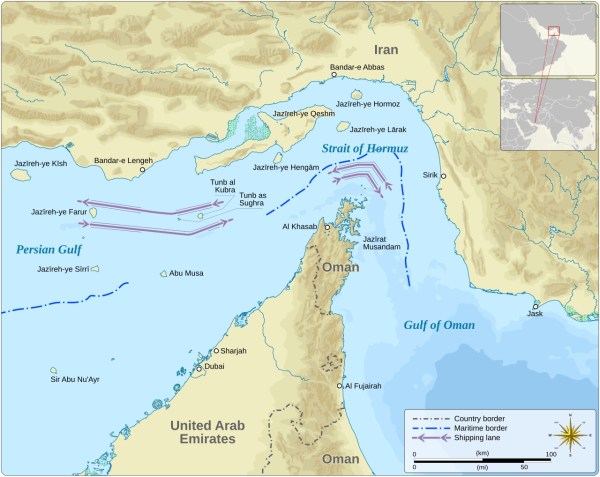 Strait of Hormuz. (Wikimedia Commons)
— Characterised by the US Energy Information Administration as the world’s most important oil transit chokepoint, the Strait of Hormuz handles approximately one-fifth of global liquid petroleum consumption and global liquefied natural gas (LNG) trade.
— The narrow waterway between Iran and Oman, connecting the Persian Gulf with the Gulf of Oman and the Arabian Sea, sees roughly 15 million barrels of crude and 20% of global LNG volumes pass through every day.
— Iran has, time and again, threatened a blockade of the strait and strikes against tankers transiting it. Moreover, there is also the lurking threat of strikes by Iran’s proxies in Yemen against tankers transiting the Bab el-Mandeb, an alternative maritime choke point that connects the Red Sea to the Gulf of Aden and the Arabian Sea, and is a critical artery for global energy flows that transit the Suez Canal.
— Notwithstanding these deterrents, the risk of conflict remains. Historically, Iran has shown restraint, even when its nuclear facilities were targeted last year. However, experts warn that if the regime in Tehran feels cornered and fears imminent collapse, the likelihood of the conflict spilling over into the Strait of Hormuz increases significantly.
Do You Know:
— India is the world’s third-largest consumer of crude oil and depends on imports to meet the bulk of its requirement. The country’s oil import dependency in domestic petroleum product consumption in April-November increased to 88.6 per cent from 88.1 per cent in the corresponding period last year amid declining domestic oil production and rising consumption of petroleum products, which are derived from crude oil.
— Oil imports top India’s merchandise imports, and the heavy reliance on imported crude oil makes its economy vulnerable to global oil price fluctuations. This also impacts the country’s trade deficit, foreign exchange reserves, the rupee’s exchange rate, and inflation rate, among others. Against that backdrop, the fall in international crude oil prices has been a positive for the Indian economy.
Other Important Articles Covering the same topic:
📍Russian oil imports may fall, but unlikely to stop
Previous year UPSC Prelims Question Covering similar theme:
(5) The term ‘West Texas Intermediate’, sometimes found in news, refers to a grade of (UPSC CSE 2020)
(a) Crude oil
(b) Bullion
(c) Rare earth elements
(d) Uranium
| ALSO IN NEWS | |
| Shah at Assam border village: Will send back every infiltrator | Union Home Minister Amit Shah formally launched the second phase of the central government’s Vibrant Villages programme in a village on the Indo-Bangladesh border in Assam’s Cachar district on Friday.
The second phase that was launched on Friday, with a total outlay of Rs 6839 crore till the financial year 2028-2029, aims to cover a total of 1,954 villages in Arunachal Pradesh, Assam, Bihar, Gujarat, J&K, Ladakh, Manipur, Meghalaya, Mizoram, Nagaland, Punjab, Rajasthan, Sikkim, Tripura, Uttarakhand, Uttar Pradesh and West Bengal, Shah said. |
| HC ruling uproar puts glare on the older, narrower definition of rape | Penetration, not ejaculation, is the sine qua non (Latin for essential ingredient) of rape. This oft-repeated line in criminal law and its emphasis in a February 16 ruling by the Chhattisgarh High Court in which a man was acquitted of rape charges has sparked outrage.
The HC held that the accused was guilty only of an attempt to rape charge and not of rape itself. Section 375 of the Indian Penal Code, till 2013, had a narrow definition of rape. It criminalised only peno-vaginal penetration. That is, the offence occurred only if a penis forcefully entered a vagina. The statutory explanation to the provision stated: “Penetration is sufficient to constitute the sexual intercourse necessary to the offence of rape.” One of the key demands from the protests over the 2012 Delhi gang rape was recognising and penalising a wide range of non-penetrative sexual offences against women. The Criminal Law (Amendment) Act, 2013, was brought in to strengthen laws against sexual offences. The new law expanded the definition of rape and introduced a mandatory minimum punishment of seven years for rape. In the expanded definition, the law recognises penetration of a penis, any object or a part of the body, to any extent, into the vagina, mouth, urethra or anus of a woman. The explanation of the provision also states that the vagina would include the labia majora. If examined under the new definition, the offence could be considered rape since penetration to any extent is included in the penal law. |
| New fund allows RWAs to propose and run projects with local bodies | In a first, the Union government’s recently-approved Rs 1-lakh crore Urban Challenge Fund will likely allow Resident Welfare Associations (RWAs) to work with local bodies to propose projects, secure funding for them and run the services in partnership, The Indian Express has learnt. |
| PRELIMS ANSWER KEY |
| 1. (b) 2. (b) 3. (b) 4. (d) 5. (a) |
Subscribe to our UPSC newsletter. Stay updated with the latest UPSC articles by joining our Telegram channel – IndianExpress UPSC Hub, and follow us on Instagram and X.
🚨 Click Here to read the UPSC Essentials magazine for February 2026. Share your views and suggestions in the comment box or at manas.srivastava@indianexpress.com🚨