

Preliminary Examination: Current events of national and international importance.
Mains Examination: General Studies-I, II, III: Geography, Effect of policies and politics of developed and developing countries on India’s interests, Indian Economy and issues relating to planning, mobilisation of resources, growth, development.
What’s the ongoing story: In what marks a new escalatory phase, the US Friday bombed Iran’s Kharg Island, a small 8-km-long rocky outcrop in the Persian Gulf around 50 km off the Iranian mainland, through which almost all of the country’s oil exports flow. Despite some 5,000 places targeted in Iran since the start of the US-Israel military operation, Kharg had been spared so far.
Key Points to Ponder:
— What is the status of the US-Israel vs Iran War.
— What is the strategic significance of Kharg Island?
— How do tensions in West Asia affect India’s energy security?
— What is the strategic significance of the Strait of Hormuz?
Story continues below this ad
— Why are desalination plants crucial for water security in the Persian Gulf countries?
— What is Operation Sankalp?
— What is India’s Middle East policy?
— What diplomatic challenges can India face in balancing its ties with Israel, the US and Iran?
— What are the efforts taken by the government for energy security amidst conflict in West Asia?
— Map work: Locate Iran, the Strait of Hormuz, Kharg Island, Israel, Bab Al Mandab,Gulf of Aden, Gulf of Oman, Horn of Africa, and other places in the news related to the US-Israel attack on Iran on the map.
Key Takeaways:
Story continues below this ad
— In a post on Truth Social, US President Trump said military targets on Kharg Island had been “totally obliterated” in “one of the most powerful bombing raids in the History of the Middle East.” He said he had chosen not to target oil infrastructure on the island for now. According to officials quoted by Reuters, only “military targets” on Kharg Island were targeted and the US Navy would soon begin “escorting tankers” through the Strait of Hormuz.
— Kharg Island is arguably Iran’s most sensitive economic target. The reason why this export terminal has remained untouched throughout the devastating US-Israel attacks is that bombing the site would likely trigger a sustained increase to already surging oil prices, as it would amount to neutralising almost all of Iran’s daily crude exports. With this attack now happening, the chances are that crude could move towards the $150 per barrel mark.
— On an average, around 1.5 million barrels of oil pass through Kharg every day, though Iran had sharply ramped up volumes to 3 million barrels a day in mid-February, according to the investment bank JP Morgan. This was in anticipation of a US-led attack. A further 18 million barrels are stored on Kharg as a backup, JP Morgan said in a note.
— Kharg is particularly significant for Iran since most of that country’s coastline is too shallow for very large crude carriers to dock. Kharg is pretty close to deep waters and has jetties built in on its eastern shoreline.
Story continues below this ad
— The infrastructure on Kharg allows very large crude tankers to be able to come up to the terminal quite easily, and then get back down the Persian Gulf and out of the Straits of Hormuz, all the way to China – the main user of Iranian oil.
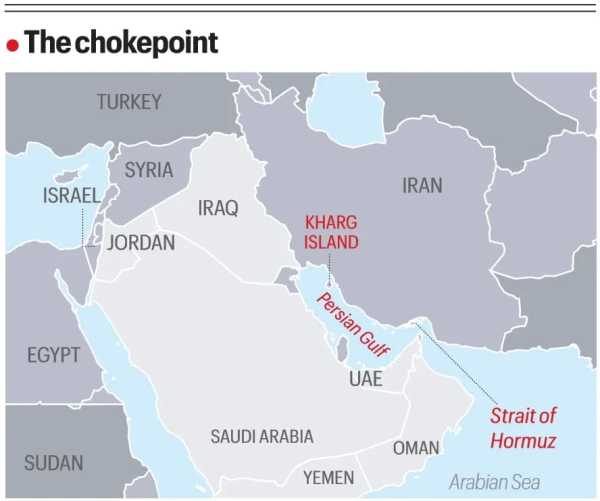 Kharg Island is a tiny speck on the Persian Gulf (Express)
— From a strategic point of view, Kharg island is the economic lifeline of the regime in Iran and is fundamental to the Iranian Islamic Revolutionary Guard Corp (IRGC) to keep fighting back the Americans and the Israelis. Theoretically, if the Americans were to take that island and hold it, then they could effectively cut off the economic lifeline of the Iranians, thereby stunting their ability to be able to conduct this war. And the ability of the Iranians to obstruct the Strait of Hormuz – the crucial maritime lifeline that is a vital conduit for transition of West Asian crude.
— But the problem for the Americans is that they would ideally not want to cause collateral damage to the oil export infrastructure on Kharg Island, since that would most certainly send the prices of crude surging. Especially as China looks to buy from elsewhere. Markets are already nervous and the destruction of Iran’s oil infrastructure could dampen sentiments further.
— Kharg is where pipelines from Iran’s oil fields in the middle and the west of the country terminate. Set up by a US oil conglomerate, American Oil Company or Amoco, it was seized by Iran during the 1979 revolution. Amoco continues to retail fuel brands under BP ownership.
Story continues below this ad
From the Front Page- “2 India-flagged LPG tankers cross, efforts on for 22 more ships: Govt”
— Two Indian-flagged liquefied petroleum gas (LPG) tankers headed to ports in Gujarat transited the critical maritime chokepoint of the Strait of Hormuz safely between Friday night and Saturday, the government announced on Saturday.
— It said diplomatic efforts are on to facilitate safe passage for the remaining 22 Indian vessels — many of which are carrying hydrocarbons — that are stuck in the Persian Gulf, which is to the west of the war-hit Strait.
— According to sources, the Indian Navy has deployed multiple warships to the Gulf region to escort merchant vessels carrying fuel to India amid heightened maritime tension in the region. At least two warships were known to have been on operational standby since Iran started the blockade of the Strait of Hormuz that connects the Persian Gulf (west) to the Gulf of Oman and the Arabian Sea (east).
Story continues below this ad
— Under the Navy’s Operation Sankalp, warships remain deployed in the Gulf of Aden and Gulf of Oman for anti-piracy operations and to secure maritime trade. Following the West Asian crisis, multiple warships have sailed to the region, the sources said. They had earlier indicated that New Delhi was in discussions with Tehran to facilitate safe passage of vessels headed for India, particularly energy tankers, through the Strait of Hormuz.
— Maritime traffic through the Strait of Hormuz — which usually accounts for a fifth of global oil and liquefied natural gas (LNG) flows and a bulk of India’s energy imports — has effectively come to a halt since the West Asia military conflict started on February 28. A number of merchant vessels have come under attack in the region in recent days.
— The effective closure of the Strait of Hormuz has created a major headache for India, which depends on imports to meet a bulk of its energy needs. Around 40% of India’s crude oil imports, over 50% of its LNG imports, and a whopping 90% of its LPG imports transited the Strait, making the chokepoint particularly critical for India’s LPG supplies.
— India’s annual LPG consumption stands at a little over 33 million tonnes, with an import dependency level of 60%. With 90% of India’s LPG imports coming from West Asia, the Strait of Hormuz effectively sees the movement of around 54% of India’s LPG consumption.
Story continues below this ad
— Now, with the crossings by Shivalik and Nanda Devi, there is growing hope of more vessels carrying energy supplies and other important cargo making their way to India, even as the situation in West Asia remains volatile. Majority of the Indian vessels that are waiting to cross the Strait of Hormuz to get to India are oil and gas tankers.
From the World Page- Iran war fuels fears for West Asia water supplies reliant on desalination plants
— Last week, Abbas Araghchi, Iran’s foreign minister, said an attack on a desalination plant on Qeshm Island, in the Persian Gulf, on March 7 had affected the water supply to 30 villages. While Iran blamed the United States for the attack, the Pentagon has denied responsibility, as has Israel.
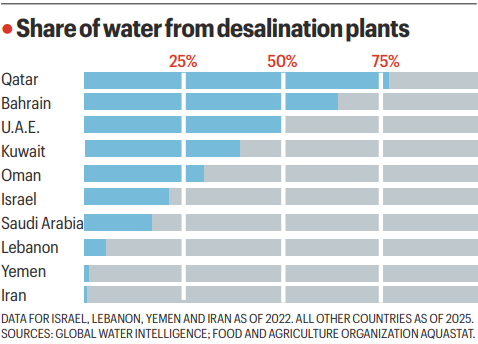
— And in Bahrain, the Interior Ministry blamed an Iranian drone for “material damage” to a desalination plant, though the country’s water and electricity authority said water supplies had not been affected. Over the last few decades, the arid countries of the Persian Gulf have become increasingly reliant on desalination plants to supply water to cities and towns.
Story continues below this ad
— Desalination plants have become crucial infrastructure in places like Qatar and Bahrain, both of which now rely on the technology for more than 50 per cent of their freshwater.
— While countries like the United Arab Emirates have tried to build up strategic water reserves, analysts say that some stocks would be depleted within days.
Other Important Articles Covering the same topic:
📍Explained: US attack on Kharg Island marks new escalation in war, could send oil prices soaring
📍War in West Asia spotlights a growing risk for Indian seafarers: Abandonment
UPSC Prelims Practice and Previous year Question Covering similar theme:
(1) Which of the statements about the Strait of Hormuz is not correct?
(a) It is a critical region for international oil and gas supplies.
(b) It is a narrow waterway between Bahrain and Qatar.
(c) It connects the Persian Gulf with the Gulf of Oman and the Arabian Sea.
(d) Disruption of shipping in this strait can significantly affect global energy prices.
(2) In the context of global oil prices, “Brent crude oil” is frequently referred to in the news. What does this term imply? (UPSC CSE 2011)
1. It is a major classification of crude oil.
2. It is sourced from the North Sea.
3. It does not contain sulfur.
Which of the statements given above is/are correct?
(a) 2 only
(b) 1 and 2 only
(c) 1 and 3 only
(d) 1, 2 and 3
THE SECOND PAGE
Setback for India’s navigation system: 1 of 4 operational IRNSS satellites fails
Syllabus:
Preliminary Examination: Current events of National importance, General Science.
Mains Examination: General Studies-III: Science and Technology- developments and their applications and effects in everyday life, Achievements of Indians in science & technology; indigenization of technology and developing new technology. Awareness in the fields of IT, Space.
What’s the ongoing story: India’s indigenous navigation satellite system—Navigation with Indian Constellation (NavIC)—has suffered a major setback with one of its four operational satellites reporting a failure “at the end of 10 years since its launch”, according to Indian Space Research Organisation (ISRO) officials.
Key Points to Ponder:
— What is the NavIC system?
— What is the significance of NavIC?
— What are the main challenges faced by ISRO in maintaining the NavIC satellite constellation?
— Read about the Global Navigation Satellite System constellations.
— What steps should be taken to strengthen the reliability of the indigenous navigation system?
Key Takeaways:
— The Indian Regional Navigation Satellite System’s IRNSS 1-F, launched on March 10, 2016, failed after its last functional atomic clock malfunctioned, space department sources indicated. The satellite had been operating with only one of its three onboard atomic clocks.
— At least four indigenous navigation satellites must be fully operational for the NavIC system to provide navigation services to the public and government agencies such as railways and the military.
— “On 13th March 2026, the procured on-board atomic clock stopped functioning. However, the satellite will continue to function in-orbit for various societal applications to provide one way broadcast messaging services,” Isro said in an official statement on Friday night.
— Although Isro has launched 11 satellites since July 2013 for the nearly Rs 2,250 crore NavIC system, six satellites have failed primarily due to defective imported atomic clocks in the initial years, and on a few recent occasions, due to orbital issues.
— Last year, in a reply in Parliament, the Union government had reported that only four of 11 satellites launched for the NavIC system were operational for positioning, navigation, and timing services, with the others being used on a sub-optimal basis.
— With the reported failure of the IRNSS 1-F, the functional NavIC satellites for PNT services at present are only the IRNSS 1-B, IRNSS 1-L, and IRNSS 1-J (NVS-01). With the reported failure of all atomic clocks on the IRNSS 1-F, a total of six of 11 Indian satellites meant for the NavIC system have failed due to the atomic clocks. Location services provided by the NavIC system in India are going to be affected,” space department sources said.
— Last year, in the July 23 reply in Parliament, the Union government had stated that “around 12,000 trains are targeted for tracking in real-time using NavIC and other GNSS constellations” and that “around 8,700 trains are already equipped with NavIC along with other GNSS constellations”.
— The Union minister of state for space had stated in Parliament in July 2025 that a new generation NavIC satellite “NVS-03 is planned to be launched by end of 2025” and “subsequently, with a gap of six months, NVS-04 & NVS-05 are planned to be launched”. But these timelines have not been realised after the launch failures for the PSLV C61 on May 18, 2025, and the PSLC C62 launch on January 12, 2026.
— Isro plans to launch three second-generation NavIC satellites—NVS-03/04/05—in the future “to augment NavIC base layer constellation with enhanced features for ensuring continuity of services”.
Other Important Articles Covering the same topic:
📍Story of NavIC: crucial indigenous SatNav system, a few hurdles in development path
UPSC Prelims Practice Question Covering similar theme:
(3) With reference to the Navigation with Indian Constellation (NavIC), consider the following statements:
1. It is India’s indigenous navigation satellite system.
2. At least two indigenous navigation satellites must be fully operational for the NavIC system to provide navigation services to the public and government agencies.
Which of the statements given above is/are correct?
(a) 1 only
(b) 2 only
(c) Both 1 and 2
(d) Neither 1 nor 2
OPINION
Ambedkar backed UCC, with a rider–can initially be voluntary
Syllabus:
Preliminary Examination: Indian Polity and Governance.
Mains Examination: General Studies-II: Constitution of India —features, amendments, significant provisions and basic structure., Government policies and interventions
What’s the ongoing story: Vikas Pathak writes- “Backing a Uniform Civil Code (UCC), the Supreme Court said Tuesday that it is the “most effective answer” to usher in equality in inheritance laws, rather than the court striking down allegedly discriminatory personal law provisions and causing ambiguities.”
Key Points to Ponder:
— What are Directive Principles of State Policy?
— What is the Uniform Civil Code?
— Know about the personal laws in India.
— What are the constitutional provisions related to freedom of religion?
— What are the arguments for and against the implementation of UCC?
— What was the Constituent Assembly debate regarding the adoption of UCC?
— What has the 22nd Law Commission said on UCC?
— What is the “Essential Religious Practices” doctrine in Indian constitutional law?
— What are the important cases related to UCC?
— What are the challenges associated with the implementation of UCC?
Key Takeaways:
— “The assertion of the apex court isn’t too different from what B R Ambedkar, Chairman of the Drafting Committee of the Constitution, said when the Constituent Assembly was discussing amendments to Article 35 of the draft Constitution (later Article 44), a Directive Principle of State Policy that said, “The State shall endeavour to secure for citizens a uniform civil code throughout the territory of India.”
— “On November 23, 1948, Constituent Assembly member Mohammad Ismail Khan, arguing that the right to follow personal law is fundamental to a community, had proposed that a proviso be added to Article 35: “Provided that the personal law of any community which has been guaranteed by the statue shall not be changed except with the previous approval of the community ascertained in such manner as the Union Legislature may determine by law.” Member Mahboob Ali Baig too moved a similar amendment. Apart from K M Munshi and Alladi Krishnaswami Ayyar, Ambedkar also spoke at length to oppose the amendment.
— “Making a historical and political argument against the claim that the Muslim personal law in India had always been fixed, uniform, and immutable, Ambedkar argued that in several regions — from the North-West Frontier Province to United Provinces, the Central Provinces and Bombay — Muslims sometimes even followed Hindu inheritance systems, until the colonial British government mandated the application of the Shariat law of 1937. In North Malabar, Ambedkar went on to say, the Marumakkathayam Law, a matrilineal law, applied to all — Hindus as well as Muslims.”
— ““It is therefore no use making a categorical statement that the Muslim law has been an immutable law which they have been following from ancient times,” Ambedkar argued.”
— “But unlike other proponents of the UCC, Ambedkar had a more conciliatory approach as he attempted to allay fears that the Code would be immediately imposed on everyone once the Constitution came into force. Pointing out that Article 35 was a Directive Principle and not a law already enforced, he said the Code could be initially applied voluntarily before broadbasing it. “It is perfectly possible that the future parliament may make a provision by way of making a beginning that the Code shall apply only to those who make a declaration that they are prepared to be bound by it, so that in the initial stage the application of the Code may be purely voluntary.”
— “The amendment was thus rejected by the Constituent Assembly and the UCC became part of the Constitution. However, the matter was brought up again on December 2, 1948, by Constituent Assembly member Kazi Syed Karimuddin, who argued that if a Code were enacted, it would interfere with the freedom to practise religion. Ambedkar countered the argument with a plea for a clear boundary between religion and civil/social law.”
— ““The religious conceptions in this country are so vast that they cover every aspect of life, from birth to death. There is nothing which is not religion and if personal law is to be saved, I am sure about it that in social matters, we will come to a standstill,” he said. “I personally do not understand why religion should be given this vast, expansive jurisdiction so as to cover the whole of life and to prevent the legislature from encroaching upon that field. After all, what are we having this liberty for?”
— “He again sought to reassure members from the minority community that recognising the State’s power to enact a uniform civil code did not mean it would be imposed immediately or without regard to social consequences.”
Do You Know:
— A Uniform Civil Code would provide for one law for the entire country, applicable to all religious communities, in their personal matters such as marriage, divorce, inheritance, adoption, etc.
— Article 44 of the Constitution says that “the State shall endeavour to secure for the citizens a uniform civil code throughout the territory of India”.
— Article 44 is among the Directive Principles of State Policy. Directive Principles are not enforceable by court, but are supposed to inform and guide governance.
Other Important Articles Covering the same topic:
📍How the Uniform Civil Code came to be included in the Indian Constitution
Previous year UPSC Prelims Question Covering similar theme:
(4) Consider the following provisions under the Directive Principles of State Policy as enshrined in the Constitution of India: (UPSC CSE 2012)
1. Securing for citizens of India a uniform civil code
2. Organising village Panchayats
3. Promoting cottage industries in rural areas
4. Securing for all the workers reasonable leisure and cultural opportunities
Which of the above are the Gandhian Principles that are reflected in the Directive Principles of State Policy?
(a) 1, 2 and 4 only
(b) 2 and 3 only
(c) 1, 3 and 4 only
(d) 1, 2, 3 and 4
Previous year UPSC Mains Question Covering similar theme:
Discuss the possible factors that inhibit India from enacting for its citizens a uniform civil code as provided for in the Directive Principles of State Policy. (UPSC CSE 2015)
NATION
BRICS members involved in conflict, difficult to forge consensus: MEA
Syllabus:
Preliminary Examination: Current events of national and international importance.
Mains Examination: General Studies-II: Bilateral, regional and global groupings and agreements involving India and/or affecting India’s interests.
What’s the ongoing story: A day after Iran reached out to Delhi for a statement on behalf of BRICS, currently chaired by India, condemning the US and Israeli strikes, the External Affairs Ministry said on Saturday that it has been difficult to forge a consensus on the issue because of involvement of BRICS member countries in the ongoing conflict.
Key Points to Ponder:
— Know about the West Asia conflict.
— BRICS-Know in detail
— Evolution of BRICS-Know in Detail.
— Why BRICS Matters?
— What challenges does India face in building consensus within BRICS on the West Asia conflict?
— What are the opportunities and challenges faced by India as the chair of BRICS?
— How is BRICS rewriting some of the rules of global politics, and increasingly positioning itself as a challenger to the Western-led liberal international order?
— Why is West Asia strategically important for India’s foreign policy?
Key Takeaways:
— Without naming any country, MEA’s official spokesperson Randhir Jaiswal said: “Some members of the BRICS are directly involved in the current situation in the West Asia region, which has impacted forging a consensus on a common BRICS position on the ongoing conflict. As Chair of BRICS, India has been facilitating discussions among members through the Sherpa channel.”
— He said the last virtual BRICS Sherpa meeting was held on March 12. In addition, “Indian leadership has been engaging with leaders of BRICS members in the region. India will continue to engage,” the MEA spokesperson said.
— The Indian Express reported on Saturday that Tehran had reached out to Delhi to take the lead in issuing a statement on behalf of the BRICS, condemning the US and Israeli strikes against Iran in the last two weeks. This put Delhi in a diplomatic pickle since it has stayed away from taking sides in the ongoing conflict.
— Prime Minister Narendra Modi has spoken to leaders of the countries in the region hit in Iran strikes, condemned the attacks and thanked them for looking after the Indian community “in these difficult times”.
— The BRICS grouping has Brazil, Russia, India, China and South Africa (the original five), besides Egypt, Ethiopia, Iran, Saudi Arabia, the UAE and Indonesia. Saudi Arabia and the UAE, which host US bases and personnel, have been targeted by Iranian missiles and drones. The fact that all three countries are in the BRICS has made diplomatic navigation difficult for Delhi.
— India, which holds the rotational presidency of the grouping for 2026, is expected to host the summit of BRICS leaders later this year.
— PM Modi has spoken to leaders of Saudi Arabia, UAE and Iran — all BRICS members — in the last two weeks. Jaishankar has also spoken to his counterparts in these countries, as well as in Russia.
— The BRICS has emerged as an influential grouping as it brings together 11 major emerging economies of the world, representing around 49.5% of the global population, around 40% of the global GDP and around 26% of the global trade.
Do You Know:
— The acronym BRIC was first used in 2001 by Goldman Sachs in their Global Economics Paper, ‘The World Needs Better Economic BRICs’. The paper projected that Brazil, Russia, India, and China would be among the world’s largest economies in the next 50 years or so.
— As a formal grouping, BRIC started after the meeting of the leaders of Russia, India and China in St. Petersburg on the margins of the G8 Outreach Summit in 2006. The grouping was formalised during the first meeting of BRIC Foreign Ministers on the margins of the UNGA in New York in 2006.
— The first BRIC Summit was held in Yekaterinburg, Russia, in 2009. It was decided to include South Africa at the BRIC Foreign Ministers’ meeting in New York in 2010, and accordingly, South Africa attended the 3rd BRICS Summit in Sanya, China, in 2011.
Other Important Articles Covering the same topic:
📍How BRICS is chipping away at the Western order
📍BRICS and the creation of a multipolar world
Previous year UPSC Prelims Question Covering similar theme:
(5) The ‘Fortaleza Declaration’, recently in the news, is related to the affairs of (UPSC CSE 2015)
(a) ASEAN
(b) BRICS
(c) OECD
(d) WTO
Previous year UPSC Mains Question Covering similar theme:
Compare the significance of IBSA and BRICS in the context of India’s multilateral diplomacy. (UPSC CSE 2012)
ECONOMY
KYC compliance loop continues to strain bank staff & account holders
Syllabus:
Preliminary Examination: Economic and Social development.
Mains Examination: General Studies-II, III: Government policies and interventions for development, Indian Economy and issues relating to planning, mobilization, of resources, growth, development and employment.
What’s the ongoing story: Over eight months after the central bank relaxed Know Your Customer (KYC) norms in a bid to simplify compliance and reduce inconvenience for customers, complaints from bank account holders show little sign of abating. Despite regulatory efforts to streamline the process and make KYC updation less cumbersome, many customers continue to face repeated requests for documentation, account restrictions and delays in verification.
Key Points to Ponder:
— What are KYC norms?
— Know about the role of the Reserve Bank of India in the banking sector.
— What are the key challenges faced by banks and customers in implementing KYC norms in India?
— How do strict KYC compliance requirements affect financial inclusion in India?
— What are the challenges faced by the banking sector in India?
— Know about the Pradhan Mantri Jan Dhan Yojana.
— How can the KYC verification process be made more efficient?
Key Takeaways:
— In June last year, the Reserve Bank of India (RBI) announced a string of changes to its Master Direction on KYC norms, which included allowing business correspondents to help conduct the KYC and giving banks one year — till June 2026 — to complete KYC updation of ‘low risk’ category customers.
— But the sheer number of bank accounts, which further swelled after the implementation of Centre’s ambitious cash transfer scheme — Pradhan Manrti Jan Dhan Yojana — made the task of verifying the customer’s identity even more difficult, bankers claim.
— It leaves both the affected customers and the depositors on tenterhooks. Regulatory pressure has triggered a wave of account restrictions and occasional freezes, leaving customers rattled — even as the bank staff scrambled to keep up with compliance demands.
— The insistence stems largely from compliance pressures, internal risk controls and an operational caution within the banking system, according to banking sources. Customers, however, say the repeated demands for KYC updates are no less than harassment.
— Bank officials say the compliance burden has become overwhelming as there are over 250 crore bank accounts in India. State Bank of India alone has over 50 crore bank accounts. The manager of a leading nationalised bank recently alleged irregularities in the KYC updation process and shot off a complaint to enforcement agencies.
— Bank officials say that the pressure to ensure KYC compliance has intensified over the past year. Regulations mandate ‘high risk’ customers to submit KYC documents every two years, ‘medium risk’ customers every eight years and ‘low risk’ customers every 10 years.
— However, this norm is often violated by banks. “Low-risk” customers are placed in the “high-risk” category, and KYC updates are demanded every two years,” said a salaried customer who faced the consequences of KYC verification.
— According to an official of a nationalised bank, the industry has been under sustained regulatory scrutiny to ensure that every account is fully KYC compliant.
Do You Know:
— The government’s flagship financial inclusion programme Pradhan Mantri Jan Dhan Yojana (PMJDY) was launched by Prime Minister Narendra Modi on August 28, 2014.
— It is a National Mission for Financial Inclusion to ensure access to financial services, namely, a basic savings & deposit accounts, remittance, credit, insurance, pension in an affordable manner.
— Under the PMJDY, there are no account opening charges, no account maintenance charges, and no minimum balance charges. Free RuPay debit card, with in-built accident insurance cover of Rs 2 lakh, and access to overdraft facility of up to Rs 10,000, are other major features of the scheme.
— PMJDY accounts are eligible for Direct Benefit Transfer (DBT), Pradhan Mantri Jeevan Jyoti Bima Yojana (PMJJBY), Pradhan Mantri Suraksha Bima Yojana (PMSBY), Atal Pension Yojana (APY), Micro Units Development & Refinance Agency Bank (MUDRA) scheme.
Other Important Articles Covering the same topic:
📍Knowledge nugget of the day: PM Jan Dhan Yojana (PMJDY)
UPSC Prelims Practice Question Covering similar theme:
(6) With reference to the Pradhan Mantri Jan Dhan Yojana (PMJDY), consider the following statements:
1. The scheme provided an unprecedented boost to the government’s campaign for financial inclusion.
2. It was launched in 2016.
3. The objective of the PMJDY was to open a Basic Savings Bank Account for unbanked individuals.
4. These accounts are required to maintain any minimum balance in PMJDY accounts.
How many of the statements given above are correct?
(a) Only one
(b) Only two
(c) Only three
(d) All four
ALSO READ |
|
| Clarity on captive power generation | The government on Saturday announced amendments in the electricity norms for bringing more clarity for captive power generation, especially for industries, in line with India’s energy transition goals. Generating power closer to the point of consumption will help reduce transmission losses, improve system efficiency and strengthen grid resilience, the Ministry of Power said in a statement. |
| Kerala Govt shifts stand on entry of women into Sabarimala temple | In a significant climbdown on the entry of women into the Sabarimala temple, the Left Democratic Government (LDF) government in Kerala has called for “wide consultations with and… soliciting views of eminent religious scholars and reputed social reformers of that religion” before any changes are made to the “religious practice followed for so many years”. Earlier, the state government had supported the decision of a five-Judge Bench of the Supreme Court on September 28, 2018, to allow the entry of all women, irrespective of their age, to the temple. In a 4-1 verdict, the Bench had held that prohibiting women between the ages of 10 and 50 years from entering the hill shrine was exclusionary and violated the right of Hindu women to freely practice their religion |
| North Korea fires about 10 missiles toward sea in show of force, says Seoul | North Korea on Saturday fired about 10 ballistic missiles toward the eastern sea, South Korea’s military said, staging its own show of force as the rival South conducts a joint military exercise with the United States. South Korea’s Joint Chiefs of Staff said the missiles were fired from an area in Sunan, the site of Pyongyang’s international airport, and flew about 350 kilometers (220 miles). |
| PRELIMS ANSWER KEY |
| 1. (b) 2. (b) 3. (a) 4. (b) 5. (b) 6. (b) |
Subscribe to our UPSC newsletter. Stay updated with the latest UPSC articles by joining our Telegram channel – Indian Express UPSC Hub, and follow us on Instagram and X.
🚨 Click Here to read the UPSC Essentials magazine for February 2026. Share your views and suggestions in the comment box or at manas.srivastava@indianexpress.com🚨