

Struggling with tricky and important concepts in UPSC Prelims? The exam increasingly tests your conceptual clarity and ability to apply core ideas, especially in the most dynamic subjects: Science, Economy, and Environment (SEE).
UPSC Essentials’ new initiative, UPSC Prelims ‘SEE’ Snapshot brings you quick, exam-focused revision of key concepts, using relevant contexts to help you avoid common traps and improve accuracy.
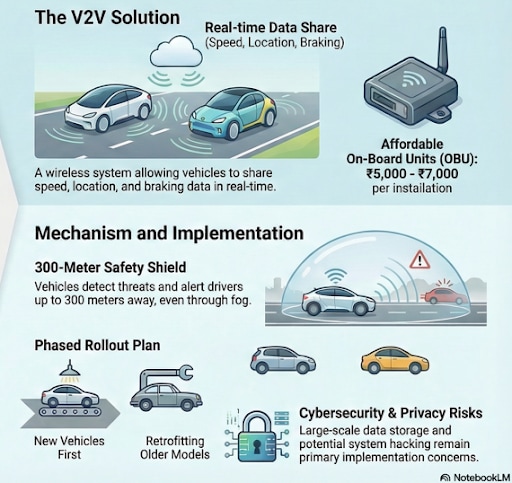
— V2V or vehicle-to-vehicle communication is a wireless technology that will enable the vehicles to communicate or talk with one another to share real-time information like speed, location, acceleration, braking, etc. It is the sub-category of Vehicle-to-Everything (V2X) and comes under the umbrella of the Intelligent Transport System.
— The system is similar to the aviation sector technology, where aircraft broadcast their position, speed, altitude, and the nearby aircraft and ground stations receive it. While this system is fortified in the aviation sector across the world, the road sector is still evolving, and V2V is working in a few countries, mostly developed nations.
— Usually, V2V systems have a range of 300 metres and can detect vehicles in this range. For instance, if a car applies brakes suddenly, the nearby vehicles will get an alert to slow down before seeing it. This will help in reducing crashes.
Story continues below this ad
 (Image: Google NotebookLM generated)
— The US is the leader in V2V communication system research and its implementation with strong regulation. Apart from this, some of the European countries like Germany, France, the United Kingdom, etc., are incorporating V2V into new vehicles and smart city projects.
📍UPSC Twist Point- V2V vs V2X Confusion
V2V is only a sub-category of V2X (Vehicle-to-Everything). V2X includes:
• Vehicle-to-Infrastructure (V2I)
• Vehicle-to-Pedestrian (V2P)
• Vehicle-to-Network (V2N)
Economy
GDP Rebasing
Core Concept
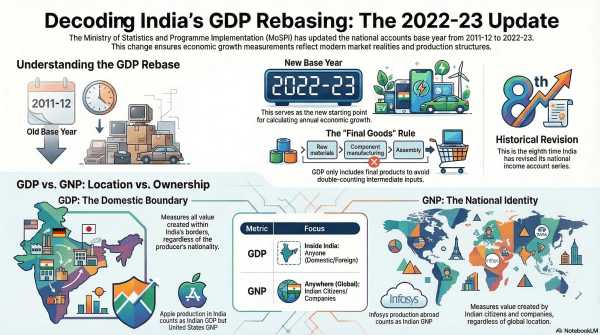
— The Gross Domestic Product (GDP) is a key indicator to assess the annual economic growth or the overall size of an economy and the “base year” refers to the year that works as a starting point for calculations.
Story continues below this ad
— The base year for GDP calculation is now 2022-23. In other words, the GDP in 2022-23 is used as a “base” over which the GDP growth of any following year is calculated.
 (Image: Google NotebookLM generated)
— GDP is the sum of the market value of all the final goods and services produced within the geographical boundaries of a country each year.
— Only final goods and services are included in GDP. Intermediate goods, those goods which are used as inputs in the production of other goods, are excluded to avoid double counting.
📍UPSC Twist Point- GDP v/s Gross National Product (GNP)
Story continues below this ad
• The Gross National Product (GNP) measures the monetary value of all goods and services by the people and companies of a country regardless of where this value was created.
• For example, if Apple manufactures its mobile phone worth $1 million within India, then this $1 million will be counted in India’s GDP and US’ GNP. On the other hand, if the US office of Infosys created software worth $1 million, then it will be counted in US’ GDP and India’s GNP. It is the domestic boundary that distinguishes the GDP.
Environment
Nor’westers
Why it mattersAt least two people died and several others sustained severe injuries as a Nor’wester wreaked havoc in the Karanjia area in Mayurbhanj district on Sunday afternoon, officials said. |
Core Concept
— The movement of air from high pressure areas to low pressure areas is called wind. Winds can be broadly divided into three types.
Story continues below this ad
• Permanent winds: These winds blow constantly throughout the year in a particular direction. The trade winds, westerlies and easterlies are the permanent winds.
• Seasonal winds: These winds change their direction in different seasons due to the shifting of regions of maximum heating, pressure and wind belts. The most pronounced effect of such a shift is noticed in the monsoons, especially over southeast Asia.
• Local winds: These winds blow only during a particular period of the day or year in a small area. Differences in the heating and cooling of earth surfaces and the cycles they develop daily or annually can create several common, local winds. Examples of these winds include the Loo in India and the Chinook in North America.
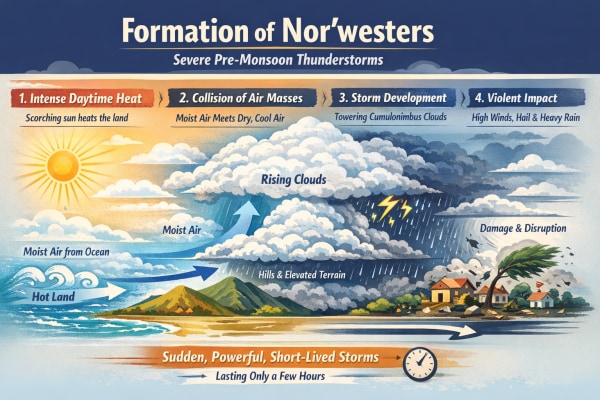
— Nor’westers: They are extremely severe thunderstorms that occur in eastern and northeastern India and Bangladesh. They form during the pre-monsoon season (March–May).
Story continues below this ad
 (Image: AI-generated)
— Nor’westers are locally called Kalbaisakhi in Bengal, meaning “the calamity of the month of Baisakh,” and Bardoli Cheerha or Bordoisila in Assam.
📍UPSC Twist Point: Nor’westers V/s Loo
Since both are pre-monsoon local winds, there is a possibility of confusing them with each other. Here’s the difference between the two:
• Loo → Hot, dry, dusty, no rainfall
• Nor’westers → Moist, stormy, with rainfall
Prelims Practice MCQ
Let’s see how much can you recall
With reference to the above-discussed themes, consider the following statements:
Story continues below this ad
1. Vehicle-to-Vehicle (V2V) technology is a subset of Vehicle-to-Everything (V2X) and enables real-time communication between vehicles regarding speed, location, and braking.
2. Gross Domestic Product includes the value of intermediate goods to capture the complete production process in an economy.
3. Nor’westers are pre-monsoon local winds locally called Kalbaisakhi in Bengal.
Which of the statements given above are correct?
(a) 1 and 2 only
(b) 1 and 3 only
(c) 2 and 3 only
(d) 1, 2 and 3
Subscribe to our UPSC newsletter. Stay updated with the latest UPSC articles by joining our Telegram channel – Indian Express UPSC Hub, and follow us on Instagram and X.
Story continues below this ad
🚨 Click Here to read the UPSC Essentials magazine for March 2026. Share your views and suggestions in the comment box or at manas.srivastava@indianexpress.com🚨