As UPSC CSE Prelims 2026 is just a few months away, current affairs should be your primary focus. UPSC Weekly Quiz is a current affairs–based quiz on relevant topics from the past week, curated for aspirants of competitive examinations. Attempt the weekly quiz every Saturday and find detailed answers to the MCQs with explanations.
🚨 Click Here to read the UPSC Essentials magazine for March 2026. Share your views and suggestions in the comment box or at manas.srivastava@indianexpress.com🚨
With reference to the India’s role in UN Peacekeeping Operations, consider the following statements:
1. India received the UN’s highest peacekeeping honour in 2025.
2. India does not have troops in the United Nations Interim Force in Lebanon.
3. India’s contribution to UN Peacekeeping began with its participation in the UN operation in Korea in the 1950s.
How many of the statements given above are correct?
(a) Only one
(b) Only two
(c) All three
(d) None
Why this question for UPSC Prelims 2026?
India’s role in UN Peacekeeping reflects its global standing and commitment to international peace. The question links to current affairs through honours like the Dag Hammarskjöld Medal and ongoing missions. UPSC may ask factual questions on international organisations and India’s contributions.
Explanation
Story continues below this ad
— “India has been playing an important role in UN Peacekeeping Operations. Our troops under the aegis of UN mandated peacekeeping missions have made significant contributions to global peace and security. In UNIFIL, we have around 600 Indian troops,” Ministry of External Affairs spokesperson Jaiswal said. Hence, statement 2 is not correct.
— In 2023, India received the UN’s highest peacekeeping honour, the Dag Hammarskjöld Medal, posthumously awarded to Indian peacekeepers Shishupal Singh and Sanwala Ram Vishnoi and civilian UN worker Shaber Taher Ali for their sacrifice in the Democratic Republic of Congo. Hence, statement 1 is not correct.
— India’s contribution to UN Peacekeeping began with its participation in the UN operation in Korea in the 1950s, where India’s mediatory role in resolving the stalemate over prisoners of war in Korea led to the signing of the armistice that ended the Korean War. India chaired the five-member Neutral Nations Repatriation Commission, while the Indian Custodian Force supervised the process of interviews and repatriation that followed. Hence, statement 3 is correct.
Therefore, option (a) is the correct answer.
(Other Source: http://www.pib.gov.in)
QUESTION 2
With reference to the landing on moon, consider the following statements:
1. Longer routes are costly and consume more fuel.
Story continues below this ad
2. The shortest path between the Earth and the Moon is always preferred for space missions as it minimises fuel consumption.
Which of the statements given above is/are correct?
(a) 1 only
(b) 2 only
(c) Both 1 and 2
(d) Neither 1 nor 2
Why this question for UPSC Prelims 2026?
Moon mission trajectories are in the news due to missions like Artemis II. The question tests understanding of basic orbital mechanics. Students should cover space missions for their UPSC prelims, as it can be highly scoring.
Explanation
— NASA’s Artemis II mission, carrying four astronauts on a flyby mission to the Moon, is all set to be launched on Wednesday. This will be the first time humans will get to the Moon’s neighbourhood after the last Apollo mission in 1972. The Artemis II mission will not land on the Moon but circle it and return to Earth after a 10-day journey. A successor mission, planned for 2028, is scheduled to make a Moon landing with another set of four astronauts.
— The Artemis II mission will take three to four days to reach the Moon’s neighbourhood — roughly the same time the Apollo missions took to land on the lunar surface. Many other recent uncrewed lunar missions, including India’s Chandrayaan-3, took much longer, between a few weeks and a few months, to get to the Moon.
Story continues below this ad
— Longer routes are more fuel-efficient and economical, while quicker routes require more powerful rockets. The SLS (Space Launch System) rockets being used for the Artemis missions are the most powerful launch vehicles available to NASA right now. The Apollo missions used Saturn V rockets, which are the most powerful rockets ever built. Hence, statement 1 is not correct.
— Space missions to the Moon do not always prefer the shortest path. Missions like Chandrayaan-3 used longer, elliptical orbits to gradually raise altitude and save fuel. Hence, statement 2 is not correct.
Therefore, option (d) is the correct answer.
QUESTION 3
With reference to the Non-Deliverable Derivatives (NDD), consider the following statements:
1. These instruments allow participants to take positions on the rupee without actual delivery of the currency.
Story continues below this ad
2. These are traded only within India under the direct supervision of the Reserve Bank of India.
3. These instruments are primarily used only by domestic retail investors in India.
How many of the statements given above are correct?
(a) Only one
(b) Only two
(c) All three
(d) None
Why this question for UPSC Prelims 2026?
Non-deliverable derivatives are frequently in news due to currency volatility and rupee management in India. The question tests understanding of the external sector, forex markets, and capital flow. UPSC can ask about such terms in prelims.
Explanation
— The Reserve Bank of India’s (RBI) latest directive to bar banks from non-deliverable derivative (NDD) contracts in the rupee — often misused and manipulated by big currency players — marks a decisive shift toward tighter control and transparency in the foreign exchange market.
Story continues below this ad
— NDDs, which are typically traded outside India in financial hubs like Singapore, Hong Kong, London or Dubai, allow participants to bet on the rupee’s direction without actual delivery of the currency. Hence, statement 1 is correct.
— An NDD is a derivative contract where two parties agree on a future exchange rate for the rupee, but settle the difference in cash, usually in US dollars. As India has capital controls, offshore investors can’t freely trade in the rupee in physical form. This led to the creation of the NDD markets in the rupee. These instruments have long been criticised for distorting price discovery and manipulation as such an offshore sentiment can diverge sharply from domestic fundamentals and movements.
— The NDD market is widely used by foreign investors, hedge funds and global banks who cannot freely access and play in the Indian rupee market, as well as by firms looking to hedge currency risk. Hence, statement 3 is not correct.
— These trades take place offshore, outside the control of the RBI. This often acts as a price discovery mechanism for the rupee, even influencing expectations before Indian markets open. The ban on NDD is aimed at curbing offshore speculation that often leads to rupee volatility. Hence, statement 2 is not correct.
Therefore, option (a) is the correct answer.
QUESTION 4
The nuclear triad refers to:
Story continues below this ad
(a) the ability to launch nuclear missiles from platforms in the air, land and at sea.
(b) a strategic alliance between three nuclear-armed countries for joint deterrence
(c) the use of nuclear energy in three sectors—power generation, medicine and agriculture
(d) a doctrine of using nuclear weapons in three phases of warfare—tactical, strategic and defensive
Why this question for UPSC Prelims 2026?
Story continues below this ad
The concept of nuclear triad is central to strategic deterrence and national security. UPSC can ask it in prelims to test clarity on defence terminology and doctrines. Aspirants should also read about India’s missile system.
Explanation
— India inducted its third nuclear-powered ballistic missile submarine (SSBN), INS Aridaman, significantly strengthening its sea-based nuclear deterrence capabilities. The indigenous SSBN (ship submersible ballistic nuclear) is designed to carry more long-range nuclear-tipped missiles than INS Arihant and INS Arighaat, which were commissioned in 2016 and 2024, respectively.
— The latest induction will also strengthen India’s nuclear triad. India is part of a select group of countries with nuclear triad capabilities. These include the US, Russia, China, and France.
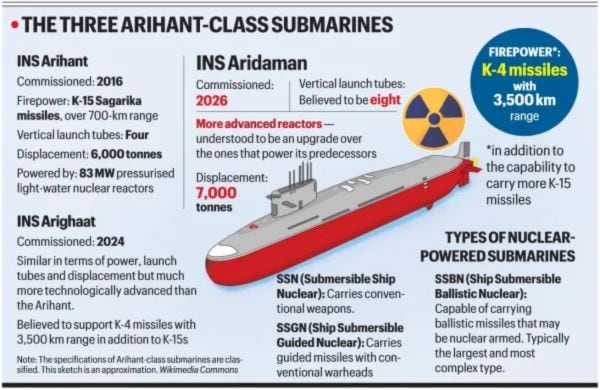
— A nuclear triad refers to the ability to launch nuclear missiles from platforms in the air, land and at sea. In the case of India, such missiles (such as the Agni series) can be launched from land, and fighter aircraft such as the Rafales, Su-30MKIs, and Mirage 2000s can deliver nuclear warheads from the air.
Therefore, option (a) is the correct answer.
QUESTION 5
With reference to the India’s defence exports, consider the following statements:
1. The year 2025-26 have marked a decline in India’s defence exports as compared to the 2024-25.
2. Out of total defence exports in 2025-26, the private sector has contributed more than Defence Public Sector Undertakings (DPSUs).
Which of the statements given above is/are correct?
(a) 1 only
(b) 2 only
(c) Both 1 and 2
(d) Neither 1 nor 2
Why this question for UPSC Prelims 2026?
India’s defence exports are a key component of self-reliance under defence indigenisation initiatives. UPSC can ask about the defence exports and imports. Aspirants must also focus on what India exports and what India imports.
Explanation
— Defence exports have reached an all-time high of Rs 38,424 crore in the financial year 2025-26, marking an increase of Rs 14,802 crore (62.66%) over the previous fiscal year’s figure of Rs 23,622 crore, in which the Defence Public Sector Undertakings (DPSUs) and the private sector have contributed 54.84% and 45.16% respectively, the Defence Ministry said. Hence, statements 1 and 2 are not correct.
— In a statement, the Ministry of Defence (MoD) said that the DPSUs’ exports surged by 151% compared to the previous year while private firms recorded an increase of 14%.
— In terms of value of contribution, the private sector accounted for Rs 17,353 crore worth of defence exports, while DPSUs contributed Rs 21,071 crore. Their respective figures in the previous financial year stood at Rs 15,233 crore and Rs 8,389 crore (respectively).
Therefore, option (d) is the correct answer.
QUESTION 6
Consider the following statements:
1. This state was the first state in India to be formed on a linguistic identity.
2. The state celebrated Utkal Divas to commemorate its formation.
3. In 2011, the name of the state and its language was changed.
The above mentioned statements refer to:
(a) Andhra Pradesh
(b) Kerala
(c) Karnataka
(d) Odisha
Why this question for UPSC Prelims 2026?
The question tests awareness of state formation timelines and regional identity movements. It also links static history with constitutional developments. Aspirants must be aware about the constitutional procedure for changing the name of the state.
Explanation
— Odisha, the first state in India to be formed on a linguistic identity, turned 90 on Wednesday as the state celebrated Utkal Divas (Odisha Day) to commemorate its formation on April 1, 1936.
— Under British rule, the Odia-speaking regions were scattered across different provinces: Bengal, Madras, Central, and Bihar. During the latter half of the 19th century, a movement began for the unification of the regions under a single administration.
— In 1928, the British authorities formed a four-member subcommittee headed by Clement Attlee (then a Labour Party MP who later became UK Prime Minister) to look into the demand for creation of a separate province with amalgamation of scattered Odia-speaking regions.
— Besides Madhusudan Das and Gajapati, the untiring efforts of other Odia nationalists like Gopabandhu Das, Pandit Nilakantha Das, Fakir Mohan Senapati, Maharaja Sriram Chandra Bhanja Deo, and Vikram Dev Burma for more than three decades finally led to the creation of Orissa as a special province on April 1, 1936.
— Until 2011, the state continued to be known as Orissa and its language was called Oriya. After Parliament passed the 113th Constitutional Amendment Bill in March 2011, it was changed to Odisha and Odia.
Therefore, option (d) is the correct answer.
QUESTION 7
Which of the following are the petrochemical products?
1. Styrene butadiene
2. Polypropylene
3. Toluene
4. Anhydrous Ammonia
5. Ammonium Nitrate
Select the correct answer using the codes given below:
(a) 1, 2 and 3 only
(b) 2, 3, 4 and 5
(c) 3, 4 and 5 only
(d) 1, 3 and 5 only
Why this question for UPSC Prelims 2026?
Questions on petrochemicals test conceptual clarity within Industrial Chemistry and their industrial linkages. It can be asked in UPSC prelims through classification-based elimination. Aspirants should also read about the by-products of crude.
Explanation
— The exemption is expected to be helpful for sectors dependent on petrochemical feedstock and intermediates such as plastics, packaging, textiles, pharmaceuticals, chemicals, automotive components, and other manufacturing segments. “This will also provide relief to consumers of final products,” the Ministry said.
— About 40 petrochemical products have been given the customs duty exemption including anhydrous ammonia, toluene, styrene, dichloromethane, methanol, acetic acid, ammonium nitrate, polypropylene, polyvinyl chloride, polyols, polycarbonates, polyurethanes, and poly butadiene, styrene butadiene.
— Anhydrous Ammonia and Ammonium Nitrate are not petrochemical products.
Therefore, option (a) is the correct answer.
QUESTION 8
The place ‘Isfahan’ was recently in the news. It is:
(a) a major port city located on the Persian Gulf involved in maritime trade
(b) central Iranian city hosting key defence facilities
(c) a desert region in Saudi Arabia known for oil reserves
(d) a capital city of Iraq known for political instability
Why this question for UPSC Prelims 2026?
The question tests map-based awareness of West Asia. It also links geography with security and defence infrastructure. Aspirants must look out for places in news in West Asia.
Explanation
— The US and Israeli forces struck an ammunition depot in Iran’s Isfahan. US officials, cited by The Wall Street Journal, said the strike involved 2,000-pound (about 907-kg) bunker-buster bombs targeting a military-linked site in Isfahan, a central Iranian city hosting key defence facilities, including the Badr airbase. It stated that a large number of penetrator munitions were used in the operation.
— The term “bunker buster” typically describes bombs designed to penetrate deep below the surface — layers of rock, earth, or concrete — before exploding. This hard-target munition is understood to have been developed during the Gulf War.
— Developed by the US Defence Major Boeing, the US GBU-57 A/B Massive Ordnance Penetrator is the most powerful in this category and is a GPS-guided 30,000-pound (13,600-kilogram) bomb, which can penetrate about 200 feet (60 meters) of solid concrete.
Therefore, option (b) is the correct answer.
QUESTION 9
With reference to the Samrat Samprati, consider the following statements:
1. The Samrat Samprati Museum has been inaugurated in Mysore.
2. Samrat Samprati was the grandson of the Mauryan ruler Ashoka.
3. He was a follower of Buddhism.
Which of the statements given above are correct?
(a) 1 only
(b) 2 only
(c) 2 and 3 only
(d) 1 and 3 only
Why this question for UPSC Prelims 2026?
Samprati represents lesser-known rulers of the Mauryan period, an area which UPSC can explore beyond major figures. The question tests clarity on religious patronage. The question links static history with current affairs.
Explanation
— On the occasion of Mahavir Jayanti on Tuesday (March 31), Prime Minister Narendra Modi inaugurated the Samrat Samprati Museum in Koba, Gandhinagar. The museum is dedicated to Jain history and the life of Samrat Samprati, the grandson of the Mauryan ruler Ashoka. Hence, statements 1 and 3 are not correct and statement 2 is correct.
— Unlike Ashoka, who is known for helping spread Buddhism, Samprati is remembered for his deep association with Jainism.
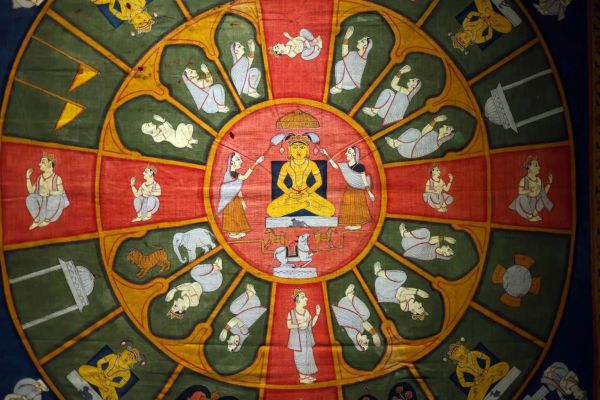 An exhibit at the Samrat Samprati Museum in Gandhinagar. ANI
— Samprati was the son of Kunala. Jain texts, in particular, portray him as an adherent who played a significant role in the dissemination of Jina images across the subcontinent.
— Samprati is believed to have reigned between 230 and 220 BCE. According to Cort, “The story of Samprati first emerges in Shvetambara writings… in the context of the rules of monastic practice.”
— Over time, his legacy grew, with anonymous and undated medieval works devoted entirely to him, such as the 461-verse Sanskrit Deeds of King Samprati (Samprati Nripa Charitra).
Therefore, option (b) is the correct answer.
To read more: Ashoka helped spread Buddhism far and wide. How his grandson did the same for Jainism
QUESTION 10
With reference to the Regional Comprehensive Economic Partnership (RCEP), consider the following statements:
1. It is a comprehensive free trade agreement being negotiated between the ASEAN Member States and ASEAN’s free trade agreement (FTA) partners.
2. India pulled out of the RCEP negotiations in 2019.
Which of the statements given above is/are correct?
(a) 1 only
(b) 2 only
(c) Both 1 and 2
(d) Neither 1 nor 2
Why this question for UPSC Prelims 2026?
RCEP is the world’s largest trade bloc, making it crucial for understanding global trade architecture. Aspirants must focus on the members of ASEAN and its FTA partners. It is also linked to current affairs like supply chains, trade deficits, and Indo-Pacific economic strategy.
Explanation
— For the first time since India pulled out of the China-led Regional Comprehensive Economic Partnership (RCEP) negotiations in 2019, Commerce and Industry Minister Piyush Goyal held bilateral talks with his Chinese counterpart Wang Wentao on the sidelines of the 14th World Trade Organisation (WTO) interministerial conference in Cameroon. Hence, statement 2 is correct.
— The Regional Comprehensive Economic Partnership (RCEP) is a comprehensive free trade agreement being negotiated by ASEAN Member States and their free trade agreement (FTA) partners. Hence, statement 1 is correct.
— RCEP reflects the world’s growing trade and economic architecture. It should not be viewed in isolation, but rather in the context of other emerging comprehensive free trade agreements, such as the Trans-Pacific Partnership (TPP) and the newly launched Trans-Atlantic Trade and Investment Partnership (TTIP) between the United States and the European Union.
Therefore, option (c) is the correct answer.
(Other Source: http://www.commerce.gov.in)
Previous Weekly Quiz
UPSC Weekly Current Affairs Quiz | March 22 to March 28, 2026
UPSC Weekly Current Affairs Quiz | March 15 to March 21, 2026
UPSC Weekly Current Affairs Quiz | March 08 to March 14, 2026
UPSC Weekly Current Affairs Quiz | March 01 to March 07, 2026
UPSC Weekly Current Affairs Quiz | February 22 to February 28, 2026
UPSC Weekly Current Affairs Quiz | February 15 to February 21, 2026
Subscribe to our UPSC newsletter and stay updated with the news cues from the past week.
Stay updated with the latest UPSC articles by joining our Telegram channel – IndianExpress UPSC Hub, and follow us on Instagram and X.