

Synopsis: The U.S.-Israel war with Iran has pushed the Middle East into one of its most dangerous crises in years. But how could it actually end? From regime change and great-power pressure to economic shock and regional backlash, here are five possible scenarios that could determine the conflict’s ultimate outcome.
Tensions between the United States and Iran date back decades and intensified after the 1979 Iranian Revolution, which led to the creation of the Islamic Republic of Iran and the end of formal diplomatic relations with Washington. During Donald Trump’s second term as U.S. President, the administration increased pressure on Tehran to abandon its nuclear program. Trump had already withdrawn the United States from the nuclear deal negotiated by former President Barack Obama during his first term. In January, the Trump administration also warned Iran over its violent crackdown on anti-government protests, further worsening relations between the two countries.

The escalation came even as Washington and Tehran were engaged in renewed negotiations over Iran’s nuclear program. Talks had resumed in early February after being stalled since June, when Israel previously attacked Iran, and the United States joined strikes on Iranian nuclear sites. American and Iranian negotiators reportedly made limited progress during meetings held in Oman on February 6 and later in Geneva on February 26 and 27, just a day before the latest U.S.-Israeli strikes were carried out.
However, the attacks have since hardened Iran’s position toward the United States and may have severely damaged the chances of reaching a diplomatic agreement over its nuclear program.

Iran responded with a large wave of retaliatory attacks across the region, targeting U.S. military installations and allied locations. Initial strikes hit areas across Israel, the United Arab Emirates, Qatar, Bahrain, Kuwait, and Saudi Arabia. Some suspected Iranian attacks also struck civilian infrastructure, including a Saudi oil refinery, a hotel in Dubai, and areas near airports in the UAE and Kuwait. In the days that followed, Iran expanded its operations by launching missiles and drones toward Jordan, which were intercepted, and targeting a British Royal Air Force base in Cyprus.
Suspected Iranian activity was also reported over Iraq and Oman’s airspace, while Iran began targeting American diplomatic sites in the region, including U.S. embassies in Riyadh and Kuwait City. These attacks have resulted in more than a dozen deaths across the region.
The conflict quickly spread beyond Iran and Israel as regional and international actors became involved. Hezbollah, an Iranian-backed paramilitary group, launched rockets and drones at an Israeli military site on March 2 in retaliation for Khamenei’s killing, prompting Israel to carry out extensive strikes on Beirut and southern Lebanon, which Lebanese state media says have killed nearly 500 people and injured more than 1,300. Lebanon condemned both Israel and Hezbollah and urged them not to turn its territory into a platform for proxy warfare while seeking direct talks with Israel to stop the attacks. Syria also accused Hezbollah of firing artillery near Damascus on March 10 and warned it would respond to any violation of its territory. As the situation escalated, world leaders and institutions such as the United Nations and the European Union called for de-escalation.
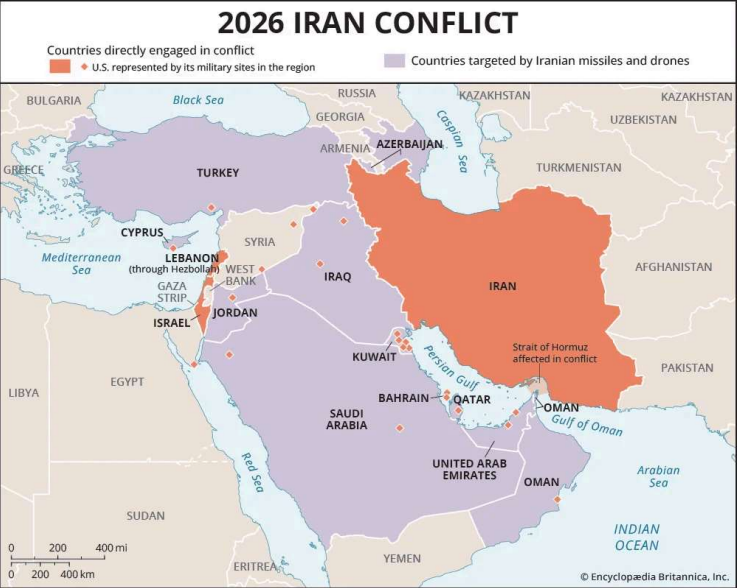
Meanwhile, the Gulf Cooperation Council held an emergency meeting after Iran targeted bases and civilian sites across the region, stating that member states reserved their legal right to respond. Several international powers have also increased military readiness, with France deploying 10 warships to key waterways, Italy preparing naval support to defend Cyprus and provide air defense assistance to Gulf partners, and NATO expressing support for the campaign against Iran while saying it will not directly enter the war. Divisions have also appeared among Western allies: the United Kingdom initially opposed U.S. use of its Chagos Islands base but later allowed operations from RAF Akrotiri in Cyprus, which was soon targeted in a suspected Hezbollah drone strike, while Spain rejected the use of its bases entirely, with Prime Minister Pedro Sánchez stating simply, “No to war.”
Despite growing international calls for restraint, the situation remains highly unpredictable, with multiple countries now directly or indirectly involved in the conflict. Military retaliation, proxy warfare, diplomatic negotiations, and international pressure are all unfolding at the same time, making it difficult to predict how the crisis will ultimately conclude. At this stage, analysts and geopolitical observers believe the war could evolve in several different directions depending on how the major powers respond in the coming weeks. Here are five possible scenarios that could determine how the U.S.-Israel-Iran conflict may eventually come to an end.

Scenario 1: The “Venezuela Model”
In this scenario, the goal would be to weaken or remove the current leadership and eventually install a government that is more aligned with Western interests. Early in the conflict, U.S. Secretary of State Marco Rubio suggested that American strikes were partly influenced by pressure from Israel, which was preparing its own attack on Iran. However, Rubio and President Donald Trump later walked back those comments, insisting that the decision to launch the strikes ultimately came from Trump himself and that Israel had not forced Washington into the operation.
According to Al Jazeera, officials in Washington have publicly denied that the war is intended to remove Iran’s leadership, but some of the messaging from both the United States and Israel has suggested otherwise. U.S. Defense Secretary Pete Hegseth said the operation was “not a so-called regime change war,” yet shortly after the strikes began, Trump publicly urged the Iranian people to “take over” their government. The strikes also came weeks after Trump had promised in January to “rescue” Iranian protesters. At the same time, Israel signaled that it would continue targeting Iran’s leadership, warning that whoever replaces Ayatollah Ali Khamenei as Supreme Leader under the current system could also become a target.
According to multiple sources, Iran’s conventional military capabilities are significantly smaller and less technologically advanced than those of the United States and Israel. Iran has more than 600,000 active military personnel and around 350,000 reservists, compared with Israel’s roughly 170,000 active-duty troops and over 450,000 reservists. However, the financial gap is even larger. Iran’s defense budget is estimated at around USD 10 billion, far below Israel’s roughly USD 35 billion, and vastly smaller than the nearly USD 1 trillion U.S. defense budget, the largest in the world. Israel also operates advanced missile defense systems and is widely believed to possess undeclared nuclear weapons, while the United States maintains one of the world’s largest nuclear arsenals and unmatched global military reach. Since the war began, the United States and Israel have targeted Iranian air defenses, nuclear facilities, and senior members of the country’s leadership, aiming to weaken the regime’s ability to control the situation.
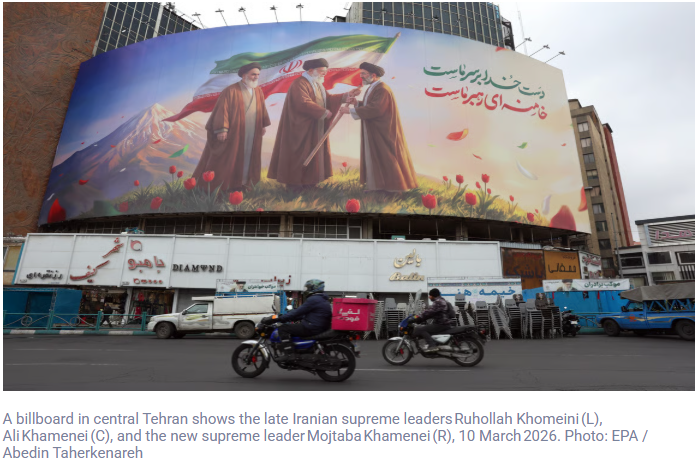
According to Reuters, some of the strikes have already killed dozens of senior Iranian officials and several high-ranking commanders from the Islamic Revolutionary Guard Corps (IRGC), an elite force that controls major parts of Iran’s economy and security structure. Following Khamenei’s death, Iran’s Assembly of Experts reportedly named his son Mojtaba Khamenei as the country’s new Supreme Leader. However, U.S. intelligence assessments suggest that the Iranian leadership and the IRGC still retain firm control over the country and that the government is not currently at risk of immediate collapse despite weeks of heavy bombardment. Analysts say a true regime change would likely require a ground offensive that could create enough pressure for large-scale protests inside Iran.
The Trump administration has not ruled out sending U.S. troops into the country, while there have also been discussions with Iranian Kurdish militias based in Iraq about potentially attacking Iranian security forces along the western border. Kurdish political leader Abdullah Mohtadi claimed that thousands of young fighters could rise up against the government if they received U.S. support and said some Iranian security units had already abandoned positions in Kurdish regions. However, according to U.S. intelligence cited by Reuters, these groups currently lack the numbers and firepower to sustain a major fight against Iranian forces. For now, most intelligence assessments indicate that while internal unrest or a coup cannot be ruled out, Iran’s government still retains control, and the outcome remains highly uncertain.
Scenario 2: The “Russian-Chinese Intervention”
The conflict has raised fears that it could expand beyond the Middle East if major global powers become more directly involved. Countries such as India have already warned about wider consequences, particularly disruptions to global trade routes and energy supply chains. Russia, which maintains close ties with Iran and is already engaged in the war in Ukraine, has blamed the United States and Israel for escalating the situation and warned that the conflict could push the region toward what it described as a potential humanitarian, economic, and even radiological disaster. Both Russia and China, Iran’s two most important diplomatic partners, have also called the U.S.-Israeli military campaign a violation of international law. Russian President Vladimir Putin condemned the killing of Iran’s Supreme Leader Ali Khamenei as a “cynical violation of all norms of human morals,” while China’s Foreign Minister Wang Yi urged Israel to avoid further escalation, stating that the use of force cannot truly resolve the crisis. The two countries also jointly called for an emergency meeting of the United Nations Security Council.
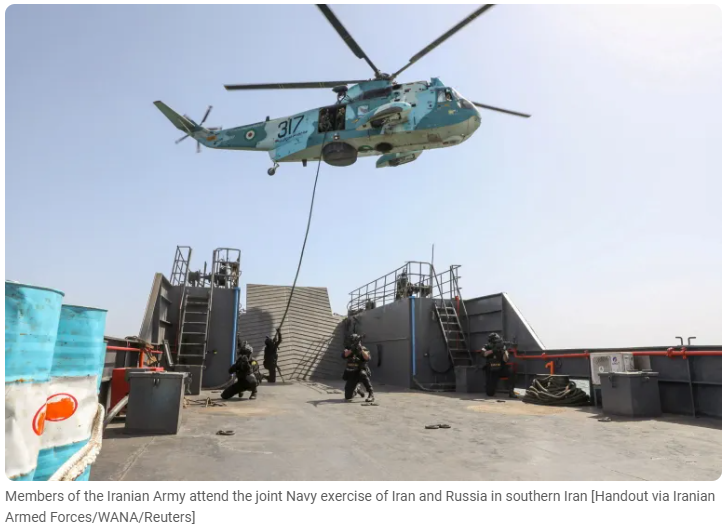
Despite this strong diplomatic response, Al Jazeera reports that neither Russia nor China has signaled any intention to intervene militarily on Iran’s behalf. Russia and Iran signed a comprehensive strategic partnership agreement in January 2025, covering cooperation in trade, defence, intelligence, science, culture, and education. The agreement also supported major infrastructure projects, including transport corridors linking Russia to the Gulf through Iran. The two countries even carried out joint naval exercises in the Indian Ocean in late February, just days before the U.S. and Israel launched their attacks. However, the treaty stops short of forming a formal military alliance because it does not contain a mutual defence clause, meaning Moscow is not legally required to join Iran in the war.
According to Al Jazeera, Russian foreign policy analyst Andrey Kortunov, former director of the Russian International Affairs Council, said the agreement with Iran is far less binding than Russia’s 2024 mutual defence treaty with North Korea, which would require Moscow to assist Pyongyang in any conflict. In contrast, the agreement with Iran only states that both sides should avoid hostile actions if the other becomes involved in a war. Kortunov explained that Russia is unlikely to intervene militarily because the risks would be extremely high and because Moscow appears to be prioritising negotiations with the United States over the conflict in Ukraine. He added that while Russia has strongly criticised Washington’s actions, its response so far has largely been limited to diplomatic pressure in international forums such as the United Nations. Some officials in Tehran, however, have reportedly expressed frustration that Russia has not gone beyond diplomatic support.
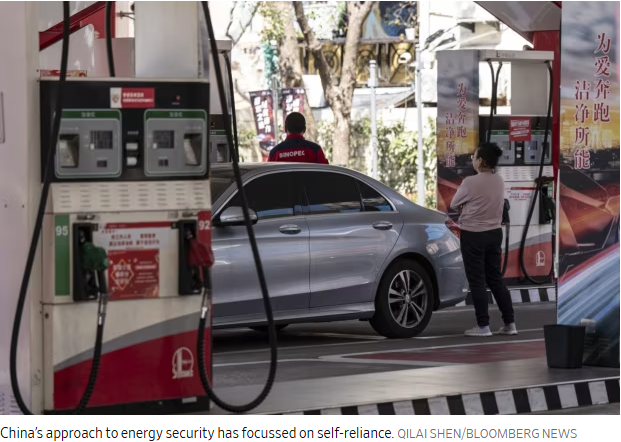
China’s relationship with Iran also reflects a similar balance between cooperation and caution. The two countries signed a 25-year cooperation agreement in 2021 designed to expand economic and energy ties and integrate Iran into China’s Belt and Road Initiative. Chinese scholar Jodie Wen from Tsinghua University said the partnership is viewed in Beijing as pragmatic and stable, with regular political exchanges and deep economic cooperation, including investments by Chinese companies inside Iran. However, she stressed that China has long maintained a policy of not interfering militarily in other countries’ conflicts, and she does not expect Beijing to send weapons to Iran. Instead, China is likely to focus on diplomacy and mediation efforts aimed at preventing a broader regional crisis. The economic relationship between the two countries is also uneven. According to vessel-tracking firm Kpler, about 87.2 percent of Iran’s crude oil exports go to China, making Beijing a crucial buyer of Iranian energy even though Iran represents a relatively small part of China’s overall trade.
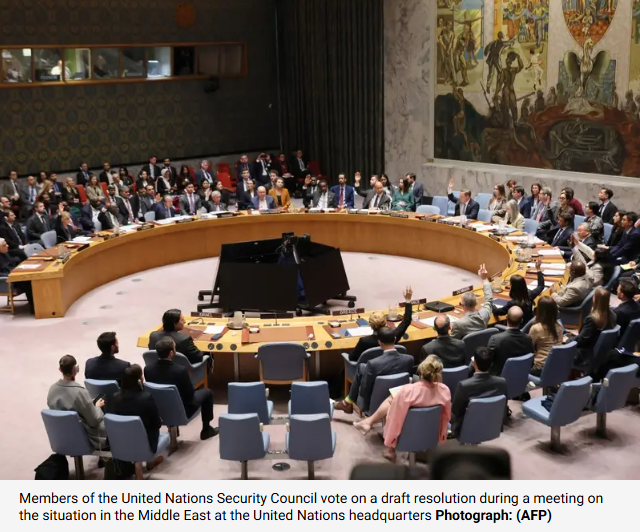
Recent diplomatic developments also suggest that both Russia and China are maintaining a cautious distance from the conflict. According to reports cited by international media, the United Nations Security Council adopted Resolution 2817 (2026) condemning Iran’s retaliatory missile and drone attacks on neighbouring countries, including the United Arab Emirates, Saudi Arabia, Bahrain, and Jordan. Both Russia and China chose to abstain from the vote rather than use their veto power, effectively allowing the resolution to pass and signalling what analysts describe as a pragmatic distancing from Tehran.
According to Novaya Gazeta, U.S. President Donald Trump and Russian President Vladimir Putin also held a one-hour phone call in which the leaders discussed the situation in Iran and ongoing negotiations over the war in Ukraine. Putin reportedly expressed support for a political and diplomatic resolution to the conflict, while Trump shared his assessment of the U.S.-Israeli military campaign. Putin also congratulated Mojtaba Khamenei on becoming Iran’s new Supreme Leader and reiterated Russia’s support for Tehran. While Moscow and Beijing continue to criticise the U.S. and Israel diplomatically, their actions so far suggest that direct military intervention remains unlikely, making a broader great-power confrontation less probable for now.
Scenario 3: The War Becomes “Too Expensive”
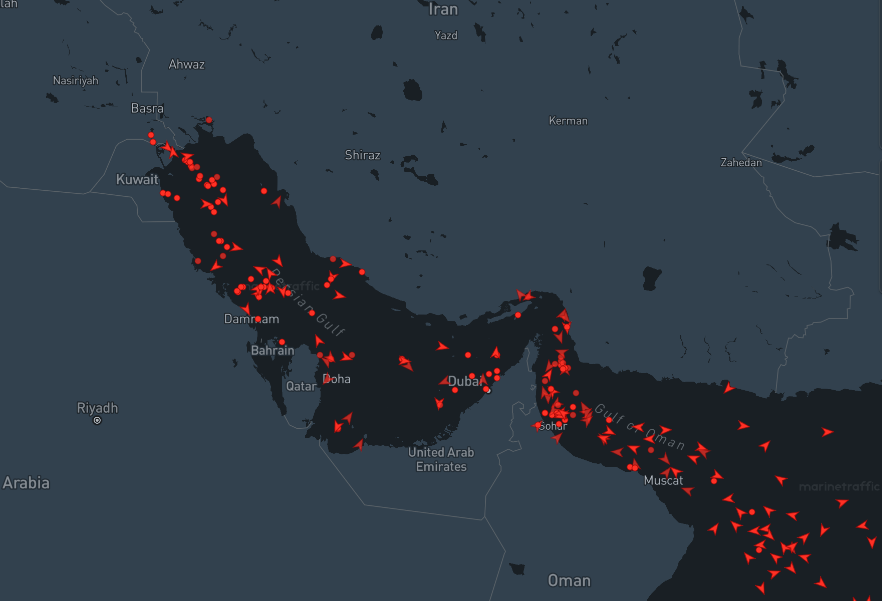
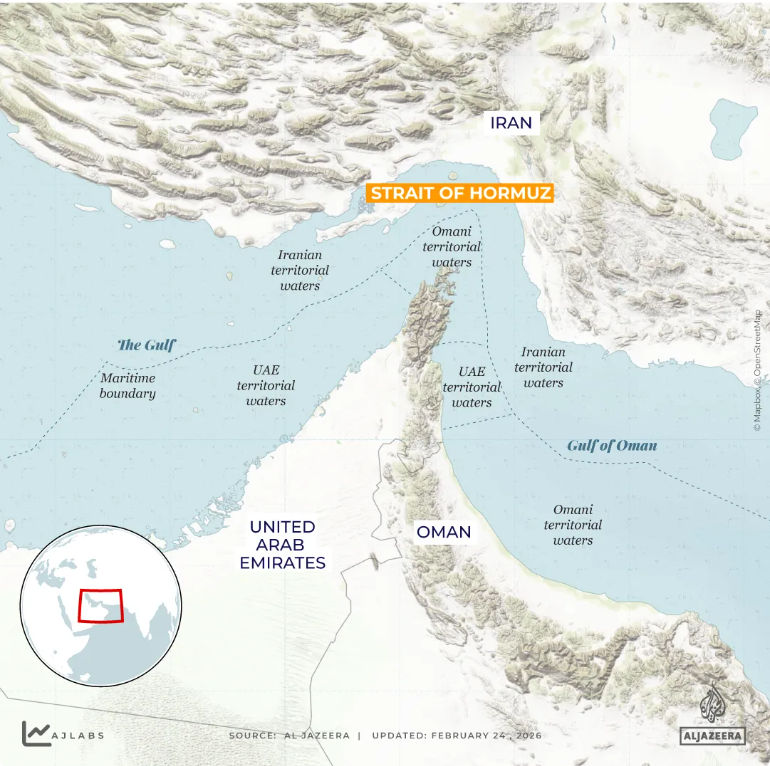
One of the clearest ways this war could end is if the economic and military cost becomes too large for all sides to bear, especially for the United States and its allies. The biggest pressure point is the Strait of Hormuz, the narrow passage between the Persian Gulf and the Gulf of Oman through which around one-fifth of the world’s oil supply moves. Iran controls the northern side of the strait and has long used it as a bargaining tool during periods of tension. After the U.S.-Israeli attack, Iran effectively shut the route by threatening to set passing ships ablaze, while several oil and LNG facilities across the region were also hit.
According to Michael Kern of Oilprice.com, the strait is only 21 miles wide at its narrowest point, yet it normally carries around 20.9 million barrels of oil per day, a major share of global LNG flows, about one-third of the world’s seaborne fertilizer exports, and an important portion of container trade between Asia, Europe, and the Middle East. The closure was not only about physical danger. Insurers pulled coverage, war-risk premiums that had already tripled became irrelevant, and tanker traffic reportedly collapsed from an average of 138 vessels a day to roughly two. Around 150 tankers were left waiting in Gulf waters, while 147 container ships were trapped inside the Persian Gulf.
Major shipping companies including Maersk, CMA CGM, Hapag-Lloyd, and MSC suspended operations, and with Houthi attacks resuming in the Red Sea, both major chokepoints were under pressure at the same time. The only alternative route around the Cape of Good Hope adds 10 to 14 days to voyages.
According to TIME, the impact on global energy markets was immediate. Within days of the war, crude oil prices rose above USD 100 a barrel for the first time since Russia’s invasion of Ukraine in 2022, as shippers either stopped moving cargo or sharply raised rates to account for the risk. Some refineries even declared force majeure, freeing themselves from contractual obligations because the disruption had become too severe.
According to Novaya Gazeta, Trump later described his phone call with Vladimir Putin as positive and said the United States may lift sanctions on “some countries” to ease the oil shortage caused by the war. The United States has already allowed Indian refiners to continue buying Russian oil without sanctions, and any wider relief would likely provide Russia with a major revenue boost as prices remain elevated.
According to Michael Kern, the shock has spread far beyond crude. LNG charter rates jumped from around USD 40,000 a day to USD 300,000 a day in less than a week, a rise of about 650 percent. Asian spot LNG prices doubled, and Qatar halted production at Ras Laffan, the world’s largest LNG export complex, after Iranian drone strikes and invoked force majeure. Since Qatar and the UAE together supply around 20 percent of global LNG, and 85 percent of Qatar’s exports go to Asia, buyers in China, India, Japan, South Korea, and Taiwan have been forced to scramble for replacement cargoes from the United States, Australia, and West Africa at much higher prices.
European wholesale gas prices surged by more than 50 percent in a single day, while the Asian LNG premium over Europe widened sharply, showing how the war is distorting global energy flows. According to the UN World Food Programme and economic analysts, the disruption is also now feeding into food inflation because fertilizer supply chains are under strain. The Fertilizer Institute said nearly 50 percent of global urea and sulfur exports and about 20 percent of global LNG, a key feedstock for nitrogen fertilizer, move through Hormuz. That means a prolonged closure could push food prices higher worldwide and revive pressures similar to the 2022 food crisis.
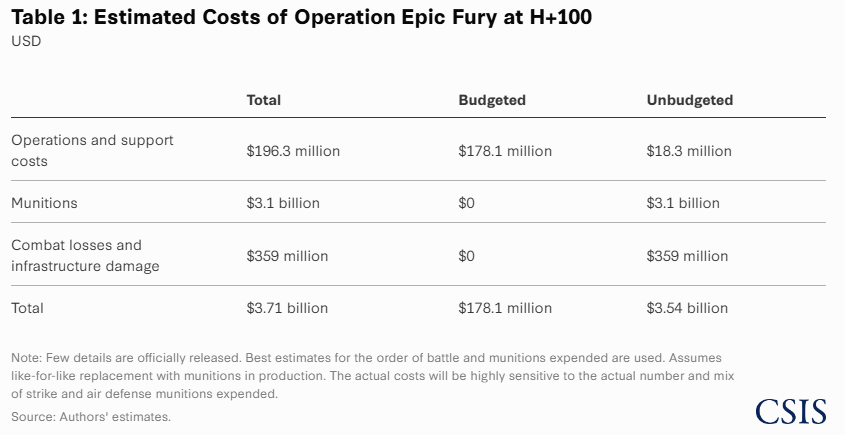
According to the Center for Strategic and International Studies (CSIS), the cost of the war for the United States is already enormous. The first 100 hours of the operation were estimated to cost about USD 3.7 billion, or roughly USD 891.4 million per day. Of this, around USD 196 million came from operational costs, with USD 178 million already budgeted and the rest unbudgeted. Another USD 3.1 billion was tied to replacing munitions, none of it budgeted, while an additional USD 350 million was estimated for replacing combat losses and repairing damaged infrastructure, also unbudgeted.
According to a separate closed-door Pentagon briefing cited by multiple sources, the first six days of the war may already have cost more than USD 11.3 billion, and Senator Chris Coons said the real total is likely higher because not every cost has yet been included. According to the Center for American Progress, the war had already cost the U.S. about USD 5 billion just four days in, while CNN analysts estimated the burn rate at no less than USD 890 million a day. According to U.S. officials, the Pentagon also burned through USD 5.6 billion worth of munitions in just the first two days of the assault.
The imbalance is particularly worrying because Iran’s attacks are far cheaper to launch than they are to stop. A Shahed drone can cost only about USD 20,000 to USD 80,000, or around USD 50,000 by some estimates, while intercepting it may require two or three missiles. PATRIOT interceptors cost roughly USD 4 million each, while THAAD interceptors can cost about USD 12 million each, and some estimates put the broader defensive cost at between USD 4 million and USD 20 million per interception. Analysts summed up the problem bluntly: the math is not in America’s favor. According to US Central Command, more than 5,000 targets inside Iran have already been struck using over 2,000 munitions, and this pace is now triggering a political battle in Washington as the Trump administration prepares a supplemental defence funding request that could run into tens of billions of dollars.
According to multiple reports, the war’s cost is not only financial but also logistical, industrial, and political. Before the campaign began, Joint Chiefs Chairman General Dan Caine reportedly warned Trump that a prolonged war with Iran could drain U.S. stocks of precision-guided weapons, especially after years of military support to Ukraine and operations in several regions. U.S. officials have publicly downplayed those fears, but military planners are already adjusting strategy. Defence Secretary Pete Hegseth and General Caine said the campaign is moving away from a heavy reliance on expensive precision munitions and toward laser-guided bombs, which are cheaper and more widely available.
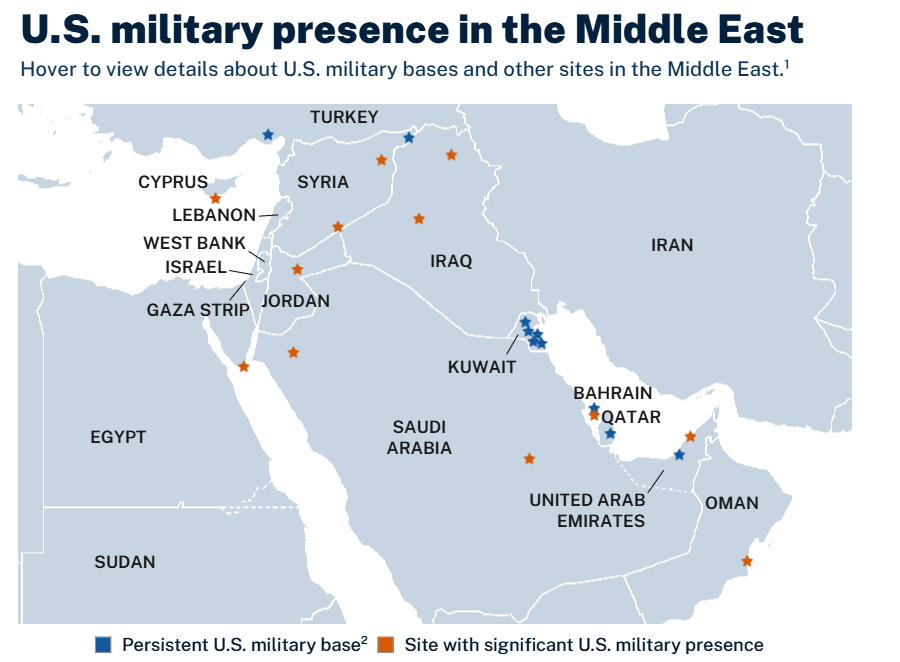
That shift matters because the war has already damaged at least 17 U.S. sites in the Middle East, according to The New York Times, while some analysts have been surprised by the sophistication of Iranian retaliation. Iranian strikes have reportedly damaged parts of U.S. and Israeli air defence systems, including radar and command infrastructure, and Russia is said to be supplying intelligence to Tehran to improve targeting. The broader economic fallout is also spreading into other sectors. Three Amazon Web Services data centres in the UAE were hit by drone strikes, causing sparks, fire, major structural damage at two facilities, leading to key regional services including S3, EC2, and DynamoDB suffering major outages across the Middle East. There have also been direct battlefield losses. In one friendly-fire incident involving Kuwait, three American F-15 fighter jets were shot down, destroying roughly USD 300 million worth of aircraft. Even U.S. consumers are feeling the pressure, with average gasoline prices rising from about USD 3 a gallon to USD 3.45 in a week, according to AAA. Taken together, these numbers suggest that if the war keeps dragging on, it may become too expensive in money, munitions, global inflation, and political support for the United States and others to continue at the same intensity, making cost itself one of the strongest forces pushing all sides toward an endgame.
Scenario 4: The “Forever War”
Another possible outcome is that the conflict drags on for a long period without a clear resolution, turning into a prolonged regional confrontation similar to other modern wars that last for years, for example- The Russia-Ukraine war. According to CBS News, President Donald Trump has given mixed signals about how long the war might last. On March 9, he said the campaign was “very complete” and that the United States was ahead of schedule in achieving its objectives. However, later the same day, he suggested that the military operation could expand further, saying the U.S. could already call it a success but might “go further.” Trump described the war as an “excursion” and said the ultimate goal was to ensure that Iran would not be able to develop weapons capable of threatening the United States, Israel, or American allies for a very long time. While White House press secretary Karoline Leavitt previously suggested the war could last up to six weeks, Israeli Prime Minister Benjamin Netanyahu said the campaign would continue for as long as necessary, indicating that there may not be a quick end.
According to reports cited by international media, Trump again insisted during a press conference on March 9 that the war would end “very soon,” even as oil prices surged above USD 100 per barrel and global markets reacted sharply to the fighting. Speaking at his Trump National Doral club in Miami, the president claimed the United States had already made major progress toward its objectives after launching the war alongside Israel on February 28. Trump said U.S. forces had destroyed more than 50 Iranian naval ships and severely damaged Iran’s air force and air defence systems, arguing that the country had effectively lost much of its leadership and military capacity. At the same time, he warned that the United States could expand the war if necessary and noted that some sensitive targets, including parts of Iran’s electricity infrastructure, had not yet been struck. Trump said the war would end once Iran no longer had the ability to threaten the United States, Israel, or allied countries with weapons. Asked about the apparent contradiction between predictions of a quick victory and comments from Defence Secretary Pete Hegseth that the conflict was just beginning, Trump said both could be true, describing the war as the beginning of building “a new country.”
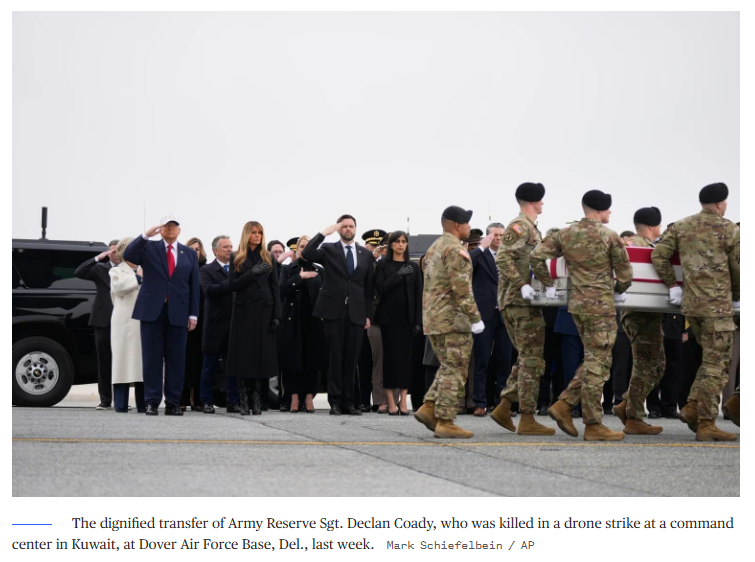
The conflict also carries the risk of becoming prolonged because of Iran’s long-standing regional strategy. For decades, Tehran has relied on what analysts describe as a “ring of fire” approach, supporting allied groups such as Hezbollah, Hamas, and the Houthis across the Middle East. This network allows Iran to pressure Israel and its allies through proxy conflicts rather than direct warfare. Even when one of these groups suffers losses, it often rebuilds with Iranian financial and military support. As a result, ceasefires rarely bring lasting peace. For Iran, a pause in fighting can serve as time to rebuild its proxy networks, while for Israel, a ceasefire often raises fears that opponents are simply rearming. This deep lack of trust means that temporary peace agreements can easily turn into another round of conflict.
Recent diplomatic signals also suggest that negotiations could eventually reopen, although the conditions remain difficult. According to recent reports, Iranian President Masoud Pezeshkian has indicated that Tehran may be willing to return to talks even while the war continues. Over the past few days he has spoken with leaders from Russia and Pakistan, signalling that diplomatic channels remain open. However, Iranian officials say any negotiations with Washington would require three major conditions: recognition of Iran’s sovereign rights, reparations for damage caused during the war, and guarantees that future military attacks will not occur. Until such conditions are addressed, the risk remains that the conflict could continue without a clear end, turning the war into a prolonged struggle rather than a quick military campaign.
Scenario 5: The Middle East Pushes Back
Another possible way the war could end is if the wider Middle East, particularly the Gulf states, pushes strongly for the conflict to stop because of the growing damage to their economies and infrastructure. Countries in the Gulf Cooperation Council (GCC), including Saudi Arabia, the United Arab Emirates, Qatar, Kuwait, Bahrain, and Oman, are currently in the middle of major economic transformation plans known as their “Vision” strategies.
These programs aim to use oil wealth, geographic location, and expanding domestic markets to attract foreign investment, diversify away from hydrocarbons, and build service- and knowledge-based economies. However, these plans depend heavily on the perception that the region is stable and safe for investors. The sudden escalation of war has put that image under serious strain and threatens to derail economic reforms that have taken years to build.
One of the biggest shocks has come through the disruption of global energy supply routes. According to the Middle East Council on Global Affairs and Al Jazeera, the Strait of Hormuz, through which roughly 20 percent of the world’s oil and LNG exports and about 16 percent of global fertilizer shipments pass, has effectively been closed following Iranian threats and attacks on tankers. Vessel-tracking data shows that commercial traffic through the waterway has nearly stopped, with around 500 ships anchored in Gulf waters rather than risk passing through the strait. Insurance companies have cancelled war-risk coverage, making it nearly impossible for ships to operate.
At the same time, disruptions at the Bab el-Mandeb chokepoint have further severed the Gulf’s connection to global trade routes. Iran has also struck key energy facilities across the region, damaging QatarEnergy installations at Ras Laffan and Mesaieed Industrial City, forcing the world’s largest LNG exporter to halt production. Major oil infrastructure has also been targeted, including Saudi Arabia’s Ras Tanura refinery and oil facilities in the United Arab Emirates.
According to the Middle East Council on Global Affairs, the war has also severely disrupted aviation and tourism, two key pillars of the Gulf economies. Dubai International Airport, the world’s busiest hub for international passenger travel, suspended operations indefinitely after strikes near the Jebel Ali port area. Abu Dhabi’s airport experienced a fatal incident, while Kuwait International Airport suffered drone damage to its passenger terminal. Qatar suspended all air navigation and grounded the Qatar Airways fleet.
For the first time, all GCC states experienced simultaneous airspace closures, shutting down travel during the important Ramadan tourism season and causing estimated economic losses of around USD 40 billion. Videos showing explosions in Dubai, Doha, and Manama, along with stranded tourists attempting to leave by land routes, have damaged the Gulf’s carefully cultivated reputation as a safe global hub. Financial markets have also reacted sharply. Stock exchanges in the UAE halted trading for two days, as banking and real estate stocks dropped across the region. Digital infrastructure has also been affected, with Amazon data centers in the UAE and Bahrain reporting prolonged outages, forcing several delivery services to suspend operations. The human and strategic costs are also rising. Iranian strikes have hit a luxury hotel on Dubai’s Palm Jumeirah, residential towers in Manama, and U.S. diplomatic missions in Riyadh, Kuwait, and Dubai.
Early in the war, Iran fired more than twice as many ballistic missiles and around twenty times more drones at Gulf states than at Israel, according to regional statistics. In the United Arab Emirates alone, three people were killed and 78 were injured, while Saudi Arabia’s largest refinery was set on fire and major airports across the Gulf came under attack. These strikes have alarmed governments that had previously tried to avoid being drawn into the conflict. The GCC ministerial statement on March 1, 2026, stressed that Gulf states had repeatedly assured Iran that their territory would not be used for attacks against it. Despite those assurances, Iran targeted infrastructure and civilian sites, actions that Al Jazeera notes raise serious concerns under international humanitarian law because they involve attacks on non-combatant facilities.
If the war continues for four to six weeks with continued disruption in Hormuz, repeated strikes on infrastructure, and prolonged aviation shutdowns, economists warn that the financial damage could grow rapidly. Oil prices could remain above USD 100 to USD 120 per barrel, while Gulf exporters would struggle to move their energy supplies to global markets. A prolonged conflict could push GCC governments into larger fiscal deficits due to infrastructure damage, declining investor confidence, and rising military spending. According to regional analysts, the more Iran targets Gulf states, the more it risks pushing them closer to the United States and deeper into the conflict rather than forcing Washington to stop the war. In that scenario, pressure from Gulf governments to end the conflict quickly could become one of the strongest forces shaping how the war eventually concludes.
Conclusion
The course of the war will ultimately depend on how the key players choose to respond in the coming weeks. Military pressure, economic costs, diplomatic negotiations, and regional political realities are all shaping the direction of the conflict at the same time. While each of these scenarios presents a different path, none offers a quick or simple resolution.
For now, the Middle East remains in a fragile and uncertain moment. Whether the conflict ends through negotiation, strategic exhaustion, or wider regional pressure will depend on decisions taken not only in Washington, Tehran, and Tel Aviv, but also across the broader international community. Until those decisions become clearer, the outcome of the war remains difficult to predict.
Disclaimer: The views and investment tips expressed by investment experts/broking houses/rating agencies on tradebrains.in are their own, and not that of the website or its management. Investing in equities poses a risk of financial losses. Investors must therefore exercise due caution while investing or trading in stocks. Trade Brains Technologies Private Limited or the author are not liable for any losses caused as a result of the decision based on this article. Please consult your investment advisor before investing.