

There is a vintage black Mercedes-Benz on a poster. A tagline that reads: “Some men set rules. Some men just rule.” And two sets of initials, KH and RK, that have sent legions of fans into a frenzy. Nearly half a century after they first walked onto a film set together, Kamal Haasan and Rajinikanth are coming back. And Tamil cinema has not been able to breathe since. To understand why that matters, you have to go back to where it started.
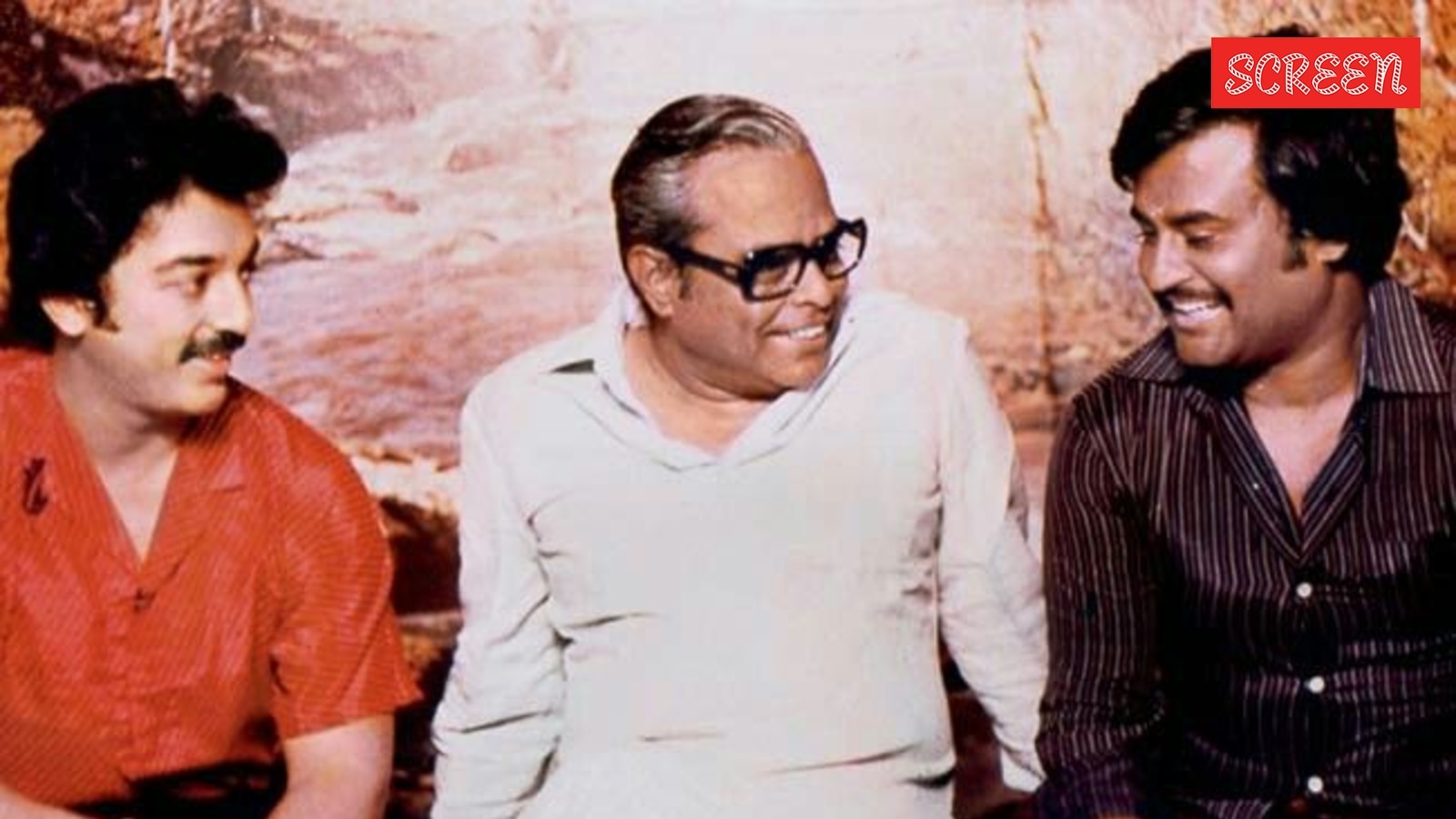
The story starts in 1975, on the set of K. Balachander’s Apoorva Raagangal. Kamal Haasan was the lead. A newcomer named Rajinikanth appeared in a minor supporting role, his first appearance in any film. It was a small beginning, but it placed two people in the same orbit who would go on to define Tamil cinema for several decades.

The following year, Moondru Mudichu, again directed by Balachander, cast both men in significant roles alongside a young Sridevi. It was Rajinikanth’s first major Tamil film role. The pay structure at the time reflected where each stood in the industry, Kamal was already an established actor, while Rajinikanth was still finding his footing.
What followed was a string of films under K Balachander’s direction, including Avargal (1977), a drama in which Kamal Haasan played a ventriloquist who learned the craft specifically for the role, and Rajinikanth played a domineering ex-husband. A widely recalled detail from that period: between his own scenes, Rajinikanth would watch Kamal perform, treating it as an informal study in screen acting.
Two Legends. One Frame.
Next update at 12:07 tomorrow. ⏳#KHxRK #RedGiant17 ✨ pic.twitter.com/FrAA4MdBMa
— Red Giant Movies (@RedGiantMovies_) February 19, 2026
Both actors credited Balachander as their mentor, and that shared foundation shaped how they related to each other throughout their careers, as people from the same school, not as rivals.
Between 1975 and 1985, Rajinikanth and Kamal Haasan appeared together in roughly 21 films across five languages, Tamil, Telugu, Kannada, Malayalam, and Hindi. The list includes Moondru Mudichu, Avargal, 16 Vayathinile, Aval Appadithan, Ninaithale Inikkum, Thappu Thalangal, Ilamai Oonjal Aadukirathu, and Thillu Mullu, among others. In some of these films they shared roughly equal screen time; in others, one led while the other appeared in a supporting or cameo capacity.
The last time they were both credited in the same film was Geraftaar (1985), a Hindi film directed by Prayag Raj that also starred Amitabh Bachchan. It was one of the higher-grossing Hindi releases of that year, and stands as the only film to feature all three actors together. After that, their on-screen partnership ended, not dramatically, but definitively.
What makes this story unusual is not just that they stopped working together, but that they made it official. At a point after their early run of shared films, Kamal Haasan and Rajinikanth held a joint press conference specifically to announce that they would no longer be taking up projects together.
Story continues below this ad
Kamal has spoken about the reasoning behind it more than once. In many interviews, he was direct about the financial logic that drove the decision: when both were billed together, producers effectively negotiated their individual fees downward, treating the combination as a single draw rather than compensating each at their true market rate. Once they separated, success was credited individually, and both were able to command what they were actually worth. Kamal described it plainly as thinking like businessmen, not like artistes making a philosophical choice.
Speaking about their relationship in later interviews, Kamal described how K Balachander had, from the very beginning, directed them toward different things, different kinds of roles, different sensibilities, so that a natural divergence was already built into how they developed as actors. That conditioning, he suggested, meant their paths were always going to lead somewhere different, even if no one had explicitly mapped it out. The competition between them remained real, he said, but it was never accompanied by animosity.
What has persisted across five decades, through entirely separate careers and only occasional contact, is mutual respect. Both have spoken positively about each other in public forums. Rajinikanth, on at least one occasion, recalled calling Kamal Haasan for advice on a difficult scene during the making of Thalapathi. These moments, small as they are, reflect that the professional separation was never personal.
Story continues below this ad
The first public signal that a reunion was genuinely being considered came at the SIIMA Awards, where Kamal, picking up an award for his performance in Kalki 2898 AD, was asked directly whether fans could expect a collaboration with Rajinikanth. His answer was candid, and he returned to the same financial reasoning he had cited for years. He put it plainly: “We were separate because they gave one biscuit to both of us. But the half biscuit makes us both happy now, so we’ll come together.”
Live the moment. Experience the euphoria. On the big screen. #KHxRK Promo Video at select theatres. Tomorrow at 12.07 pm. 🔥#RedGiant17 pic.twitter.com/oJm1v2A1i1
— Red Giant Movies (@RedGiantMovies_) February 20, 2026
On Friday, Red Giant Movies released a poster bearing the hashtag #KHxRK and the tagline, “Witness the greatest duo back in cinema after 47 years.” The poster featured the unmistakable silhouettes of Kamal Haasan and Rajinikanth, and hinted at a promo launch scheduled for Saturday. The project is rumoured to be a friendship-driven story set partly in the 1980s, with music by Anirudh Ravichander.


