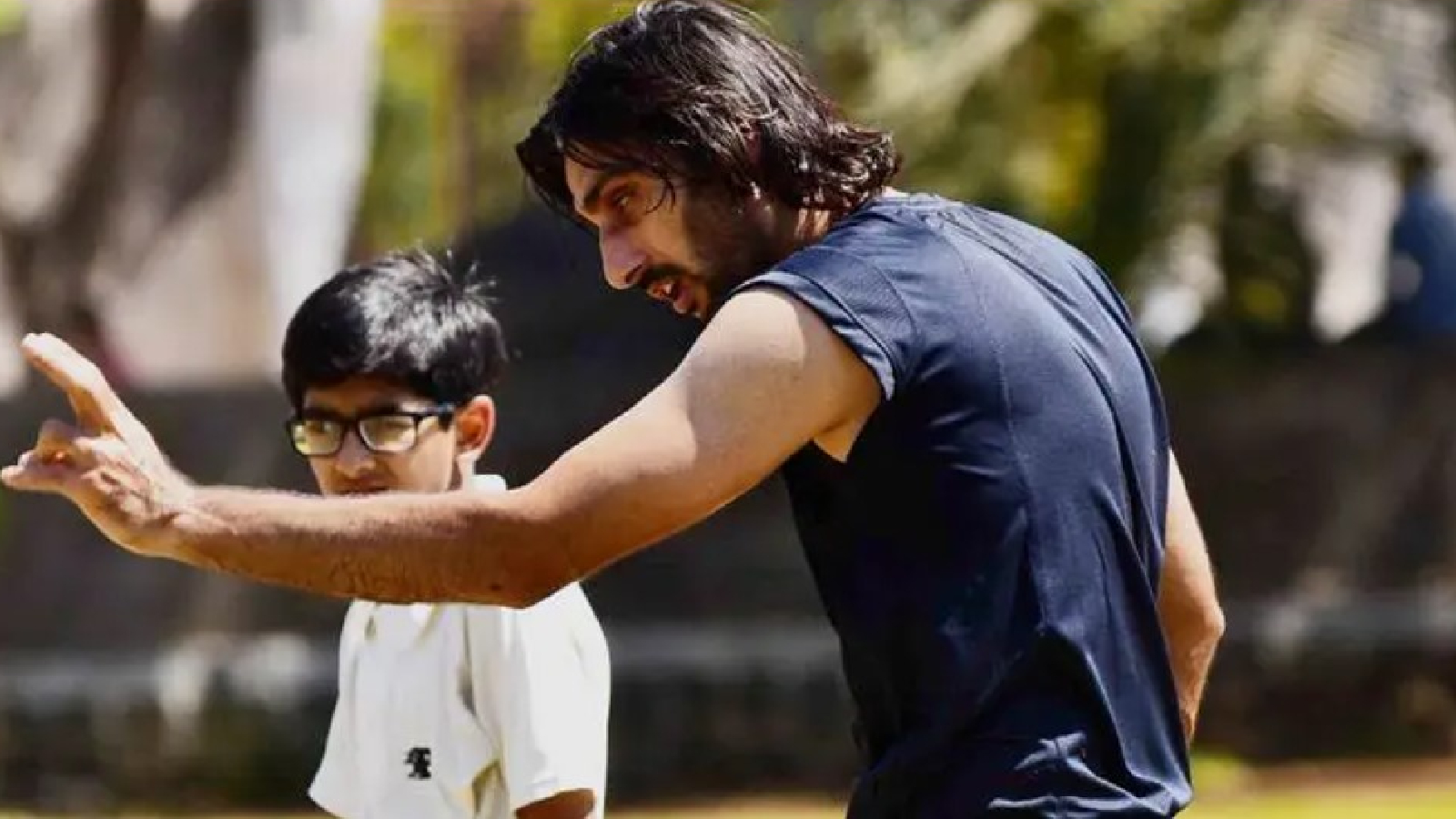
The setting helped. It was the 2015 World Cup, the eve of Afghanistan’s match against Australia in Perth. Keeping his promise to meet after a tiring net session, the 6’2″ pacer walked in with a swagger, running his fingers through his freshly showered, wavy hair like a movie star at a premiere. “My height is very big, my hair is very big, and I have too much style,” Zadran said, in broken English. It was his way of laying his calling card on the table between him and the reporters.
This was well before Rashid Khan’s debut. Afghanistan lacked superstars and an identity of their own. They were counted among cricket’s minnows, a flash-in-the-pan side, not yet the habitual giant-killers they’d become. Zadran, though, carried no inferiority complex. He was evidence of a nation waiting to exhale. They lacked results, but never passion.

Zadran bowled in the high 140s, throwing a piercing gaze at batsmen. He wasn’t really his nation’s poster boy so much as its fantasy cricketer. Afghanistan loved aggressive players, and the sight of him striding in, hair flying like a cape, exuded hostility. “In Afghanistan, too much like in speed, too much like in the long run-up,” he’d say, again caressing his hair.
The full-of-life Zadran breathed his last away from home, in Delhi, on Tuesday, bedridden for months while battling a rare illness that chips away at the immune system, block by block. Through the long fight, players and fans rallied around him. Teammates stayed by his bedside, promising all the help he needed. When he needed blood, cricket fans lined up to give it. But the popular Afghan would lose his battle.
The Afghanistan Cricket Board put out a detailed statement making clear his contribution to his country’s cricket went well beyond the 80 wickets he took in 44 ODIs and 36 T20Is between 2009 and 2020. Zadran sowed the seed of what has become one of world cricket’s fastest-growing teams. The ACB called him a “foundation-laying figure of Afghanistan cricket,” “a proud cricketer who stood at the heart of Afghanistan’s early cricket journey,” and “a true source of inspiration for many young Afghan cricketers,” adding that “his memory will forever remain alive in the hearts of the people of Afghanistan.”
The 2015 World Cup was the finest hour of Zadran’s career. He took 10 wickets across the tournament. Afghanistan jerseys with his name on the back flew off the counters on match days. That day in Perth, the dream destination for cricket’s speed merchants, his excitement was hard to hide. They were playing the eventual champions the next day, but the hardcore Shoaib Akhtar fan matched his idol’s own boast and bluster. When he said he’d blow away the mighty Australian top order, he sounded like he believed it.
The next day, he kept his word, somewhat. He got the wickets of David Warner and Steve Smith, but only after they’d made 178 and 88 respectively. The boundaries he conceded along the way didn’t dampen his pace or his spirit. He kept running in fast, banging the ball in short, kept throwing his hair back.
Story continues below this ad
Zadran grew up in Afghanistan’s Logar province, a region best known for the long, brutal war between the US-trained mujahideen and Soviet-backed government troops. Life was hard. Like many Afghan families, the Zadrans moved to Peshawar, in Pakistan, and it was there, as a teenager, that he first saw his inspiration on television. Shoaib Akhtar had a charisma that could hook any young cricketer, and Zadran was hooked the day he watched Akhtar bowl in Perth, a delivery flying clean over the wicketkeeper’s head.
That day in Perth, Zadran shared the memory again, rattling off names to make his point: “Dennis Lillee, Shaun Tait, Brett Lee, Ambrose, Walsh, Shoaib Akhtar, Wasim Akram, Waqar Younis, Shoaib Akhtar, too much bounce, too much speed.”
Soon he grew restless, the pull of the Perth pitch too strong to resist for long. Once the team’s rock star had wandered off, the media manager shared a few more nuggets, chuckling as he talked about Zadran’s sizeable female fanbase back home, and his surprisingly exquisite dancing. “He is the one leading the Attan, the traditional Afghan dance, others make a queue behind him. It’s a dance we do during festivals, weddings, and to celebrate wins. He did it when we qualified for the World Cup. He is outstanding. You can find him doing the Attan on YouTube,” he said.
Afghanistan has lost its pied piper, the man everyone once lined up behind. He had you at hello. Now, he’s said goodbye.