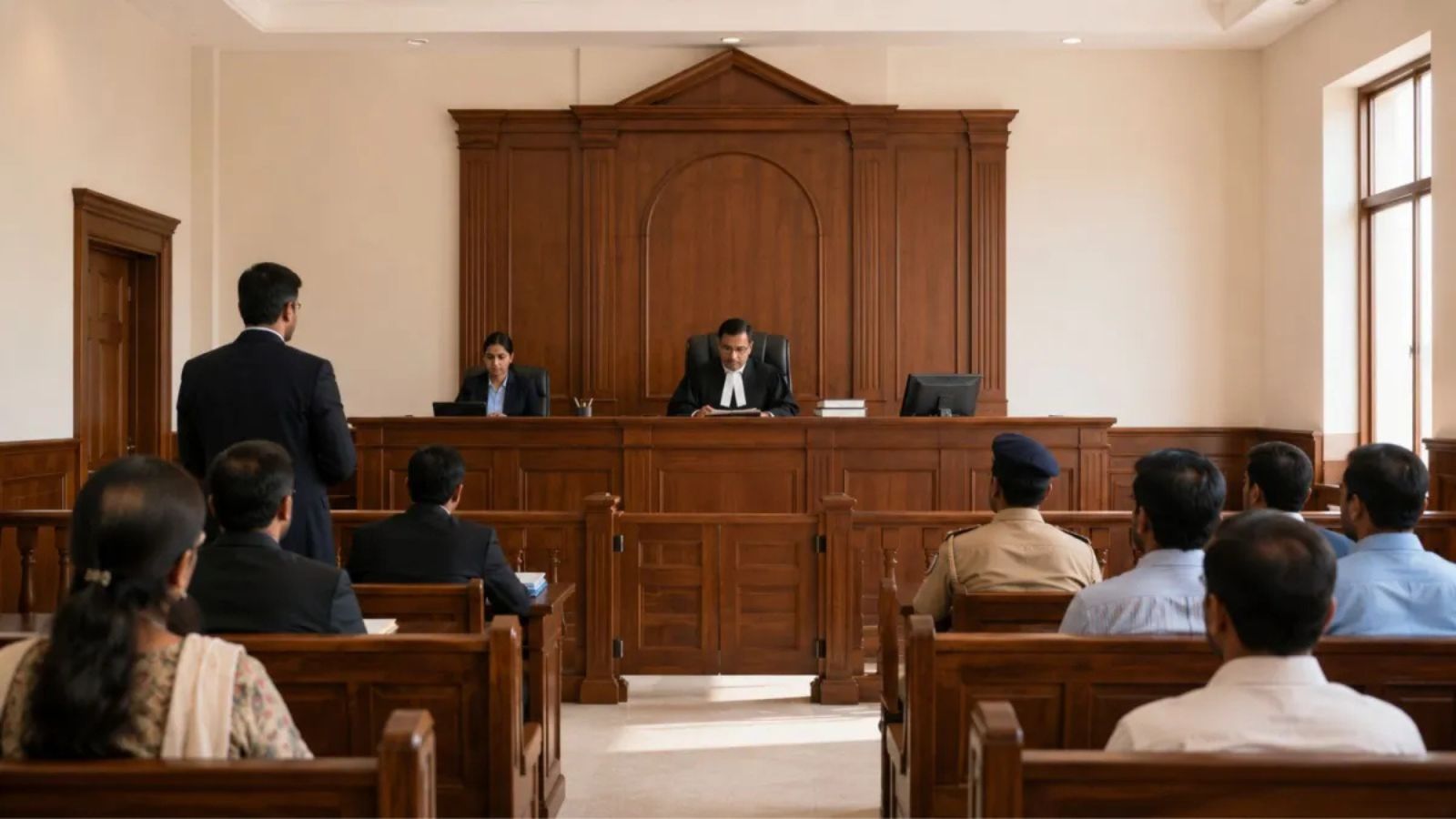
An alleged key operative in the transnational narco-terror network accused of smuggling 500 kg of heroin from Pakistan into India through the Gujarat coast in Salaya in 2020 to finance the banned Lashkar-e-Taiba (LeT) has secured default bail after the Gujarat High Court (HC) ruled that a Special Court of the National Investigation Agency (NIA) extended his judicial custody in July last year without following the mandatory legal procedure requiring his production before the court.
Hearing an application filed by the accused, Ankur Kapoor, a Division Bench of Justices Gita Gopi and L S Pirzada on Friday set aside orders of the Special NIA Court extending the investigation period from 90 to 180 days, holding that although the prosecution had complied with the statutory requirement of seeking an extension of time to complete the investigation, it had failed to ensure the accused’s physical or virtual presence before the court – a mandatory requirement under law.

Kapoor challenged the Special Court’s orders dated July 9 and October 16, 2025, rejecting his plea for statutory bail under Section 167(2) of the Code of Criminal Procedure and Section 43D(2)(b) of the Unlawful Activities (Prevention) Act (UAPA) and Section 36A(4) of the NDPS Act. Kapoor contended that the Special Court “was required to direct the jail authority to bring the accused before the Court after having read the endorsement of the havaldar”, who had claimed that Kapoor refused to accept the notice.
Kapoor is among the accused in the 2020 Salaya narco-terror case bring investigated by the NIA. In its eighth supplementary chargesheet filed in October last year, the agency described Kapoor as one of the alleged India-based “masterminds” responsible for managing the “on-ground activities of the narco-terror syndicate in Punjab” As per the NIA investigations, Kapoor allegedly “coordinated logistics, storage and local distribution” of the 500 kg heroin contraband, and “actively facilitated funding to accused persons based both in India and abroad.”
The agency has alleged that the network operated across Gujarat, Punjab, Delhi and Chandigarh with international links extending to Pakistan, Italy, Australia, the UAE, Iran and Thailand. The Gujarat ATS filed the original chargesheet and NIA filed seven supplementary chargesheets earlier. A total of 26 accused have been arrested in the case till date, while eight accused persons are absconding.
Senior Advocate I H Syed, appearing for Kapoor, submitted that “non-compliance of the mandatory provision entitles the appellant for default bail, and urged to allow the appeal by quashing and setting aside the orders passed by the learned Special Designated Court in July and October last year. Syed argued that once the court had before it the jail official’s endorsement that notice had not been served, it ought to have directed prison authorities to produce Kapoor on the scheduled date of hearing. Mere reliance on the endorsement, he submitted, could not override the mandatory requirement contained in Sections.
Opposing the plea, Additional Solicitor General Raja Thakare submitted that Kapoor was a “central figure in a large-scale narcotics and terror-financing conspiracy involving 500 kg of heroin” and several accused spread across India and abroad. He pointed out that the NIA had filed several supplementary chargesheets in the case and that Kapoor was also involved in two cases in Punjab before being transferred to Gujarat pursuant to orders of the Supreme Court.
Story continues below this ad
The NIA argued that the object of Section 43D of the UAPA is to ensure that investigation is not mechanically prolonged and that, in the present case, the statutory requirements had been fully satisfied. The Public Prosecutor had filed a report detailing the progress of the investigation along with specific reasons for seeking extension beyond 90 days, while the investigating authority had also filed a supporting affidavit.
The agency further contended that Kapoor had consciously refused to receive the notice served inside the jail and therefore could not be permitted to take advantage of his own conduct. The court, it argued, was entitled to presume that the court havaldar had performed his official duty correctly.
The prosecution also submitted that Kapoor was fully aware of the proceedings and had deliberately avoided service of notice, while his advocate had remained “continuously absent” before the Special Court. According to the NIA, the Special Judge had duly applied his mind to the Public Prosecutor’s report and the material placed on record before extending the investigation period.
Referring extensively to the Supreme Court rulings, the HC reiterated that “the presence of the accused has to be procured either physically or virtually. This is the mandatory requirement of law. This requirement is sine qua non (indispensable) for the exercise of the power to extend the judicial custody remand.”
Story continues below this ad
The HC emphasised that the purpose behind the procedure is to preserve the accused’s right to oppose the prosecution’s request for extension. “It is mandatory to procure the presence of the accused before the Special Court, when a prayer of the prosecution is for the extension of time to complete the investigation.”
After calling for reports from both the Sabarmati Central Jail Superintendent and the Special NIA Court, the HC found that there was no record showing Kapoor had been produced physically or through video conferencing on July 9, 2025. Jail records confirmed that the notice had been returned unserved after Kapoor allegedly refused to acknowledge it, while the video conferencing register contained no entry indicating his production before the court.
The judges held that the Special Court ought to have taken further steps to secure Kapoor’s presence instead of proceeding in his absence. “Refusal to accept the notice or the documents or the application for the extension of the judicial custody itself cannot be made a ground for extending the judicial custody from 90 days to 180 days, when the law mandates the Court to procure his presence either physically or virtually,” the HC order states.
The HC further observed that “the Court had on that day of hearing made no efforts by further issuing notice to the Superintendent or the jail authority to bring the accused… physically before the Court or virtually. There was no compliance of this mandatory requirement of law.”
Story continues below this ad
Allowing the appeals, the High Court quashed the Special Court’s orders and directed Kapoor’s release on default bail in the NIA case upon furnishing a personal bond of Rs 2 lakh with two sureties of the like amount, subject to conditions including surrender of his passport, not leaving India without prior permission of the trial court, furnishing his residential address to the investigating officer and court and refraining from misusing the liberty granted.