5 min readNew DelhiUpdated: Jul 19, 2026 05:54 PM IST
In any multiple-choice question (MCQ) examination, fairness, uniformity, and credibility depend on two conditions. First, every question and its answer key must be scientifically and legally correct, leaving no scope for ambiguity. Second, every candidate’s marked response must be accurately captured and evaluated. An error in either process can affect the rankings and future of thousands —or even millions — of candidates competing for a limited number of seats in high-stakes examinations.
Achieving perfection at either stage, however, is challenging. Human error is inevitable, even when questions and answer keys are prepared and vetted by experts. Likewise, in pen-and-paper (PnP) examinations that rely on Optical Mark Recognition (OMR), technical limitations may lead to incorrect recording of candidates’ responses. Inadequate darkening of bubbles, poor scan quality, or digitisation errors can result in valid responses being misread. Such issues are absent in computer-based tests (CBTs), where responses are captured digitally.

To address these concerns, examination agencies have progressively introduced post-examination transparency mechanisms. Following Re-NEET 2026, the National Testing Agency (NTA) implemented a two-stage review process, allowing candidates to challenge provisional answer keys and later verify scanned OMR responses. While this enhances transparency, candidates must pay Rs 200 per objection.
The above raises a fundamental policy question: Should candidates be required to pay to identify errors that ultimately arise from the examining agency’s own processes?
Evolution of Transparency in MCQ exams
Until about two decades ago, India’s large-scale MCQ-based competitive examinations functioned as virtual black-boxes. Candidates were neither allowed to retain question papers nor were they made publicly available after the examination. Official answer keys were also withheld, leaving candidates with no means to verify the correctness of questions or answers.
The transparency framework that exists today evolved through judicial interventions and technological advancements. The publication of question papers and official answer keys was the first major step towards transparency.
In 2014, the Delhi High Court, while deciding a Public Interest Litigation (PIL) filed by this author, directed the IITs to invite objections to provisional answer keys before finalising them for evaluation. Pursuant to these directions, the IITs institutionalised an answer-key objection mechanism across JEE (Advanced), GATE, and JAM. Importantly, the IITs have never charged candidates for this. Subject experts examine every representation, and accepted corrections are incorporated into the final answer keys, which are uniformly applicable to all candidates.
Story continues below this ad
CBSE, then conducting JEE (Main) and NEET, adopted a similar mechanism. Candidates were required to substantiate objections with authentic academic references, including NCERT and other standard textbooks, before expert review. However, CBSE levied a fee for every objection.
More than a decade later, the UPSC adopted a similar transparency framework for the Civil Services (Preliminary) Examination, 2026, following sustained demands from aspirants and observations made during proceedings before the Supreme Court. For the first time, UPSC published provisional answer keys immediately after the Preliminary Examination and invited evidence-based objections without any application fee. To discourage frivolous representations, every objection must be supported by three authentic and verifiable academic references before being examined by subject experts.
The rationale behind this evolution is straightforward. In an MCQ examination, an incorrect answer key affects every candidate who attempted the question. Correcting such errors, therefore, strengthens the integrity of the examination system as a whole, rather than addressing an individual grievance. The remaining policy question is whether candidates should bear the financial burden of identifying errors that ultimately benefit every examinee.
One MCQ Format, three systems, three rules
Although IITs, UPSC, and NTA conduct large-scale MCQ examinations, they follow markedly different approaches to handling answer-key objections and OMR verification.
Story continues below this ad
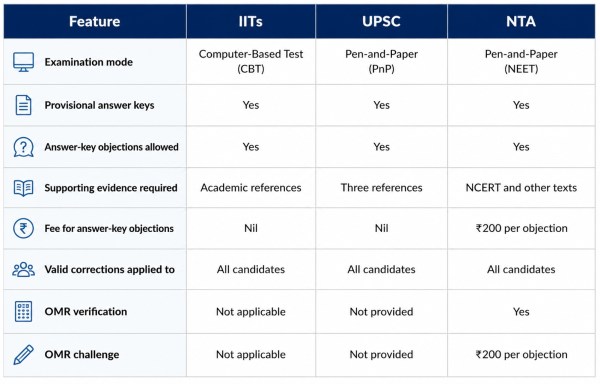 Table by the author
A second area of divergence concerns the recording of candidates’ responses in PnP examinations. NTA now allows NEET candidates to verify scanned OMR sheets against machine-recorded responses, but charges Rs 200 per objection. For an OMR swapping, it may go upto Rs 36000 per candidate.
UPSC, despite also conducting the Civil Services (Preliminary) Examination in the PnP mode, has not introduced a comparable OMR verification mechanism. IIT examinations, being CBT-based, are inherently free from such scanning-related issues.
The above comparison reveals a single MCQ format but three different regulatory approaches. At the same time, NTA provides an OMR verification facility, while UPSC has yet to adopt a similar safeguard for its OMR-based examination.
The way forward
India has made remarkable progress in making MCQ examinations more transparent, but the framework remains inconsistent across major examination bodies. The next step should be a uniform, student-centric Standard Operating Procedure (SOP) applicable to all MCQ-based examinations.
The author is a former Computer Science Professor at IIT Kharagpur, IIT Kanpur, BITS Pilani, and JNU, and a former scientist at DRDO and DST.