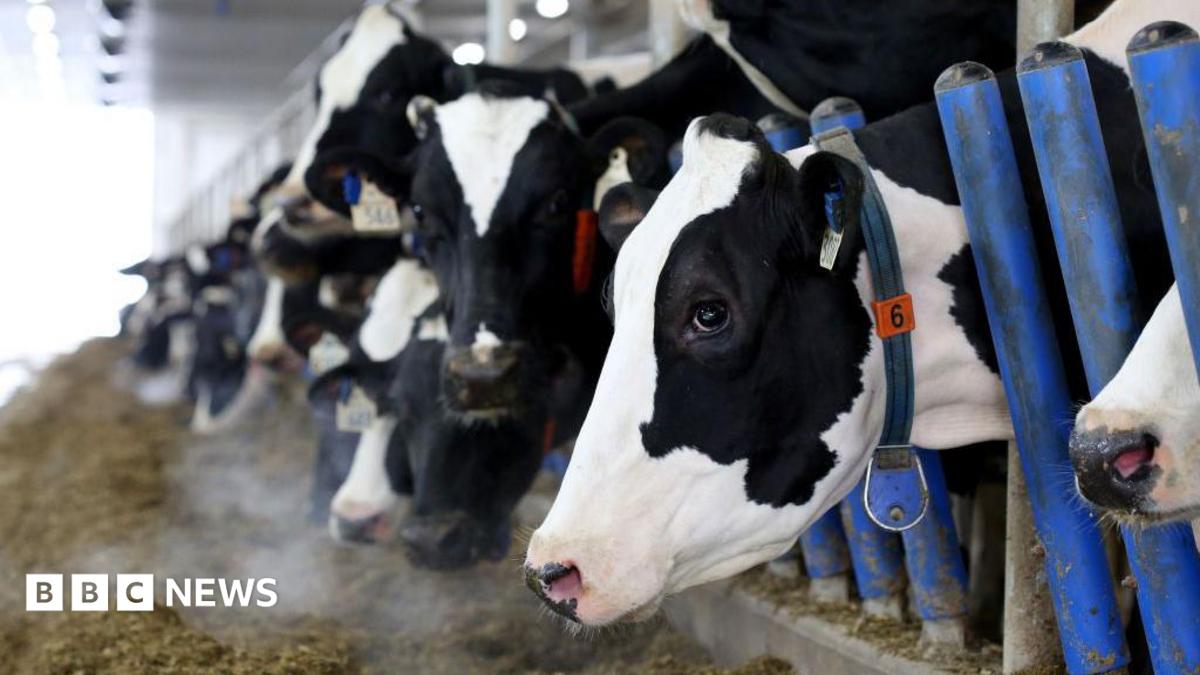
Canada’s dairy industry policy is among the most politically sacrosanct in the country. It has also long been a thorn in the side of Donald Trump.
Now, Canada’s dairy supply management system is back in the spotlight after the US president singled it out as one of three main irritants used to justify a 50% tariff on $20bn worth of Canadian goods imported to the US, which is set to come into effect in August.
Trump argues the system, which sees production quotas, set pricing, and import quotas on dairy, eggs, and poultry, is “unreasonable” to American farmers who want to sell their product north of the border.
Canadian politicians will now have to decide whether to stand firm on its popular supply management system or risk the ire of the public and a politically “powerful” dairy industry by attempting to fix this issue with Trump.
So far, they have indicated that dairy is a non-starter.
Quebec Premier Christine Fréchette, whose province is home to Canada’s largest dairy industry, said on Tuesday that supply management was non-negotiable.
And last week, US-Canada Trade Minister Dominic LeBlanc told the BBC that the system “is a cornerstone of Canada’s economy and our rural communities” that “ensures that Canadians have access to high-quality dairy products made by Canadian dairy farmers”.
They argue that it supports Canadian farmers and guarantees price and supply stability for food staples.
Dairy farmers have also been known to stage protests – complete with tractors and cattle on Parliament Hill – when faced with possible concessions in trade talks.
“It is the most powerful political lobby in the country that stretches across all of the major political parties,” said David Clement, a Canadian policy director at the international advocacy group Consumer Choice Center.
Canada’s supply management system has been in place since the early 1970s, and has endured despite other Commonwealth nations, like Australia and New Zealand, phasing out similar policies.
Farmers hold production quotas that limit how much dairy they can produce. Prices are then set by marketing boards in each province, giving farmers a predictable income while providing a consistent domestic supply.
A small amount of foreign dairy is able to enter Canada tariff-free or at low tariff rates under set quota limits. Those that exceed the limit, however, face a levy of 200% to nearly 300%, making it prohibitively costly for both foreign producers and consumers to sell in Canada.
Currently, US producers have tariff-free access to only 3.5% of Canada’s market, even as the country is among the top importers of US dairy, buying $1.3bn worth of products in 2025, according to data from the US Department of Agriculture (USDA).