Stay, or try to escape? Nina Ivanova, 77, felt the odds of survival were 50/50 either way, and she had nothing left to lose.
Russian forces were just over a mile away, battering her city, Lyman, in eastern Ukraine, with glide bombs and drones. Her husband was dead after a long illness, and her home was destroyed. She was hiding in a basement with her two daughters.
Lyman was burning, but civilian and military evacuation teams no longer entered the city, given the danger. The only way out was on foot — nine miles under drone-filled skies.
When Ms. Ivanova saw a body eaten by dogs in Lyman, it helped push her to her limit, she said. She and her daughters would take their chances on the road, as countless Ukrainians have done before them all along the front line.
“We got up and left,” she said.
Living in Lyman
Ms. Ivanova and her husband, Borys, lived in Lyman for decades. They raised their children there, in a house on Michurina Street.
The city, which had a prewar population of 20,000, served as a rail hub for the Donbas region. When Russia invaded Ukraine in February 2022, seizing the Donbas was a central aim, and that made Lyman a prime target.
Russian forces fought their way through dense forests and fields surrounding Lyman and seized the city in May 2022. Ukrainian troops drove them out five months later. But Lyman was never fully free of Russian fire.
Over time, Moscow’s small advances toward the city began to add up, and strikes on Lyman started intensifying again last fall. That’s when humanitarian aid deliveries stopped.
Ms. Ivanova’s home was hit in a strike on Dec. 17. The roof collapsed, and the windows were blown out. Two days later, her living room was smashed in a second strike.
Her family, though, was safe. They were sheltering in the basement of a five-story building with neighbors. They slept under three blankets, wearing jackets and hats, in below-zero temperatures, and they cooked stockpiled food aid on bricks over an open fire.
Mr. Ivanov, 79, who had been bedridden for eight years, died on Jan. 12. The Ivanova women buried him in the yard.
Things only got worse. One man who was living in their basement died in a strike on March 14. Another was killed the next day, while digging a grave for the first.
That left seven people in the underground shelter: The Ivanovas, a friend named Tetyana Shmarko and a family of three.
The Ivanova women stayed as Russian troops intensified attacks through March and April and into May. They stayed even as their supplies dwindled, even as others took their chances fleeing the city on foot and even as the mayor implored them to do the same.
Then, on May 23, Ms. Ivanova said, they realized that they simply could not sit in that basement any longer. Their patience and nerves had run out.
Getting Out
Their initial attempt to walk to safety ended in failure. The Ivanovas and Ms. Shmarko made it to a forest but could not enter — too many craters and downed trees. After three hours of wandering, they knew that the morning’s shelling would soon start. They made the gut-wrenching decision to go back.
After returning, exhausted and despondent, they called the mayor and said that they were resigned to their fate. He said they should rest for a few days but must go again. They repacked bags that had weighed them down on the initial try, taking out tracksuits and cutting 10 pairs of underwear and socks down to five.
Two days after the aborted escape, and after a night that Ms. Ivanova spent in prayer, too anxious to sleep or eat, she and her daughters, Olha, 54, and Tetyana, 53, prepared to leave at 3:40 a.m., when fewer drones tend to be in the air. They wore comfortable sneakers but paid no heed to layers. Walking and fear would keep them warm.
They were joined by Ms. Shmarko and the other family from the basement — a couple and their wounded 31-year-old son. The group balanced backpacks and a pair of cats on two bicycles, then started walking.
This time, they took a different route — a longer circle road — on the mayor’s advice. They passed destroyed buildings. They passed the railway, its tracks torn apart, then the burned forest. They passed the shells of military vehicles and saw shreds of torn uniforms on a crater-marked highway.
They pressed on, too scared to pause even for a sip of water. Drones were flying, and shelling would usually start after 7 a.m.
The other family from the basement struggled to keep up. The son, with two pieces of shrapnel in his back from an earlier Russian strike, could not walk fast.
But the Ivanovas and Ms. Shmarko kept going, and praying.
Anti-drone netting over the road offered little comfort. The destroyed civilian and military cars underneath illustrated the scant protection. They knew others from Lyman who had been killed while walking this stretch.
Ms. Ivanova was exhausted. “I was walking down the road like a drunk, couldn’t stand on my feet, swaying and falling,” she recalled.
After four hours and 20 minutes, the Siverskyi Donets River was in sight. Ms. Ivanova’s daughter Tetyana, who had fished there as a child, ran ahead to find the crossing and called out.
Ukrainian soldiers emerged from bushes on the riverbank. The mayor had told them to expect the Ivanovas. The soldiers offered the women water and told them to hide in the shrubs.
The bags and the cats were loaded into a small wooden boat that was pulled across the dark green water via ropes that have been used throughout the war to ferry soldiers and supplies. The women would go next — two at a time, wearing bulletproof vests.
Seeing the shrapnel-scarred boat that would carry her left Ms. Ivanova “so scared,” she said. Had she known what crossing the river would entail, she later told her daughters, she would have refused the journey and “laid down there with my old man, buried in the yard.”
Soldiers tried to ease her fears, joking and promising delivery “in comfort.”
When they made it to the other side, the Ivanovas clambered up the steep riverbank through the mud. “You have no idea what we looked like,” Ms. Ivanova said with a laugh.
More soldiers greeted them there, loading the women onto ATVs with instructions to “hold tight.”
On to Safety
The ATVs sped through a forest, onto the highway and to waiting military vehicles that took the women to an evacuation hub in Sloviansk, where we met them. They arrived at around 10 a.m., still covered in mud.
When they bathed later, it was the first hot water to touch their skin in months, they said.
Tetyana Ivanova’s blond hair was still wet when she called an aunt.
“We walked out on foot today, walked 15 kilometers!” she exclaimed. There were other updates after months in a basement with no phone signal. “My father died, we buried him,” she said.
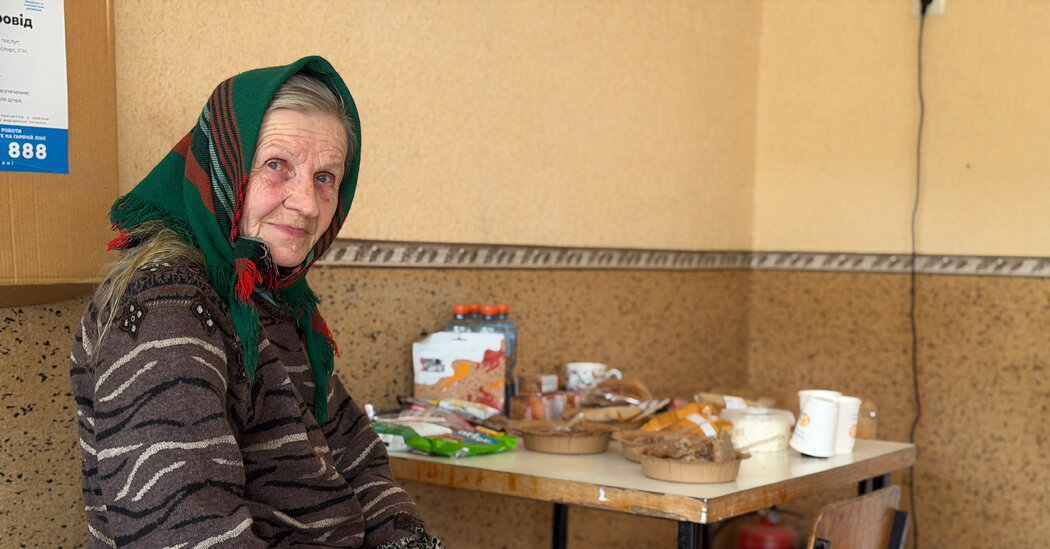
Humanitarian workers brought the women lunch. For seven months, they had dreamed of store-bought bread and ice cream. Still, they could not eat.
“We are in shock,” Ms. Ivanova explained, sitting hunched on a cot.
She insisted that she felt fine after the walk. Swollen ankles, cutting into a pair of donated black-and-gold sandals, suggested otherwise. Still, sore feet were no matter at this point.
“We escaped from hell,” Ms. Ivanova said. “We took a 50/50 chance, as they say — whether they kill us there, or on the road,” she added. “Fifty-fifty — nothing to lose.”