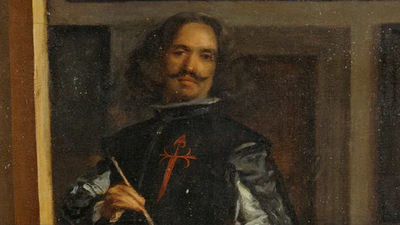
The J. Paul Getty Museum has acquired a long-lost 17th-century portrait by Spanish painter Diego Velázquez, bringing the first work by the Baroque master into the museum’s permanent collection. The oil painting, titled Portrait of the Count-Duke of Olivares, was officially announced by the Los Angeles museum on 23 September 2026. Before its recent discovery in a private European collection, art historians knew the image only through a famous 17th-century engraving by Flemish printmaker Paulus Pontius, created in collaboration with Peter Paul Rubens. It is the first Velázquez painting held by a museum on the West Coast of the United States. The work will go on public display at the Getty Center’s East Pavilion in Los Angeles before traveling to Michigan for a museum exhibition next year.
First Velázquez painting for Getty collection
The acquisition fills an important gap in the Getty Museum’s collection. Until now, the museum had no works by Velázquez, despite its large collection of European art. “Velázquez was one of the greatest painters of early modern Europe and one of the most remarkable proponents of the long and multifaceted tradition of state portraiture,” said Timothy Potts, director of the Getty Museum. “This work is a landmark addition to Getty’s collection, made even more extraordinary by the painting’s history as it was not fully known until recently.” There are around 120 known surviving paintings by Velázquez worldwide, with about 50 held by the Museo Nacional del Prado in Madrid. Davide Gasparotto, senior curator of paintings at the Getty Museum, described the canvas as an important addition to the museum’s collection of early European art. “This commanding and almost intimidating portrait is a strong visual record of one of Spain’s most powerful 17th century statesmen that exemplifies the painter’s innovation in court portraiture and his superb ability to capture the sitter’s personality directly from life,” Gasparotto said. “It is a major addition to the Getty’s collection of 17th-century European paintings and adds a major example to our growing holdings of Spanish paintings.”
Subject of near absolute power
Measuring 60 by 48 centimetres, the bust-length canvas shows Gaspar de Guzmán y Pimentel, the Count-Duke of Olivares. Wearing gold-trimmed armor and a red sash, Olivares turns his head and looks directly at the viewer. During the 1620s and 1630s, Olivares served as valido, or prime minister, to King Philip IV of Spain. For more than two decades, he held near absolute power over decisions involving the Spanish government, administrative reforms, and military operations. Velázquez likely painted the work in the summer of 1626 as a diplomatic gift for Cardinal Francesco Barberini, who was visiting Madrid on a papal mission. Historical records support this idea. An inventory of the Barberini family collection in Rome from 1631 lists “a painting with the portrait of Count Olivares, that is [his] head and armored bust.” Experts believe this description refers to the Getty painting.
Centuries of hidden ownership
After reaching Italy in the 17th century, the painting stayed in private hands for centuries. It was eventually held by the Coppellotti family collection in Asti, northern Italy, throughout the 20th century. The painting passed to a private collector in 2025 before being purchased by the Getty Museum. For generations, art historians knew the composition only through an engraving by Paulus Pontius. The print was made in collaboration with Peter Paul Rubens. Rubens created an elaborate allegorical border around Olivares’ head, while inscriptions on the print clearly said that the central portrait was based on a prototype by Velázquez. A surviving letter from Olivares to Rubens confirms that the prime minister received copies of the print and thanked the Flemish artist. The newly identified canvas has been confirmed as the original prototype Velázquez made for that print.
Identification by Spanish art scholar
The painting was identified by Salvador Salort-Pons, director of the Detroit Institute of Arts and a specialist in 17th-century Spanish art. While researching an upcoming exhibition about portraits of Olivares, Salort-Pons found the unrecorded painting in a private collection. Further technical study found several pentimenti, or visible changes made by the artist directly on the canvas while working. Changes to Olivares’ armor and clothing supported the conclusion that the work was an original Velázquez painting, rather than a later copy. After its display at the Getty Center in Los Angeles, the painting will travel to the Detroit Institute of Arts. There, it will be part of the exhibition Velázquez & Olivares: Early Years at Court, scheduled to run from 24 January to 25 July 2027.