

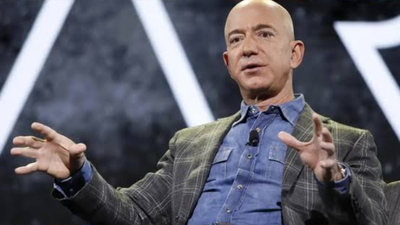
More than 50 years after the first crewed moon landing, Jeff Bezos has a straightforward explanation for why returning to the lunar surface remains so difficult. The Amazon founder says the United States devoted almost 3% of its gross domestic product (GDP) to the effort in 1969, making Apollo an exceptionally expensive national project. During an October 2026 interview with Fox News presenter Bret Baier, Bezos argued that the next phase of exploration must take a different approach. He tentatively identified December 2026 as the month for a lunar mission later this year. Rather than sending astronauts on brief visits, he wants to build a sustainable lunar base, backed by billions of dollars in investment through his space company, Blue Origin.
Jeff Bezos reveals why the 1969 moon landing cost the US billions
Bezos’s explanation centres on the financial commitment behind the original moon landing. Speaking to Baier, he recalled that the United States devoted almost 3% of its GDP to the effort in 1969. The figure, he argued, helps explain why the achievement cannot simply be repeated by recreating the technology used during the Apollo missions.The Apollo programme was a national undertaking shaped by the Cold War competition between the United States and the Soviet Union. Following Soviet successes in the early space race, including the launch of Sputnik in 1957, Washington treated reaching the moon as a strategic priority. As reported by Nasa, President John F. Kennedy set the goal of landing a man on the lunar surface and returning him safely to Earth in 1961. The commitment brought together government funding, scientific research, industrial manufacturing and thousands of workers across the country.Apollo 11 fulfilled that ambition on 20 July 1969, when Neil Armstrong and Buzz Aldrin became the first humans to walk on the moon. Michael Collins remained in lunar orbit aboard the command module.Bezos’s remarks address a distinction that can be overlooked when looking back at the landing. The United States had the capacity to undertake the mission, but it also had to sustain the political and financial commitment needed to make it happen.
Why repeating a historic moon landing is not a simple task
The Apollo missions were conducted under circumstances that differ considerably from those facing space agencies and private companies today. During the 1960s, the prospect of beating the Soviet Union to the moon gave the American government a compelling reason to direct vast resources towards a clearly defined objective. That level of spending was possible because lunar exploration had become a matter of national prestige and geopolitical competition.The passage of time has not removed those engineering difficulties. Nor does the existence of modern computing, improved materials and more advanced manufacturing automatically make every aspect of spaceflight cheaper. New systems still need to be tested, and human missions require additional safeguards that uncrewed flights do not.The question raised during the Fox News interview therefore goes beyond the original Apollo achievement. It concerns how to make lunar travel repeatable, affordable and useful over a longer period, rather than treating each expedition as a rare event supported by an exceptional burst of public spending.
Bezos outlines vision for long-term lunar exploration
Bezos has described a future in which astronauts do more than land on the moon, conduct experiments and return home. His stated ambition is to establish a sustainable lunar base, creating infrastructure that could support continued scientific work and further exploration.Such a settlement would represent a different kind of commitment from the Apollo programme. The earlier missions were designed around specific objectives, with astronauts spending limited periods on the surface before returning to Earth. A permanent or regularly occupied facility would require a much broader range of capabilities, including reliable transport, power supplies, communications, equipment maintenance and systems to support human life.Bezos told Baier, “Today, we’re going to do it at a lower cost and going to the Moon to stay.”“It won’t be just a mission and leave. It will be a real sustainable Lunar Base.”
The moon could provide resources for future space travel
During the interview, Bezos also described the moon as a useful destination because of its relatively short distance from Earth. A journey takes roughly three days under typical mission conditions, although the precise travel time depends on the spacecraft and trajectory.He sees the lunar environment as a possible source of materials and ‘interesting things’ that could eventually support activities beyond the moon itself. Among the possibilities he discussed were producing solar cells and rocket propellant using resources available in space.Bezos has also argued that developing the moon should come before sending humans to Mars. A lunar programme could provide experience in operating away from Earth, although the moon and Mars present different environments and logistical challenges. For now, the proposed use of lunar resources remains part of a longer-term vision rather than an established commercial system.
Bezos reveals $28 billion investment in Blue Origin since 2000
The scale of Bezos’s ambition is reflected in his personal investment in Blue Origin. According to his October interview with Fox News, he has put $28 billion into the company since founding it in 2000. The business has spent years developing launch vehicles, engines and other technologies intended to support commercial spaceflight and more ambitious missions. Blue Origin’s activities extend beyond the goal of establishing a lunar base. Bezos said, “We just raised $10 billion from outside parties for the first time.”“Some day Blue Origin will have an IPO.” Bezos suggested that investors should not expect it to happen immediately. He did not provide a precise time, saying it could be ‘several years away’.A public listing would give outside investors an opportunity to buy shares in the business, while potentially providing the company with another route to raise capital. It would also bring greater scrutiny of its financial performance, development costs and commercial prospects.