5 min readUpdated: Mar 16, 2026 08:29 PM IST
It is a mark of a great philosopher when you keep carrying their ideas years and decades after the book is closed as their theory becomes a lens to diagnose the world. Jurgen Habermas, who died on March 14 aged 96, was one of the most important figures in 20th-century post-war Germany.
Habermas gave us the concepts of the public sphere, communicative action, and deliberative democracy, which are now embedded in how we diagnose politics and policies.

Condoling his death, German Chancellor Friedrich Merz said, “Germany and Europe have lost one of the most significant thinkers of our time.”
A sentiment shared by the majority of academics and intellectuals, though of course, Habermas had his share of detractors. Born in Düsseldorf in 1929, at his father’s instigation, he joined the junior Hitler Youth. What he witnessed became the engine of everything he wrote, and he became one of the most trenchant critics of fascism and Nazism, so much so that he went on to challenge Martin Heidegger, one of the most significant philosophers of the time.
 Jürgen Habermas’s book The Structural Transformation of the Public Sphere was first published in 1962. (Source: amazon.in/AI)
The Structural Transformation of the Public Sphere (German 1962; English translation by Thomas Burger and Frederick Lawrence, MIT Press, 1989)
Those just discovering the philosopher should begin here. Habermas traces the emergence – in 18th-century coffee houses, salons and newspapers – of an informal arena where private citizens could deliberate on matters of common concern, shaping political life through reason alone. He called it the bourgeois public sphere, and argued that democratic legitimacy was forged there, through what he would later call “the unforced force of the better argument.”
Today the coffee house is now a comment section, the newspaper of record competes with a thousand Substack essays. In 2022, Habermas published a brief sequel addressing fake news and filter bubbles. As to what happens to democracy when the arena for rational deliberation collapses, the sequel cannot satisfactorily answer.
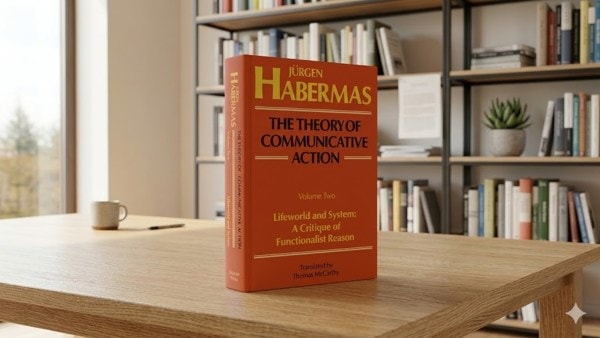 Jürgen Habermas’ The Theory of Communicative Action comprises two dense volumes.
The Theory of Communicative Action (German 1981; English translation by Thomas McCarthy, Beacon Press: Vol. 1, 1984; Vol. 2, 1987)
This is a bit harder, comprising two dense volumes, but they are the foundation on which everything else rests.
Story continues below this ad
In these volumes, Habermas’ central claim is that rationality is not a quality possessed by exceptional individuals and is the natural outcome of people talking to each other in good faith. Power, manipulation and deception are corruptions of something language itself reaches toward.
In 2019, Cambridge philosopher Raymond Geuss argued in The Point magazine that Brexit had refuted this. It was debate, Geuss said, that manufactured the crisis, transforming a fringe position into a national rupture.
Discussions, he wrote, “just as often foster polemics, and generate further bitterness, rancor and division.”
Seyla Benhabib, then at Yale, replied that Geuss had attacked a caricature and committed a performative contradiction: “But democracies cannot simply be republics of hypocrites.” Berkeley historian Martin Jay said that by abandoning communicative rationality, Geuss had “preempted the possibility of objecting to anything at all that might happen in his post-discussion future world.” Writing
Story continues below this ad
in The Outline, philosopher Tom Whyman found both defences insufficient. He said that the Habermasian habit of treating discourse as an end in itself had, in his view, curdled into “pseudo-activity,” awareness-raising as a substitute for action.
 Jürgen Habermas’ book Between Facts and Norms was first published in 1962. (Source: amazon.in/AI)
Between Facts and Norms (German 1992; English translation by William Rehg, MIT Press, 1996)
The book bridges the gap between what law is and what legitimate law ought to be, essentially rules citizens could in principle have given themselves through free deliberation. Read it alongside the controversy that engulfed Habermas in his final years and the tension surfaces.
In 2023, Habermas co-authored “Principles of Solidarity,” arguing that support for Israel is “a fundamental part of German political culture” and cautioning against those in Germany protesting its military campaign. Sociologist Asef Bayat responded in New Lines Magazine with what the editors called an immanent critique, a challenge from within Habermasian logic itself.
In German universities, Bayat observed, almost everyone fell silent when Palestine came up; people had been dismissed and events cancelled for calling for a ceasefire. His charge was structural: German exceptionalism creates precisely the differential moral standards Between Facts and Norms was written to prevent, designating some lives as worthy of protection and others as less so. He described a “hidden sphere” in democratic Germany where young people held one set of views in private and performed another in public, bearing an uncomfortable resemblance, he said, to pre-1989 Eastern Europe.
Story continues below this ad
Habermas has also been criticised for a Western-centric (Eurocentric) and idealised approach to democracy, which has come to be known as Habermas exceptionalism.

© IE Online Media Services Pvt Ltd