New Delhi:
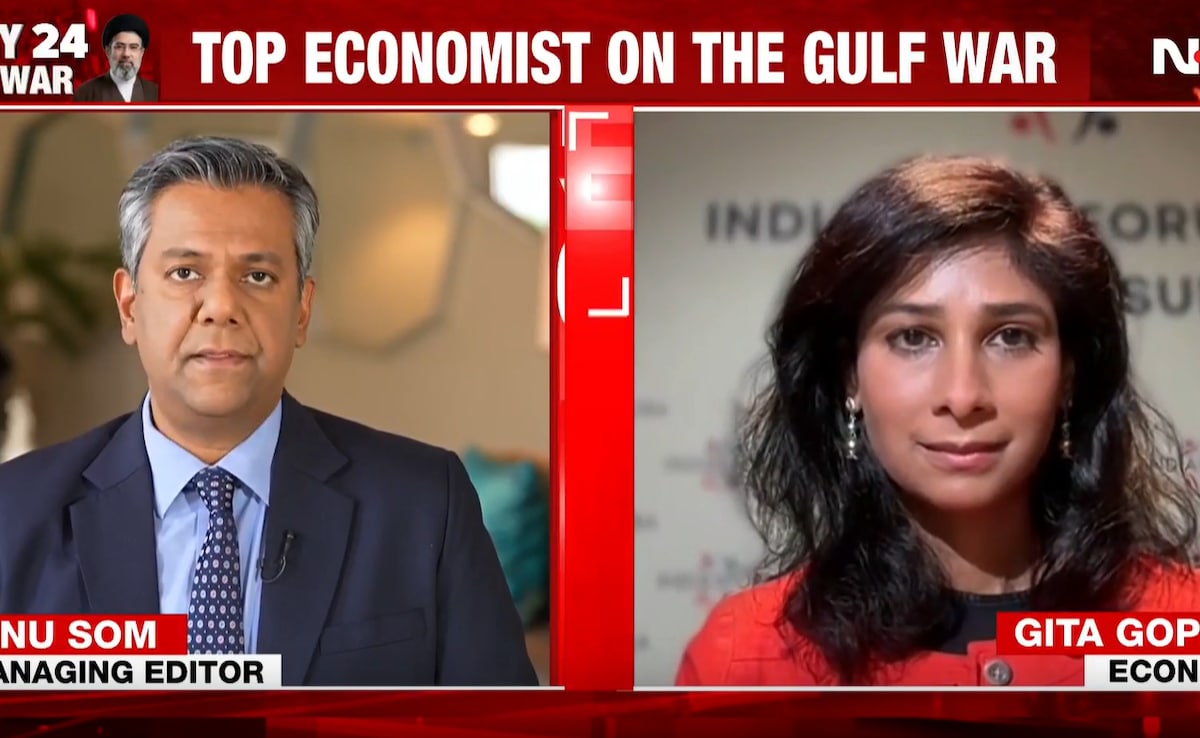
The United States’ war on Iran has already had an impact on India’s GDP growth figures for the year, Harvard professor and former IMF Chief Economist Gita Gopinath told NDTV Monday afternoon.
“Even if oil were to average say only US$85 for the rest of the year, that would shave off about half a percentage point from India’s growth,” she said, “If it were to average closer to US$100, we’re talking about almost one percentage point being impacted. So it’s already consequential.”
In January the IMF cited robust momentum and strong third-quarter performance to revise its India GDP estimate for FY26 to 7.3. FY27 growth was projected at 6.4 per cent. A one-point hit could effectively wipe out most of that upgrade, she indicated.
“The effect on inflation, of course, depends a lot on how much the government is willing to absorb… in terms of the fuel subsidy itself versus letting that pass and show up at the pump.”
Gopinath noted that base fuel prices haven’t gone up in India since “most of the shock is being absorbed by oil companies”.
This, however, is not a long-term solution, she said, serving up a warning. “If oil stays at current prices for a few more weeks, prices should go up even in India.” She said she expected this ‘because otherwise the pressure on fiscal deficit is going to be substantial and pressure on the Balance of Payments are already substantial at this moment’.
Food prices tend to follow a six-month lag to higher energy costs, Gopinath also said, pointing to rising fertiliser prices
RECAP | After Oil, Gas, Iran’s Hormuz Chokehold Raises Fertiliser Red Flag For India
Apart from oil and gas, around 63 per cent of India’s nitrogen fertiliser imports – which includes urea and ammonia, and 32 per cent of di-ammonium phosphate – comes from the Gulf.
Impact on world economy
“I would hold off,” she also said, asked about the impact of crude oil prices, including on the world economy, “It matters a hell of a lot whether oil is going to average US$85… or US$100, because the impact on the world economy is going to be very different (in each case).”
Gopinath also told NDTV the next 24 hours – including how Iran reacts to Donald Trump’s ultimatum to ‘fully reopen the Strait of Hormuz’ – “are going to be absolutely critical for the direction of this war, and what that could imply for oil prices (for India and the world) …”
“What is critical, as we know, is the Strait of Hormuz and what is happening to energy infrastructure. (It is) less about Iran and more about what happens in Saudi Arabia, the UAE, Qatar… and how much damage could follow if we have an escalation in the next 24 hours.”
Soaring Brent crude
Prices of Brent crude – a global oil benchmark – soared past the US$100 mark, for the first time in nearly four years, this month on the back of the war and targeting of energy infrastructure in West Asia, as well as Tehran shutting down the Strait of Hormuz, a critical energy chokepoint.
They plummeted 10 per cent Monday evening, hours after NDTV spoke to Gopinath and minutes after the US President’s Truth Social post about a possible five-day ceasefire.
RECAP | Trump Hints At Possible Middle East Breakthrough, Then Iran Rubs It In
This volatility in energy markets has led to fears of fuel and gas scarcity in India, particularly after neighbouring Bangladesh began rationing petrol and Indian households complained of LPG (liquified petroleum gas, used by over 33 crore houses for cooking) cylinder shortages.
Pre-war, a fifth of the world’s seaborne energy trade, i.e., between 20 and 25 million barrels per day, passed through the Strait of Hormuz. India bought around 12 to 15 per cent of that volume.
But after the war began tanker traffic was crippled, driving up fuel and gas prices worldwide, including in the US. India, though, remained relatively insulated with the government absorbing any volatility, though commercial LPG and premium petrol prices have since increased.
PM Modi’s assurances
Speaking in Parliament earlier this afternoon, Prime Minister Narendra Modi said his government is working to minimise impact on supply of fuel, gas, or coal to Indian households. The PM said the country had moved to diversify energy imports over the past decade, underscoring increased resilience to global shortages and expanded strategic reserves.
RECAP | PM On How India Is Reacting To Hormuz Chokehold-Driven Energy Crisis
“In the last 11 years, we have diversified our energy imports… earlier we used to import from 27 nations. Now we import from 41 countries. We have 53 lakh metric tons (in) strategic reserves.”
Gopinath, though, said that even with buffers, prolonged supply disruptions will push up prices.
A global recession?
On a question about a possible global recession, Gopinath seemed to play down those fears, explaining, “In terms of a true recession, i.e., you have global growth going into negative territory, I would say ‘no, that takes a lot’. The only time it has gone into negative territory in the past few decades, was during the pandemic and briefly during the great financial crisis…”
“But if you think of a recessionary environment in the global economy… which is global growth going to say two per cent (and) if you have oil at US$120 or US$130 a barrel for the rest of the year, then I think that is a real possibility.”