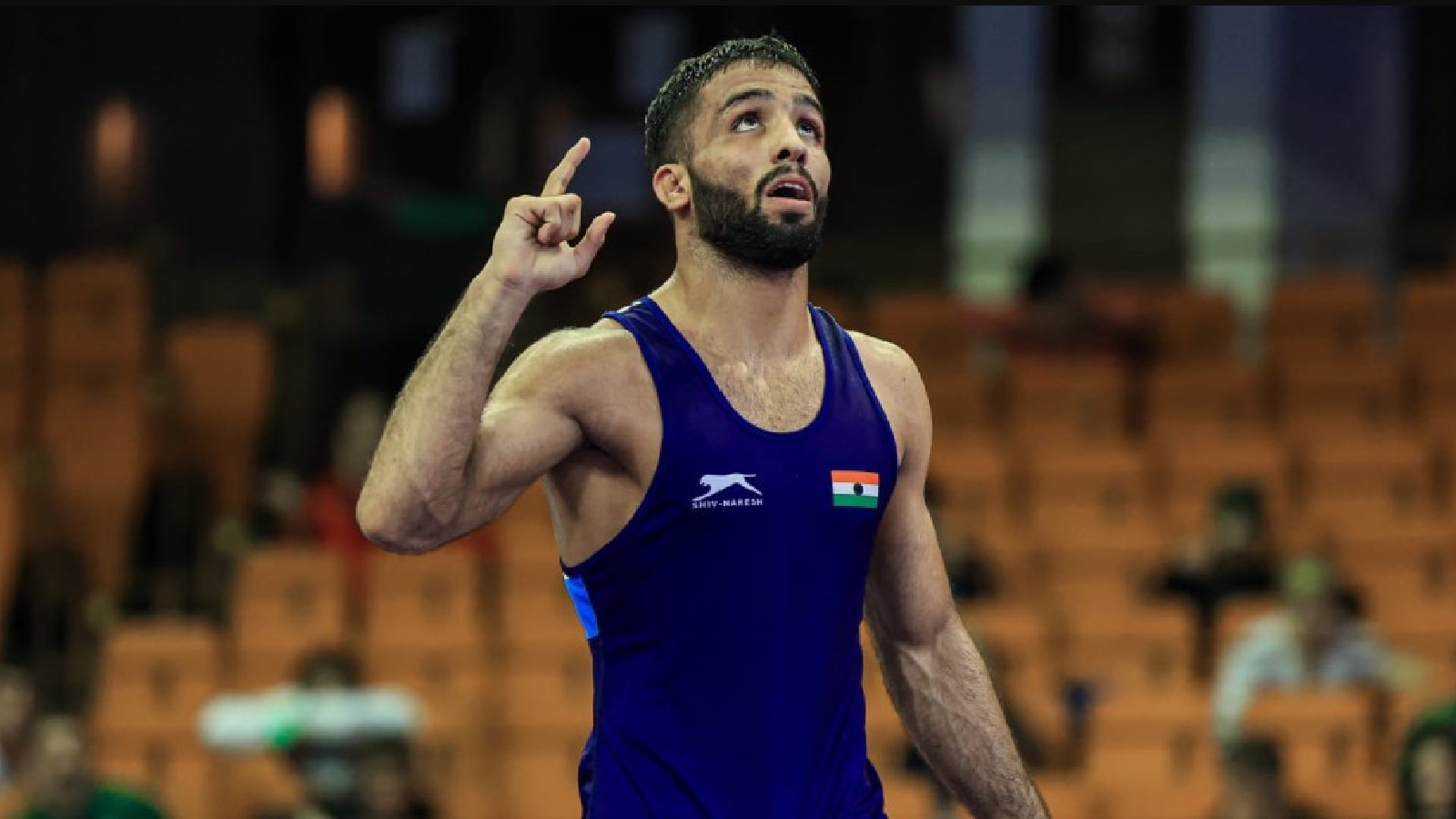
It pleased Dayanand Kalkal that his son had ended India’s three-year wait for an Asian title. What brought him greater satisfaction, however, was Sujeet’s restraint — there were no over-the-top celebrations. “These are small medals,” says Dayanand, a former wrestler and his son’s coach. “When you are aiming for the summit, you acknowledge the milestones, but you don’t celebrate them as though you’ve already reached the peak.”
For him, the summit is the Olympic podium. Not just any step, but the very top. It is a pursuit that father and son have been charting together.
To them, the Asian Championship gold might only be a pit stop on a long journey. But for India’s wrestling community, hungry for a new standard-bearer this cycle, Sujeet’s ascent gives voice to a long-held belief: his is the name the conversation keeps returning to.
A glance at his record this year is evidence enough. Unbeaten in 2026, winning all 10 matches, Sujeet completed a gold medal hat-trick on Saturday — adding the Asian Championship to the Zagreb and Tirana titles he had already bagged. He has scored 96 points, conceded just 7, underlining his dominance in every bout.
The 23-year-old’s 8-1 win in the final over last year’s World Championship bronze medallist, Uzbekistan’s Umidjon Jalolov, landed India’s first men’s freestyle gold at 65kg since 2019, ending a seven-year wait in a weight category considered the deepest and toughest in the discipline. Overall, it ended a three-year drought for Indian men’s freestyle gold at the Asians. India has won gold at 65kg just twice since 2015 — both times through Bajrang Punia, who went on to win bronze at the Tokyo Olympics.
“Winning or losing isn’t in my hands,” Sujeet told UWW. “But it is my job to give my best and I did that. I was very confident that I would win the gold medal.”
***
A late bloomer, Sujeet had been visiting the akhara with his father since childhood, but it was only five years ago that he began taking wrestling seriously. Until then, academics had been his primary focus. Scoring over 90 per cent in Class 12, he once aspired to become an engineer. But when the time came to choose between higher studies and the mat, he chose to follow in his father’s footsteps.
Story continues below this ad
A former national champion, Dayanand had long been a keen observer of the sport. During international travels — to Russia, Iran and the United States in particular — he meticulously noted training methods and systems. When he retired and took up coaching in 2012, those observations became the foundation of his approach.
“India’s weakness has been poor basic skills. That’s one reason we haven’t won an Olympic gold,” Dayanand said. “When I spent time in Colorado Springs, my focus was on fundamentals: flexibility, speed, technique, tactics, and movement. These have to be taught young. You can’t instil them at the elite level.”
Sujeet became one of his first students. At nine, he began with the simplest drills — basic movements on the mat. “My goal was to make his technique and movement second nature,” Dayanand says.
The result is a wrestler who stands in stark contrast to the traditional Indian style. Where many Indian wrestlers have relied heavily on endurance, aiming to outlast opponents, Sujeet is different. His approach is rooted in precision — technical drills honed over years of disciplined training.
Story continues below this ad
His current coach, Kuldeep Singh, praises his explosive strength. Add to that his sharp single-and-double-leg attacks, along with his signature bagal doop — a swift transition from a double-arm lock into a deceptive feint, followed by a spin to the back that immobilises his opponent — and Sujeet possesses a toolkit capable of troubling the very best.
Sujeet, too, has evolved as a student of the sport. Training stints abroad exposed him to new methods: in Russia, a greater emphasis on scrambles and live bouts; in Japan, shorter but high-intensity sessions focused on speed. He absorbed these ideas and blended them with India’s hallmark conditioning — relentless stamina built through long training hours.
“There’s an additional factor this year,” Dayanand says. “Experience. Earlier, pressure affected him, as we saw at the World Championship. Now, he’s better equipped to handle those moments.”
The summit, he says, is still ahead. The milestones are being noted, not celebrated.