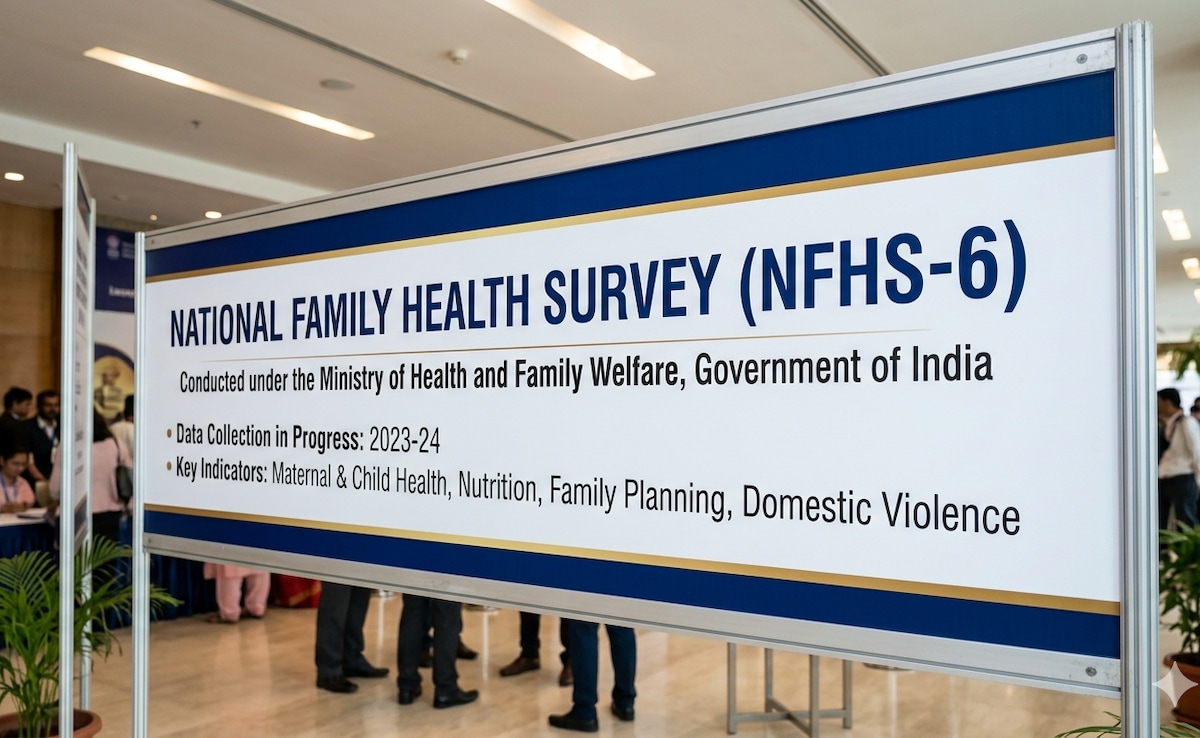
The Ministry of Health and Family Welfare (MoHFW) is expected to release the sixth round of the National Family Health Survey (NFHS-6) shortly, according to reports. The NFHS is among the largest and most comprehensive sample surveys undertaken in the country. NFHS-6 covered 6,79,238 households across States and Union Territories of the country, and was conducted during 2023-24. This survey aims to generate high-quality data on health and related indicators to support policymakers and programme managers in setting benchmarks and assessing progress over time in India’s health sector.
For the first time, in NFHS-6 all aspects of the survey have been coordinated solely by the International Institute for Population Sciences, Mumbai. NFHS-6 has provided estimates of the levels of fertility, infant and child mortality, and other family welfare and health indicators by background characteristics at the national and district levels; and has measured trends in family welfare and health indicators over time at the national and district levels.
The NFHS-6 has used entirely digital mode for data collection using Computer-Assisted Personal Interviewing (CAPI) software, which incorporates in-built provisions for real-time error detection, checks, and data scrutiny.
The sixth round of the National Family Health Survey (NFHS-6) is expected to be released shortly. The NFHS is among the largest and most comprehensive sample surveys undertaken in the country. The NFHS-6 covered 6,79,238 households across States and Union Territories of the…
— ANI (@ANI) April 28, 2026
What Is The National Family Health Survey (NFHS)?
The National Family Health Survey (NFHS) is a large-scale, multi-round household survey conducted across India to collect detailed information on population, health, and nutrition. It is carried out by the Ministry of Health and Family Welfare (MOHFW), Government of India, with the International Institute for Population Sciences (IIPS), Mumbai, as the nodal agency.
What Is The Main Purpose Of NFHS?
The main purpose of the NFHS is to provide high-quality, nationally representative data on key indicators such as fertility, mortality, family planning, maternal and child health, immunisation, nutrition, anaemia, non-communicable diseases, HIV-related behaviour, and women’s empowerment. This data serves as a critical evidence base for policy formulation, programme evaluation, and monitoring of national and global health and development goals at both state and district levels.
What Are The Functions And Uses Of The NFHS?
The NFHS acts as a “dashboard” of health and demographic indicators for India, helping planners track progress and identify gaps in health services. It provides comparable numbers over time so changes in fertility, mortality, immunisation coverage, or malnutrition rates and other indicators can be monitored.
The survey also measures coverage and equity, showing how indicators differ by state, rural/urban residence, wealth quintile, caste, religion, and gender. This helps policymakers to target interventions to lagging districts or disadvantaged groups. Also, NFHS findings help in the design and revision of national programmes such as the National Health Mission, POSHAN Abhiyaan, family planning initiatives, and schemes for women’s safety and empowerment.
An Overview Of The NFHS-5
NFHS-5 was the fifth round of the National Family Health Survey, conducted in India during 2019-21. Fieldwork was carried out in two phases: Phase-1 from June 2019 to January 2020 for 17 states and 5 union territories, and Phase-2 from January 2020 to April 2021 for the remaining states and UTs. In total, the survey covered about 6.37 lakh households, 7.24 lakh women (aged 15-49), and over 1 lakh men (aged 15-54).
NFHS-5 provides information on population, fertility and family-planning preferences, maternal and child health, nutrition and anaemia, morbidity and healthcare-seeking behaviour, adult health, HIV-related knowledge, women’s empowerment, and domestic violence. It also introduces new areas such as disabilities, preschool education, access to toilet facilities, death registration, and reasons and methods of abortion. For the first time, NFHS-5 also collected data on the percentage of women and men who have ever used the Internet.
Key Findings Of NFHS-5
NFHS-5 shows that India’s sex ratio has improved, with about 1,020 females for every 1,000 males at the national level, the highest ratio recorded in any NFHS round. The sex ratio at birth also indicates a positive trend compared with earlier surveys, however, there were imbalances in a few states.
The survey further reveals progress in women’s empowerment indicators, such as a higher proportion of women having a bank or savings account, owning a mobile phone, and participating in major household decisions. However, NFHS-5 also documents that domestic violence and unmet need for contraception remain significant points, which need stronger programmes and support.
(With agency inputs)
Disclaimer: This content including advice provides generic information only. It is in no way a substitute for a qualified medical opinion. Always consult a specialist or your own doctor for more information. NDTV does not claim responsibility for this information.