Germany’s national leaders and its state intelligence agencies have privately clashed since the start of the U.S.-Israeli war with Iran over how bluntly to warn the public about the rising risk of Iran-sponsored attacks on German soil.
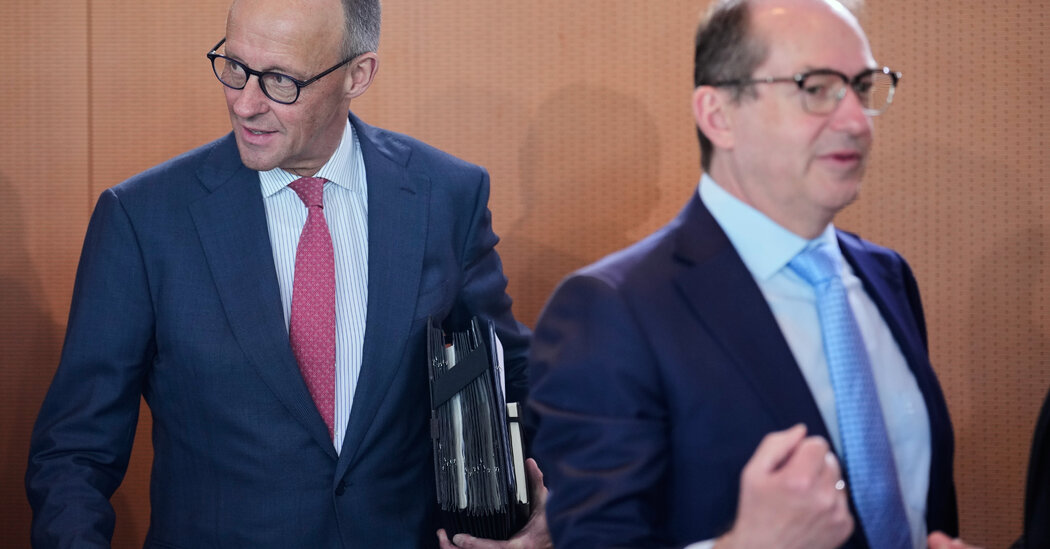
Chancellor Friedrich Merz and Interior Minister Alexander Dobrindt have publicly acknowledged Iranian threats linked to the war against Iran. But they have played down their severity, casting them as largely hypothetical.
Intelligence chiefs, particularly regional officials inside state governments, say that the threats are more concrete and urgent than those leaders let on, according to five senior German officials familiar with the discussions. Those differences have created tensions between national and state officials, four of them said.
The division within the German leadership illustrates how the war has both raised security concerns in Europe and complicated domestic politics. Those headaches are compounded by other war-related challenges, such as higher energy costs, dampened economic growth and inflamed trans-Atlantic tensions.
European leaders were not consulted before the attacks began and appear to have little say in when the war might end, but have nonetheless been drawn into the fray. Germany, in particular, has provided critical support for the U.S. attacks in the Middle East, including allowing the unfettered use of military bases on German soil, which makes the country an enemy in the eyes of Iranian leaders.
Now, Germans and their neighbors fear they could become potential targets for bombings or other “hybrid” attacks that could be carried out by proxy agents recruited by Tehran, according to seven officials who spoke with The New York Times. They were among 11 German intelligence officials, former officials and lawmakers who spoke to The Times on the condition of anonymity to discuss sensitive security matters.
Mr. Merz said in a March 12 speech that government officials had beefed up security measures around Israeli, Jewish and American institutions in Germany to guard against possible attacks. But, he said, “At present, there is no information suggesting that we should assume an increased threat level domestically.”
His government maintained that posture even as intelligence agents and lawmakers overseeing domestic intelligence services privately urged political leaders to express greater alarm, according to four senior officials familiar with the exchanges. Privately, including in conversations with lawmakers, intelligence officials have said that the war has made domestic terrorism inside Germany more likely.
State intelligence officials fear that without clear public communication, Germans might not take the threats sufficiently seriously. National leaders worry that if they talk up the threats, they could become a self-fulfilling prophecy.
The federal intelligence agency declined to comment.
The Interior Ministry did not directly address questions about the tensions between politicians and spy chiefs. But in a statement, a spokesman, Leonard Kaminski, acknowledged that in the course of the war, evidence of Iranian plots in Germany “has increased.”
A spokesman for Mr. Merz, Stefan Kornelius, told The Times this week that there was no daylight among intelligence officials about the severity and handling of the Iranian threat. He declined to talk about other aspects of the issue, saying that the chancellor’s office did not talk publicly about specific threats or targets.
“There is unanimity in detecting and targeting the threats to keep them under control,” Mr. Kornelius said.
Germany has federal intelligence agencies and also separate intelligence services that report to the governments of the 16 states. The frustration about how leaders have discussed the threats is particularly high among state intelligence officials, four senior officials said. State intelligence officials operate closer to the physical threat locations and farther away from Berlin’s political leadership than federal officials — factors that help explain their added frustrations.
Within the intelligence community, state-level chiefs have voiced concern that their federal counterparts have grown too close to Mr. Merz’s office, failing to push back against what they see as an inaccurate framing of the Iranian threat, two of the senior officials said.
Though German officials disagree about how to talk about the Iranian threat, they agree that Iran has stepped up efforts to promote attacks and sabotage in Germany in recent years. Tehran has long been angry with Berlin for supporting Israel and for taking a leading role in European efforts to apply economic and diplomatic pressure on Iran to curb its nuclear program.
Even before the war against Iran began, European intelligence officials had identified about 50 suspected plots by Iran-linked underground groups in Germany alone, according to three senior officials briefed on the matter. Those underground groups remain active today. Some receive financial or other support from Iranian sources, while others are coerced, the officials said.
Officials say that many of Iran’s most prominent targets in Germany are Jewish institutions, two of which are thought to be the subject of current plots by the Iranian leadership.
In Germany, Iran’s intelligence services have increasingly mirrored tactics from their Russian counterparts by making frequent use of proxies as opposed to employing their own agents, according to five current and former senior officials. It is cheaper for Iran to hire proxies and harder to prove the connection between the proxies and their handlers, the officials said. The approach was previously reported by WirtschaftsWoche, a German publication.
In recent years, German intelligence services have also noticed a more pronounced connection between Iranian agents and organized crime, the officials said, including links to biker gangs and human traffickers. At times, the agents have approached European criminals with Iranian roots, whom they find easier to recruit, two of the officials said.
German investigators say they are assessing whether Iranian proxies were responsible for an after-hours attack last month on an Israeli restaurant in Munich’s university district. The assailants smashed windows and tossed explosive devices inside the restaurant. No one was hurt.
The group claiming responsibility for the attack is known as Harakat Ashab al-Yamin al-Islamiyya, or the Islamic Movement of the Companions of the Right. The group says it has carried out more than a dozen similar attacks across Europe over the past two months, including attacks in Belgium, Britain and the Netherlands. It also claimed responsibility for a planned attack on the Bank of America building in Paris, which the authorities foiled before it could be carried out.
German intelligence has discovered evidence that the group has previously operated with financial and other support tied to Tehran, two officials said. Outside analysts have reached similar conclusions.
As well as plotting against Jewish institutions in Germany, intelligence officials say, Tehran is also targeting Iranians living in Germany.
Iranian intelligence officers mingled with the crowd at a large anti-Iranian-government demonstration in mid-February in Munich, attended by roughly 250,000 people, according to two German officials, citing interviews with protesters. The Iranian officers later confronted, threatened and physically attacked certain participants of the protests, revealing themselves as Iranian officers by citing specific information about Iran-based relatives of targeted protesters, the German officials said.
Federal officials said little about those threats to protesters for months. This week, Mr. Kaminski, the Interior Ministry spokesman, said that the government was investigating planned Iranian operations, including those against Germany-based critics of Tehran.