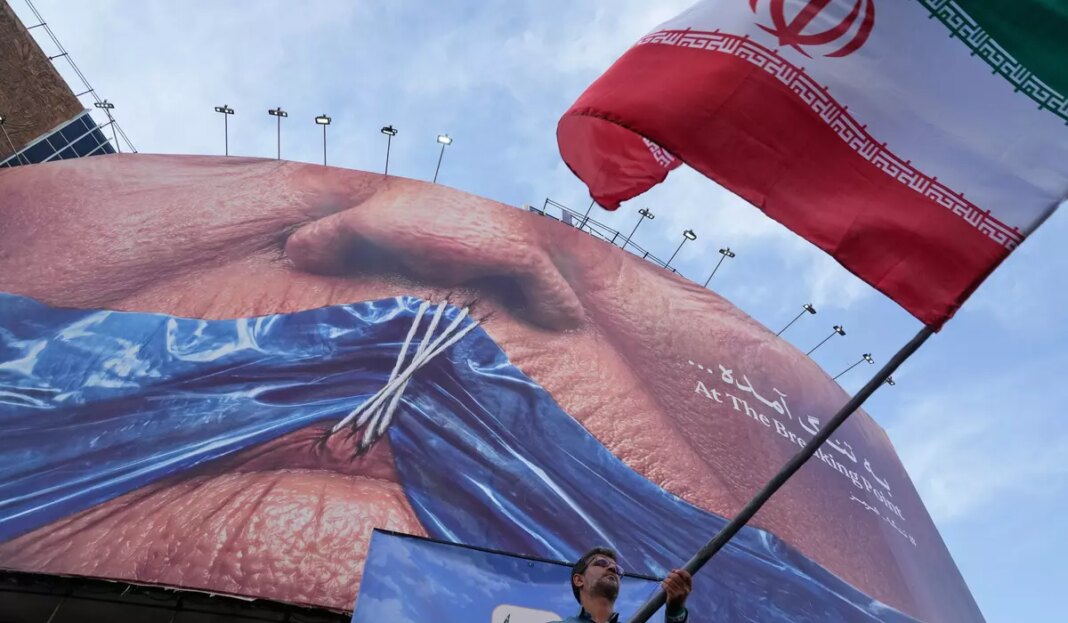

Iranian officials are considering a new proposal from the U.S. that could jump-start peace negotiations as President Trump threatens to resume a devastating bombing campaign if Tehran does not agree.
Iranian Foreign Ministry spokesperson Esmaeil Baghaei said Tehran is reviewing the proposal and would submit an official response to Pakistani mediators.
The terms the Trump administration offered to Iran this week have not been made public, but some Iranians familiar with the proposal have dismissed the one-page memorandum as a list of “American wishes” rather than a serious offer.
The proposed deal reportedly calls for further negotiations over a 30-day period, during which the Strait of Hormuz would remain open.
“It’s very possible that we’ll make a deal,” Mr. Trump said in the Oval Office.
Stock markets worldwide rallied amid hopes that the U.S. and Iran are nearing a deal.
SEE ALSO: Trump warns that time is running out for Iran to make a deal
On Wall Street, the S&P 500 climbed 1.5% for its best day in nearly a month and hit another record high. The Dow Jones Industrial Average jumped 612 points, or 1.2%, and the Nasdaq composite rose 2% to its own record.
Stock markets abroad had even bigger gains. Indexes leaped 6.5% in Seoul, 2.9% in Paris and 2.1% in London.
Tensions in the strait, which Iran has kept effectively closed for two months, continued after a Navy fighter jet disabled an Iran-flagged oil tanker trying to breach the U.S. blockade of Iranian ports. About 20% of the world’s oil flows through the strait.
U.S. Central Command, which oversees military operations in the Middle East, reported that a Navy F/A-18 Super Hornet launched from the USS Abraham Lincoln fired several rounds at the tanker Hasna after the Iranian-flagged vessel failed to heed repeated warnings that it was violating the U.S. blockade.
“Centcom forces continue to act deliberately and professionally to ensure compliance,” CENTCOM said in a statement.
Earlier Wednesday, Mr. Trump threatened to bomb Iran at a “much higher level” unless the regime agreed to the terms of the latest American offer.
SEE ALSO: Navy jet fighter disabled an Iran-flagged oil tanker trying to breach U.S. blockade
“Assuming Iran agrees to give what has been agreed to, which is, perhaps, a big assumption, the already legendary Epic Fury will be at an end, and the highly effective Blockade will allow the Hormuz Strait to be OPEN TO ALL, including Iran,” Mr. Trump said on social media. He was referring to Operation Epic Fury, the joint U.S.-Israeli military campaign against Iran. “If they don’t agree, the bombing starts, and it will be, sadly, at a much higher level and intensity than it was before.”
He made the threat after an abrupt pause of Project Freedom, the U.S. effort to guarantee safe passage through the Strait of Hormuz for commercial ships. Mr. Trump, citing positive diplomatic developments with Iran, announced the pause Tuesday.
Iran reacted furiously to the safe-passage guarantees with a series of attacks on commercial and U.S. naval vessels in regional waters. The United Arab Emirates also reported intercepting more than a dozen Iranian missiles Monday and reported fires at its oil facilities.
The attacks underscore Iran’s continued ability to strike at the Persian Gulf region’s most valuable assets despite enduring weeks of intense U.S. and Israeli bombardments. The attacks also follow the UAE’s departure from OPEC last week.
“The recent attacks on the UAE are particularly important because they were directed at the UAE’s oil facilities in Fujairah, which have been a critical lifeline for the country’s oil industry during the war,” said Caleb Jasso, a senior policy adviser at the Institute for Energy Research. “Although not the first time the area has been subject to attacks, the timing of the most recent ones can’t be ignored, given the UAE’s recent departure from OPEC.”
Before the pause, Secretary of State Marco Rubio and Defense Secretary Pete Hegseth praised the Project Freedom effort as a purely peaceful initiative. They said U.S. forces would not fire unless fired upon. Mr. Rubio added that the shooting phase of the war was over.
Still, CENTCOM said U.S. forces in the region Monday sank at least six small Iranian boats.
The U.S. is maintaining an active blockade of Iranian ports, launched in late April, that is aimed at further pressuring Iran’s economy.
U.S. forces have turned away nearly 50 vessels trying to enter or exit Iranian ports since the start of the blockade. They also have seized several vessels traveling in the Indo-Pacific region that were allegedly carrying Iranian cargo.
The closure of the Strait of Hormuz has driven energy prices higher.
Although Brent crude oil prices dropped from more than $110 a barrel to $101 on Wednesday in response to positive diplomatic developments, prices are still well above prewar levels.
The energy crisis has driven up U.S. gas prices dramatically to an average of $4.50 a gallon, putting severe political pressure on Mr. Trump to end the war.
Still, diplomacy between Iran and the U.S. has remained relatively muted after the launch of the U.S. blockade. It has now been nearly one month since the two parties met face to face in Islamabad. Both delegations cited positive developments but noted that they were far apart on demands.
Since then, U.S. and Iranian officials have been working quietly behind the scenes. Publicly, Washington has demanded that Iran dismantle its nuclear program, dilute its stockpile of enriched uranium and reopen the Strait of Hormuz.
Iran maintains that it has a right to enrich uranium and will continue oversight of the waterway after a peace deal is reached.
Along with Pakistan, China and Russia have offered to provide diplomatic support for a peaceful resolution to the war.
Abbas Araghchi, Iran’s foreign minister, who participated in talks with the U.S. last month, met with his Chinese counterpart, Wang Yi, on Wednesday to discuss the status of the negotiations. Mr. Wang stressed China’s continued support of Iran but said the Strait of Hormuz must be opened quickly. China is the leading consumer of Iranian crude oil.
“We believe that a comprehensive ceasefire is urgently needed, that a resumption of hostilities is not acceptable, and that it is particularly important to remain committed to dialogue and negotiations,” Mr. Wang said, according to a statement from the Chinese Foreign Ministry.
• This article is based in part on wire service reports.