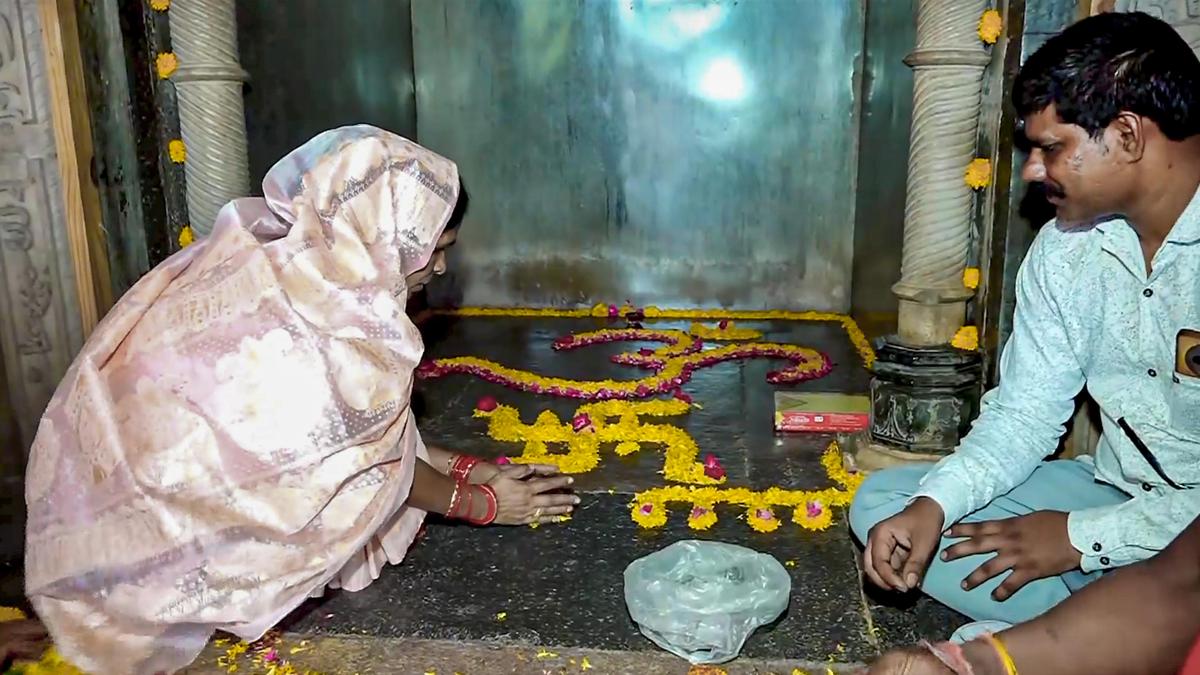
A woman decorates a floor as people gather to offer prayers inside the Bhojshala complex following the Madhya Pradesh High Court verdict declaring the site a Hindu temple dedicated to Goddess Vagdevi (Saraswati) in Dhar.
| Photo Credit: PTI
Hindu groups performed worship at the Bhojshala complex in Madhya Pradesh’s Dhar on Saturday (May 16, 2026) with several Hindu devotees thronging the historical site, a day after the High Court declared it a Hindu temple dedicated to Goddess Saraswati and a Sanskrit learning centre.
Members of the Hindu Front for Justice, which represented the Hindu side in the High Court, Bhoj Utsav Samiti, as well as several locals, performed Aarti at the Bhojshala complex even as the situation remained peaceful in Dhar town and nearby areas amid heavy security arrangements.

Meanwhile, the Archaeological Survey of India (ASI) acknowledged the High Court’s verdict and issued directions for its implementation.
In a May 16 order, the ASI said the Hindu community “shall have unrestricted access to the Bhojshala Complex in connection with the ancient practice of learning and worship of Goddess Saraswati”.
The order also said the time of entry for visitors and devotees, and permissible activities related to learning and worship would be determined by the superintending archaeologist of the ASI, Bhopal, in consultation with the Dhar district administration, while ensuring the conservation and protection of the monument under the provisions of the Ancient Monuments and Archaeological Sites and Remains (AMASR) Act, 1958.

“The Bhojshala Complex shall continue to be a protected monument under the AMASR Act, 1958. This order shall be in supersession of all previous orders issued in this regard,” said the order issued by A.M.V. Subramanyam, Director, Monument 1, ASI.
While Hindu groups and leaders have termed the High Court’s verdict “historic and the result of a 700-year struggle”, Muslim representatives termed it “one-sided” and said they would challenge it in the Supreme Court.
‘Will move Supreme Court’
Abdul Samad, president of the Maulana Kamaluddin Welfare Society, which represented the Muslim side in the court, said, “The court’s decision is completely one-sided. We will approach the Supreme Court regarding this matter. In fact, the Hindu side has already reached the Supreme Court [with a caveat] before us, which itself clearly shows that they also had doubts about the judgment and about the intent of the High Court.”
Mr. Samad also raised questions about Hindu community members performing worship at the site and said the High Court had asked the government to make arrangements for the same.
“Nowhere in that order, not even remotely, is it written [in the verdict] that the ASI or the Hindu side is permitted to conduct daily worship at the site. The ASI is acting in direct contravention of the established rules. It is also not stated that the offering of namaz should be discontinued and start daily worship,” he told reporters.
A caveat has been filed in the Supreme Court by a petitioner from the Hindu side, urging that no order be passed on any appeal against the High Court’s verdict without hearing its side.
Deputy Inspector General (DIG) of Police, Indore (Rural), Manoj Kumar Singh, said the deployment of more than 1,200 personnel would stay in place for the next few days and that the administration and the police would assess the ground situation.
“There has been no incident or confrontation between the two sides so far. We have held discussions with representatives of both sides and are keeping a strict vigil,” he said.
In a long-awaited verdict on May 15, a Division Bench of the Madhya Pradesh High Court in Indore declared the long-disputed site of the Bhojshala complex and Kamal Maula Mosque as a Bhojshala with a temple of Goddess Vagdevi (Saraswati) and a centre of Sanskrit learning associated with Raja Bhoj of the Parmar Dynasty.
While dismissing the claims of the Muslim side, the court also quashed a 2003 order of the ASI that allowed the Muslim community to offer Friday prayers at the site, while restricting the right of Hindus to worship within the Bhojshala complex on Tuesdays and Basant Panchami.
Published – May 16, 2026 09:54 pm IST