
The European Central Bank “will do what is necessary” to keep inflation on target, one of its top policymakers has told CNBC.
Speaking to CNBC’s Lisa Kim in Singapore on Tuesday, Bank of France Governor Francois Villeroy de Galhau sought to reassure sovereign debt markets that central bankers in Europe were committed to minimizing the impact of the Iran war.
Spiking oil prices, a result of the effective closure of the Strait of Hormuz, have fueled concerns that an energy crisis could lead to a resurgence of inflation in various markets.
Villeroy de Galhau, who is a member of the ECB’s Governing Council, added that European policymakers “will do what is necessary as an independent central bank to bring inflation back to target.”
“If I speak on behalf of the ECB, this means do what is necessary to bring inflation back to 2% in the medium term. Markets can be assured of that,” he told CNBC.
Eurozone inflation had dipped below the ECB’s target to 1.9% before the war in the Middle East began with joint U.S. and Israeli strikes on Iran on Feb. 28. Inflation in the eurozone jumped to 3% in April, up from 2.6% in March.
Europe is particularly vulnerable to energy shocks as a major net energy importer. Prices of gasoline, diesel and jet fuel have surged in recent months, prompting government intervention in some countries and warnings of flight cancellations over the summer.
Villeroy de Galhau told CNBC that there was a fear of inflation permeating financial markets, which was particularly visible in government bonds.
“The effect of the Middle East conflict is clear,” Villeroy de Galhau told CNBC. “In the short run, there are significant upward pressure first round effects due to energy prices, but it’s our responsibility, I would even say our commitment to prevent second round effects.”
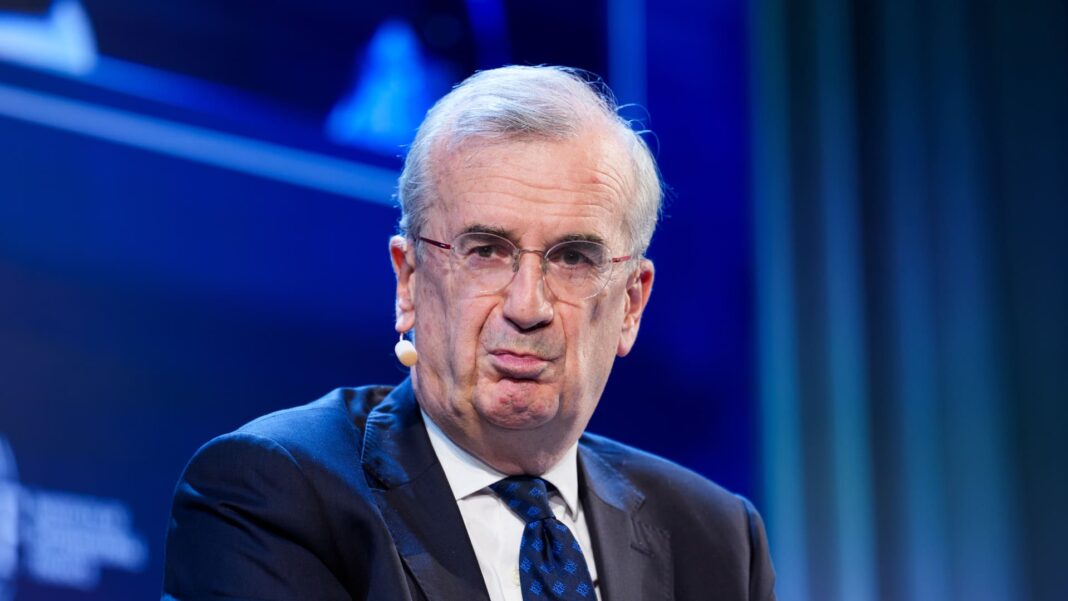
Francois Villeroy de Galhau, governor of the Bank of France, during the 2025 IIF annual membership meeting in Washington, D.C.
Aaron Schwartz | Bloomberg | Getty Images
Global government bonds have been volatile since the war began. Germany’s 10-year bund, a benchmark for the euro zone, has surged by around 32 basis points, while other eurozone bonds have seen even bigger swings.
Bond yields and prices move in opposite directions. The rise in yields has come as investors price in higher inflation and more hawkish monetary policy.
Villeroy de Galhau said that the ECB held its key interest rate steady at 2% last month because officials lacked sufficient data on the risk of so-called second-round inflation effects.
These include figures on underlying inflation without energy and food, inflation expectations from both households and businesses, and wage growth.
“The data so far are telling that it’s mainly a first-round effect, but we should be extremely vigilant about possible second-round effect,” he said. “So, again, have no doubt we will act as much as necessary.”
Markets are overwhelmingly pricing in a rate hike at the ECB’s June meeting, according to LSEG data, with most traders anticipating a rise of at least 50 basis points by the end of the year.

At the end of March, ECB President Christine Lagarde said the central bank was ready to hike interest rates, even if an expected rise in inflation proved temporary.
“If the shock gives rise to a large, though not-too-persistent, overshoot of our [inflation] target, some measured adjustment of policy could be warranted,” Lagarde told an audience at “The ECB and Its Watchers” conference in Frankfurt, Germany.
“To leave such an overshoot entirely unaddressed could pose a communication risk: the public may find it difficult to understand a reaction function that does not react.”
Speaking to CNBC at the IMF’s Spring Meeting in Washington, DC, last month, Joachim Nagel, president of Germany’s Bundesbank, said oil price volatility had left the ECB “between our baseline and our adverse scenario.”
Martins Kazaks, the governor of Latvia’s central bank who sits on the ECB’s Governing Council, warned of a potential “layer cake” of economic shocks.