Preliminary Examination: Current events of national and international importance.
Main Examination: General Studies IV: Corporate Governance.
What’s the ongoing story: When Atanu Chakraborty abruptly resigned on March 18 as chairman of HDFC Bank, the country’s largest private bank, citing “certain happenings and practices within the bank” that were not in “congruence” with his personal values and ethics, it didn’t ring many alarm bells across the banking establishment.
Key Points to Ponder:
• Who is Atanu Chakraborty?
• What is corporate ethics?
• What are the five codes of ethics?
• There are generally certain business or Corporate ethics principles-What are they?
• Why is corporate ethics Important?
• Corporate governance and corporate ethics-Connect the dot
• Is corporate governance the same as corporate ethics?
• What is the role of corporate governance in maintaining financial-system stability?
• Know the significance of internal control and vigilance systems in banking institutions.
• What are the challenges associated with ensuring ethical governance in banking institutions?
Key Takeaways:
Story continues below this ad
• The bank’s newly appointed interim chairman, Keki Mistry, was quick to step in with a statement. “The bank has very strong ethics,” he said on March 19. “I would never remain on the board if there were any issues with governance.” He said board members had pressed Chakraborty for details the previous day but he “did not give any specific explanation.”
• The Reserve Bank of India, too, moved just as swiftly. In a press statement the same day, it declared, “Basis our periodical assessment, there are no material concerns on record as regards its conduct or governance.”
• What went undisclosed was that, just six days earlier, on March 12, the Audit Committee of the Board (ACB), under the chairmanship of M D Ranganath, had ordered a formal “Internal Vigilance Investigation” into payments totalling Rs 45 crore made to the Maharashtra State Road Development Corporation (MSRDC), a state government agency, during FY2024 and FY2025.
• This order came after an internal audit of the bank’s marketing department, covering the period 2024-25, which had flagged these payments and rated the department’s performance as “unsatisfactory.”
Story continues below this ad
• These payments, The Indian Express investigation, based on internal records, has revealed, were meant for MSRDC as “differential interest” i.e., interest over and above the specified rate, on its deposits. But instead of being credited directly to MSRDC’s account as interest earned, they were routed through the bank’s marketing department, disguised as contributions to a road safety awareness campaign through four local vendors.
• Significantly, records reveal that this payout was approved in the presence of HDFC Bank MD & CEO Sashidhar Jagdishan during senior-level discussions where a higher rate for MSRDC was “verbally” agreed upon. Many officials have testified in the internal probe that Jagdishan “participated in the call convened to examine how the bank could compensate MSRDC and was part of the decision to provide the differential interest through the marketing budget as a one-off arrangement.”
• HDFC Bank Chief Marketing Officer Ravi Santhanam acknowledged in his testimony during the Vigilance probe that the marketing department acted as a “facilitator to camouflage differential interest reimbursement as marketing spend”.
• Significantly, the Vigilance probe report was sent to two top committees: Audit Committee of the Board (ACB) on April 10, and the Nomination and Remuneration Committee of the board a week later.
Do You Know:
Story continues below this ad
• A code of ethics is a set of guiding principles and values designed to help professionals conduct business with honesty and integrity. It provides a moral framework for decision-making rather than dictating specific rules, ensuring actions align with socially acceptable norms.
Other Important Articles Covering the same topic:
📍Why this raises questions on bank’s governance and its code of ethics
Previous year UPSC main Question Covering similar theme:
📍In the light of the Satyam Scandal (2009), discuss the changes brought in corporate governance to ensure transparency and accountability. (UPSC CSE, 2015)
Energy to rare earth to Fiji port: Quad bid to counter China rise in Indo-Pacific
Story continues below this ad
Mains Examination: General Studies II: Bilateral, regional and global groupings and agreements involving India and/or affecting India’s interests
What’s the ongoing story: Unveiling regional initiatives for energy security and critical minerals, Foreign Ministers of the Quad nations Tuesday agreed to launch an Indo-Pacific Maritime Surveillance Corporation, expand maritime domain awareness and enhance port infrastructure in Fiji.
Key Points to Ponder:
• What is the QUAD?
• What are its objectives?
• What is Indo-Pacific Maritime Surveillance Corporation?
• India and the US signed a bilateral “critical minerals framework”-What are key outcomes?
• What is the significance of Maritime Domain Awareness in ensuring regional security?
Story continues below this ad
• What is the role of critical minerals in the emerging global strategic landscape?
• Know the strategic significance of the recent Quad initiatives in the Indo-Pacific.
• What are critical minerals?
• Why critical minerals are significant for India’s economic and strategic security?
Key Takeaways:
• These moves by the Quad, comprising the US, India, Japan and Australia, come at a time when China’s ambitions in the Indo-Pacific are on the rise, and ongoing conflicts, most recently in West Asia, are disrupting supply chains and hurting economies.
Story continues below this ad
• In a clear message to Beijing, the Quad voiced serious concern about the situation in the East China Sea and the South China Sea and opposed “any destabilizing or unilateral actions” that would threaten “peace and stability” in the region.
• Meeting at the Hyderabad House in New Delhi, the Quad Foreign Ministers – External Affairs Minister S Jaishankar, US Secretary of State Marco Rubio, Japan’s Foreign Minister Toshimitsu Motegi and Australia’s Foreign Minister Penny Wong – issued a joint statement which said, “We look forward to the convening of the Quad Leaders’ Summit, the next Quad Foreign Ministers’ Meeting, and continuing our engagements that advance peace, stability, and prosperity in the Indo-Pacific and beyond.”
Do You Know:
• New Delhi is to host the next summit of the Quad leaders but there’s no word yet on when it will take place later this year, or if another country will play host – there has been a cloud of uncertainty ever since the slide in ties in 2025 between India and the US, and the US-China engagement which took President Donald Trump to Beijing earlier this month.
• On the Indo-Pacific Maritime Surveillance Corporation initiative, Rubio said it is going to “leverage each of our country’s maritime surveillance capabilities in the Indo-Pacific to enhance information sharing”.
Story continues below this ad
• Cooperation on critical minerals also figured prominently during Prime Minister Narendra Modi’s official visit to the United States in February 2025. Under the India-US TRUST (“Transforming the Relationship Utilising Strategic Technology”) initiative, both countries agreed to strengthen trusted and resilient supply chains in sectors such as semiconductors, critical minerals, advanced materials, and pharmaceuticals.
• Both countries also committed to intensifying efforts to deepen cooperation in the exploration, beneficiation, and processing, as well as recycling technologies of critical minerals.
Other Important Articles Covering the same topic:
📍Amid China concerns, India & US ink pact to secure critical minerals supply
📍Will critical minerals treaty with US bring investments?
Previous year UPSC Prelims Question Covering similar theme:
1) Consider the following minerals: (UPSC CSE, 2020)
1. Bentonite
2. Chromite
3. Kyanite
4. Sillimanite
In India, which of the above is/are officially designated as major minerals?
(a) 1 and 2 only
(b) 4 only
(c) 1 and 3 only
(d) 2, 3 and 4 only
2) Recently, there has been a concern over the short supply of a group of elements called ‘rare earth metals’. Why? (UPSC CSE, 2012)
1. China, which is the largest producer of these elements, has imposed some restrictions on their export.
2. Other than China, Australia, Canada and Chile, these elements are not found in any country.
3. Rare earth metals are essential for the manufacture of various kinds of electronic items and there is a growing demand for these elements.
Which of the statements given above is/are correct?
(a) 1 only
(b) 2 and 3 only
(c) 1 and 3 only
(d) 1, 2 and 3
Politics
Panel set up to study demographic changes — causes & consequences
Preliminary Examination: Current events of national and international importance.
Mains Examination: General Studies I: population and associated issues
What’s the ongoing story: The government on Tuesday constituted a “High-Level Committee on Demographic Changes” (HLCDC) under the Ministry of Home Affairs “to undertake scientific study of the nature, causes and consequences of unnatural demographic changes occurring across the country and to recommend appropriate policy, administrative and legal measures”.
Key Points to Ponder:
• Why is a high-level committee on demographic changes (HLCDC) under the Ministry of Home Affairs set up?
• What is the problem of infiltration?
• What is infiltration?
• What is the main difference between infiltration and migration?
• How infiltration induces demographic changes?
• What are the major challenges in managing the India–Bangladesh border?
• What is the significance of border management in maintaining internal security?
• What are the challenges associated with illegal migration in border states?
Key Takeaways:
• The committee will be chaired by retired Supreme Court judge Justice Prakash Prabhakar Naolekar and will include the Census Commissioner, former UP Chief Secretary Durga Shanker Mishra, former BPR&D chief Balaji Srivastava, and economist Dr Shamika Ravi as members. The Joint Secretary (Foreigners-I), MHA, will serve as the Member Secretary.
• The notification said the panel may also consult local governments, security agencies, social organisations and academic institutions, and nominate other experts or agencies if required.
• In a statement announcing the constitution of the committee, Union Home Minister Amit Shah said: “Infiltration and other reasons causing unnatural demographic change pose a very significant challenge to the present and future of any nation.”
• Shah said Prime Minister Narendra Modi had first announced the proposed committee in his Independence Day address on August 15, 2025. “Demographic change is a serious issue linked not only to our sovereignty but also to national security, law and order, profound changes in social structure, and the preservation of tribal society,” he said, adding that the committee would conduct a “comprehensive assessment” of demographic changes occurring due to “illegal immigration and other unnatural causes”.
Do You Know:
• Recently, West Bengal Chief Minister Suvendu Adhikari announced a new “detect, delete and deport”’ framework against “infiltrators” in the state. The state government also announced to hand over a 27-km stretch of land to the Border Security Force (BSF) within two weeks, for long-pending fencing work and construction of border outposts along the India-Bangladesh International Border.
• Under the new mechanism — as part of what the CM described as a broader “detect, delete and deport”’ framework — the “infiltrators” detained by the state police would be handed over directly to the BSF for deportation.
• India shares a 4,096-km border with Bangladesh, of which a 2,216-km stretch falls in West Bengal. Of the total border stretch, around 1,653-km stretch has been fenced, leaving approximately 563 km unfenced border, largely along the state, as per a reply to a question in the Rajya Sabha in August 2025.
Other Important Articles Covering the same topic:
📍Bengal win shows demographic anxieties cannot be ignored
Previous year UPSC Prelims Question Covering similar theme:
3) Consider the following statements: (UPSC CSE, 2024)
1. Recently, all the countries of the United Nations have adopted the first-ever compact for international migration, the ‘Global Compact for Safe, Orderly and Regular Migration (GCM)’.
2. The objectives and commitments stated in the GCM are binding on the UN member countries.
3. The GCM addresses internal migration or internally displaced people also in its objectives and commitments.
How many of the above statements are
(a) Only one
(b) Only two
(c) All three
(d) None
Previous year UPSC main Question Covering similar theme:
📍How does illegal transborder migration pose a threat to India’s security? Discuss the strategies to curb this, bringing out the factors which give impetus to such migration. (UPSC CSE, 2014)
Nation
Vedanta’s Odisha mine project gets expert panel nod for green clearance
Preliminary Examination: Economic and Social Development
Mains Examination: General Studies III: Conservation, environmental pollution and degradation, environmental impact assessment.
What’s the ongoing story: VEDANTA LIMITED’S bauxite mine project, proposed on a hilltop straddling Kalahandi and Rayagada districts in Odisha, has received environmental clearance from an expert panel of the Union Environment Ministry. The project, proposed to mine high-grade bauxite reserves of 311 million tonnes, will be spread over 1,549 hectares and requires diversion of 709.72 hectares of forest land.
Key Points to Ponder:
• What is bauxite?
• Why bauxite reserves are strategically important?
• Bauxite mining in Odisha-know in detail
• Bauxite mining in Odisha-What is the issue?
• What is Bauxite?
• Map Work-Sijimali, Niyamgiri Hill Range, Kalahandi and Rayagada
• Why tribals are opposing bauxite mining?
• What you know about Dongria Kondh Tribe?
• What are the key features of the Forest Rights Act (FRA), 2006?
• Why mining projects frequently generate governance debates?
• What is the process of environmental clearance for mining projects in India?
Key Takeaways:
• Vedanta has proposed to mine bauxite from the mine block for its alumina smelter plant in Lanjigarh, Kalahandi district. The mine is proposed in Thuamul Rampur and Kashipur tehsils, covering 18 villages across both districts.
• The Union Environment Ministry’s expert appraisal committee (EAC) on non-coal mining recommended the project for grant of environmental clearance in their May 15 meeting, according to minutes of the EAC meeting.
• The recommendation of environmental clearance is incumbent on the specific condition that “no mining activities shall be carried out in 709.72 hectares without obtaining stage-II forest clearance”.
Do You Know:
• Sijimali is part of the Eastern Ghats hill ranges and is interspersed with valleys. The bauxite reserve, spread over 1,500 hectares, covers Rayagada and Kalahandi districts. With an estimated reserve of 311 million tonnes of high-grade bauxite, Sijimali is located close to Vedanta’s alumina refinery at Lanjigarh in Kalahandi district.
• Alumina is refined from bauxite ore and used to produce aluminium, which is instrumental in making everything from soda cans to aircraft. Aluminium’s strength, lightness and conductivity allow for a multiplicity of uses. It is also the most abundant metal in the Earth’s crust, and the third most common element, after oxygen and silicon.
• According to the Indian Bureau of Mines’ 2022 Yearbook, Odisha alone accounts for 41% of India’s bauxite resources, and was the leading producer in 2021-22, comprising about 73% of the total production. Beyond bauxite, Odisha has some of the richest mineral deposits in the country, including high-grade iron ore, coal, nickel, gemstones and graphite, together accounting for nearly 17% of India’s total mineral reserves.
• Vedanta had earlier faced rejection in its bid to mine bauxite from the nearby eco-sensitive Niyamgiri hill, inhabited by the Dongria Kondhs, a Particularly Vulnerable Tribal Group which worships Niyam Raja as the God of the Niyamgiri forest.
• Vedanta and the state-owned Odisha Mining Corporation had formed a joint venture to mine the bauxite reserve for the Lanjigarh alumina refinery. The project ran into rough weather after the Centre refused Stage-II forest clearance in 2010 for diverting 660 hectares of forest land. In 2013, the Supreme Court ruled that the mining project required clearance from the Gram Sabhas. Later that year, all 12 Gram Sabhas rejected the plan.
Other Important Articles Covering the same topic:
📍Knowledge Nugget: Bauxite in Focus— Distribution, uses, and tribal opposition in Odisha
Previous year UPSC Prelims Question Covering similar theme:
4) Which of the following minerals are found in a natural way in the State of Chhattisgarh? (UPSC CSE, 2008)
1. Bauxite
2. Dolomite
3. Iron ore
4. Tin
Select the correct answer using the code given below:
Code:
(a) 1, 2 and 3 only
(b) 1 and 3 only
(c) 2 and 4 only
(d) 1, 2, 3 and 4
5) Consider the following minerals: (UPSC CSE, 2020)
1. Bentonite
2. Chromite
3. Kyanite
4. Sillimanite
In India, which of the above is/are officially designated as major minerals?
(a) 1 and 2 only
(b) 4 only
(c) 1 and 3 only
(d) 2, 3 and 4 only
Explained
In warming India, local data monitoring is key
Preliminary Examination: General issues on Environmental ecology, Bio-diversity and Climate Change – that do not require subject specialization.
Mains Examination: General Studies III: Conservation, environmental pollution and degradation, environmental impact assessment.
What’s the ongoing story: India Heatwave 2026: As sweltering temperatures are recorded across northwest and central India, the India Meteorological Department (IMD) warned of prolonged to severe heatwave conditions this week.
Key Points to Ponder:
• What is a heat wave?
• Indian Meteorological Department (IMD) criteria for Heat Waves?
• What is the present situation of Heat Waves in India?
• Why is India facing a prolonged heat wave?
• What is the Impact of these Heat Waves?
• What do heat maps indicate about India’s summer?
• How are heat and temperature maps generated, and how should they be read?
Key Takeaways:
• The deep reds and oranges seen in temperature maps over the Indian subcontinent represent regions experiencing elevated land surface or near-surface air temperatures, depending on the dataset used. In climate science and geospatial analysis, such colour gradients are commonly used in satellite observations, weather station data and numerical weather models’ outputs to indicate the intensity and spread of heat visually.
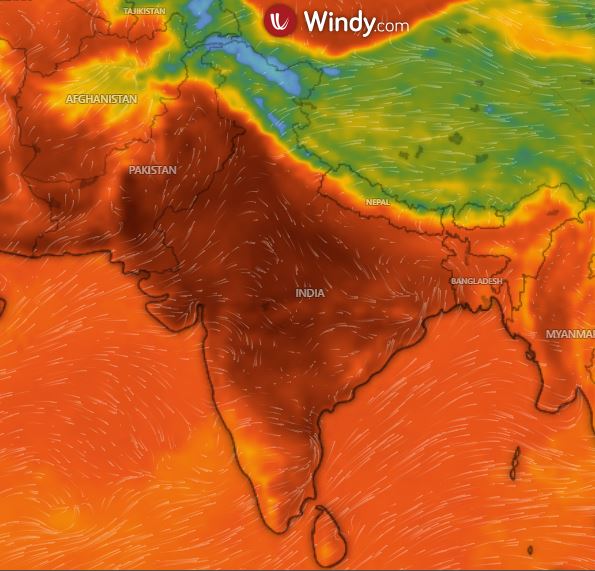 Temperatures in and around India on the afternoon of May 19, 2026. Shades of yellow show temperature between 20 to 30 degrees Celsius, orange between 30 and 40 degrees, and deep reds beyond 40 degrees. (Windy.com screengrab)
• However, what is concerning this year is the intensity, persistence and large spatial extent of the heat. Temperatures are remaining abnormally high over prolonged periods with limited nighttime cooling, indicating severe heat wave conditions. Reduced pre-monsoon rainfall, persistent dry air circulation, extensive land surface warming and Urban Heat Island effects (the latter a result of unplanned urbanisation and construction) are further amplifying the situation.
• Climate change is also acting as a background stress multiplier. While heat waves are not new to India, rising baseline temperatures are increasing their frequency, duration and severity, making extreme summer conditions more common across the region.
Do You Know:
• A heatwave is basically a period of unusually high temperatures over a place. Thus, the threshold to declare a
heatwave depends on the temperatures normally seen in that area in that time of the year.
• According to the IMD, a heatwave is declared when the “maximum temperature of a station reaches at least 40 degree C or more for plains and at least 30 degree C or more for hilly regions.”
• Based on departure from the normal temperature, a heatwave is when the departure is 4.5 degree C to 6.4 degree C, and a severe heatwave is declared when the departure is more than 6.4 degree C.
• Based on actual maximum temperature, the IMD says, a heatwave exists when the maximum temperature is greater than 45 degree C, and a severe heatwave when the temperature is over 47 degree C.
• IMD has a big network of surface observatories covering the entire country to measure various metrological parameters like Temperature, Relative humidity, pressure, wind speed & direction etc. Based on daily maximum temperature station data, climatology of maximum temperature is prepared for the period 1991-2020 to find out normal maximum temperature of the day for a particular station. Thereafter, IMD declares heat waves over the region as per its definition,” the weather body says.
Other Important Articles Covering the same topic:
📍Mercury soaring in parts of country: How a ‘heatwave’ is defined and measured, what makes it worse
Previous year UPSC Prelims Question Covering similar theme:
6) What are the possible limitations of India in mitigating global warming at present and in the immediate future? (UPSC CSE, 2010)
1. Appropriate alternate technologies are not sufficiently available.
2. India cannot invest huge funds in research and development.
3. Many developed countries have already set up their polluting industries in India.
Which of the statements given above is/are correct?
(a) 1 and 2 only
(b) 2 only
(c) 1 and 3 only
(d) 1, 2 and 3
|
PRELIMS ANSWER KEY |
|
1.(d) 2.(c) 3.(d) 4.(d) 5.(d) 6.(a) |
For any queries and feedback, contact priya.shukla@indianexpress.com
Subscribe to our UPSC newsletter. Stay updated with the latest UPSC articles by joining our Telegram channel – IndianExpress UPSC Hub, and follow us on Instagram and X.