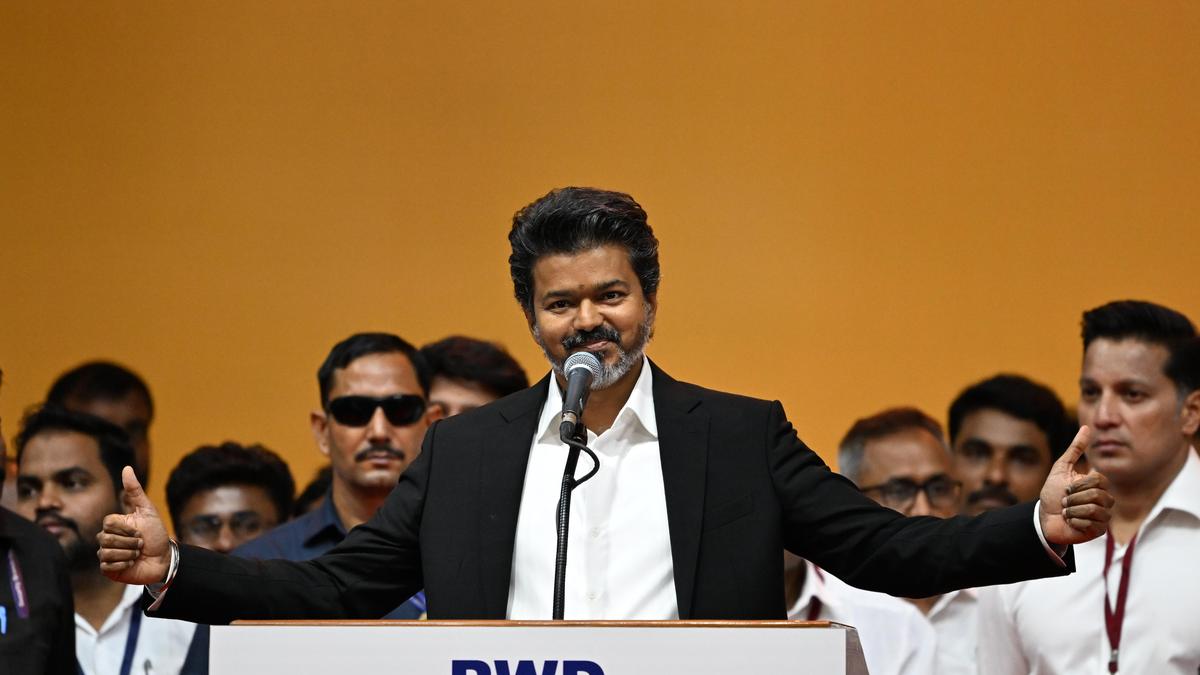
Tamilaga Vettri Kazhagam (TVK) leader and Tamil Nadu Chief Minister C. Joseph Vijay addresses after his swearing-in ceremony at the Jawaharlal Nehru Indoor Stadium in Chennai.
| Photo Credit: B. Jothi Ramalingam
It appears that the Tamilaga Vetri Kazhagam (TVK), led by actor-turned-politician C. Joseph Vijay, has triggered a political upheaval in Tamil Nadu following the 2026 Assembly elections. In many ways, Mr. Vijay has demonstrated that a Chief Ministerial candidate need not necessarily hail from a numerically dominant community, backed by entrenched political networks to capture power in Tamil Nadu. Equally significant is the fact that he has become the first Christian Chief Minister to head a coalition government in the State’s history.
The ascent of the TVK to power in Tamil Nadu has posed a formidable challenge to the two principal Dravidian parties, the Dravida Munnetra Kazhagam (DMK) and the All India Anna Dravida Munnetra Kazhagam (AIADMK), which have alternated in power in the State for more than half a century. Tamil Nadu politics appears to have evolved into a contest between the charisma and mass appeal of Mr. Vijay — carefully cultivated through cinema and popular culture — and the leaders of the two Dravidian majors, who continue to invoke and defend the Dravidian legacy whenever they perceive a political threat.
Also Read: Vijay’s Tamilaga Vettri Kazhagam: a new political dawn in Tamil Nadu
Breaking from tradition
Mr. Vijay heads a remarkably young government. Barring senior figures such as K. A. Sengottaiyan and N. Anand, most Ministers and MLAs are relatively young and possess little to no independent political capital. Moreover, the traditional white dhoti emblazoned with party colours on its border no longer defines the political culture of the TVK. The Chief Minister is often seen in sharply tailored formal suits, while many of his MLAs appear in white shirts and black trousers, projecting the image of a new political generation eager to break from convention. In several constituencies, voters scarcely know the names of their MLAs; instead, it was the ‘whistle’ symbol of the party, the charisma of Mr. Vijay, and the electorate’s yearning for political change that shaped the electoral verdict.
The composition of the Cabinet also marks a striking departure from previous regimes. It includes eight Ministers from the Scheduled Caste (SC) community, among them Vanni Arasu of the Viduthalai Chiruthaigal Katchi (VCK) and P. Viswanathan from the Congress. The Ministry also features four women entrusted with major portfolios. Traditionally, departments such as Industries, Animal Husbandry and Dairy Development were regarded as male bastions. Under the TVK government, however, these influential portfolios are being handled by women Ministers, signalling a conscious attempt to redefine the contours of political representation in Tamil Nadu.
The manner in which Mr. Vijay, despite securing only 108 seats, managed to garner support for his government also bears the imprint of a shrewd political strategist. After the Congress volunteered its support, he reached out to the leaders of the two Communist parties, the VCK and the Indian Union Muslim League. He personally engaged with their leadership, offered Cabinet berths, and won over a section of AIADMK legislators, who voted in favour of his government during the trust vote in the Assembly.
Also Read: Tamilaga Vettri Kazhagam | The star who stormed into politics
All’s fair in politics
Meanwhile, the TVK appears to be steadily moving towards securing a legislative majority of its own. Mr. Vijay and his lieutenants seem to have embraced the principle that, in politics, expediency often matters more than ideology or principles. Capitalising on the growing dissent within the AIADMK, the TVK has successfully drawn dissident legislators into its fold. So far, four AIADMK MLAs have resigned their Assembly seats and joined the TVK. The apparent strategy is either to field them as TVK candidates in the ensuing by-elections or to replace them with TVK nominees.
The question of disqualifying the AIADMK MLAs who violated the party whip is now pending before the Speaker. Should the Speaker move ahead with disqualification proceedings, several vacancies could arise in the Assembly. The TVK appears confident that it can win enough seats in the subsequent by-elections to secure a clear majority, thereby freeing itself from dependence on outside support.
Though a political novice, Mr. Vijay seems to have quickly learnt that power often rewards those willing to pursue victory through strategic calculation and relentless manoeuvring.
kolappan.b@thehindu.co.in
Published – May 27, 2026 12:32 am IST