


More than 1,000 years before Homer wrote of Odysseus’s voyage home across the Aegean, seafaring traders from modern-day Lebanon were ranging even farther, selling their prized cedar wood from the slopes of Mount Lebanon throughout the eastern Mediterranean.
These traders, who would later be known as Phoenicians, came from Byblos, one of the oldest continuously occupied cities in the world. For a time, beginning in 3000 B.C., it was the Mediterranean’s most important timber-shipping center.
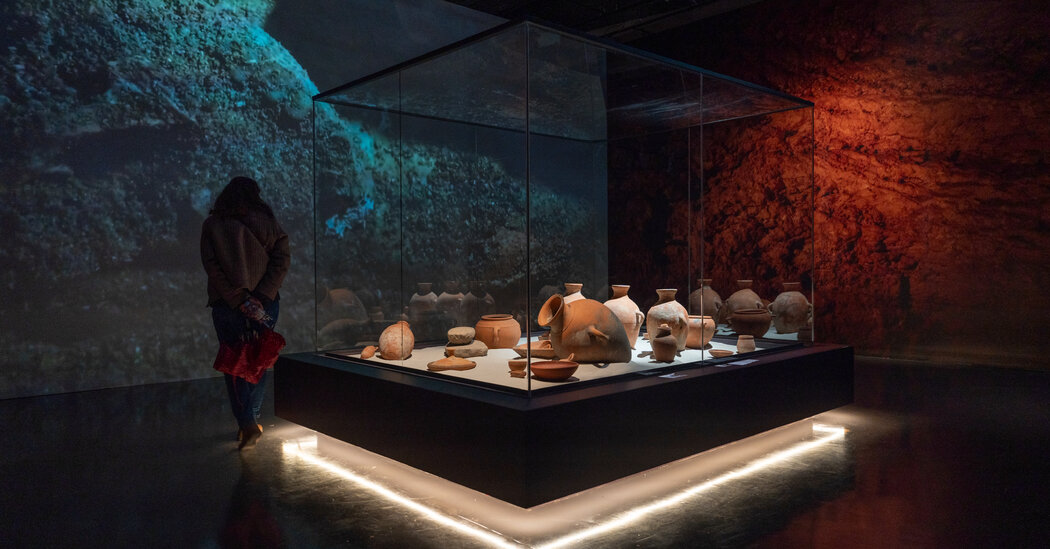
This summer, a vast array of artifacts from Byblos have been on display at the Arab World Institute in Paris in cooperation with Lebanon’s Ministry of Culture, which oversees the country’s antiquities and heritage sites. But like Odysseus, the show had an arduous journey that highlights how modern-day conflict in the Middle East is imperiling not just human life but also the art, architecture and cultural heritage of the region.
At the show’s opening, Anne-Claire Legendre, the president of the institute, said the exhibition was a reminder of “our duty” to preserve the history and heritage of the Middle East from “all forms of erasure.”
The show was conceived of as a way to show off recent important finds in Byblos by Lebanese and French archaeologists and to persuade potential tourists that Lebanon was, as Marie-Antoinette Gemayel, a curator at the National Museum of Beirut, put it, “more than a place of war — we have a history, a civilization.”
But by fall of 2024, when the artifacts were scheduled to fly to Paris, open conflict had erupted in Lebanon between Israel and Hezbollah, the Iran-supported militants, who opposed Israel’s war in Gaza. The ministry decided to postpone the show for fear the convoy ferrying the pieces to the airport could become a target.
But the curators also worried about damage to the site. In just the first few days of the 2024 war, Israeli bombing damaged a half dozen of Lebanon’s heritage sites, sometimes flattening them, according to Lebanon’s Ministry of Culture.
Israel says Hezbollah uses archaeological sites and historic buildings either as hiding places or as cover for tunnels that the group has built to hide arms and operatives. Hezbollah’s media office denied those assertions.
A new date for the show was set for this spring, but in February, Israel and the United States began their war against Iran. Hezbollah then fired on Israel in solidarity with Tehran. In turn, Israel unleashed another bombing campaign on Lebanon and sent troops to southern Lebanon.
The culture ministry was reluctant to delay the show a second time. But curators decided to keep back a half dozen of the most valuable objects, including an obelisk, that if damaged could never be replaced.
The Lebanese Army and a private security firm accompanied the objects on the short but perilous journey to the airport.
The exhibition’s curators say it spotlights Lebanon’s story as a crossroads of culture enriched and changed by the many peoples who have lived there and who have found a way to exist together despite their different faiths and ethnicities.
“Because Byblos was continuously inhabited, all the civilizations that have succeeded one another have left their mark there,” said Agnès Carayon, an institute curator.
She noted that Byblos had seen Persians, Greeks and Romans come and go and then a succession of Umayyad and Abbasid Muslim caliphs, as well as Mamluks, Ottomans and colonies of Christian crusaders.
The exhibition starts with an arresting display of rough-hewed stone anchors and iron fish hooks, attesting to the Phoenicians’ long reliance on the sea for food, commerce and transport. Also on view are miniature anchors that were offered to the gods to grant sailors safe travels.
As commerce across the Mediterranean expanded, Byblos’s boats became large enough to transport heavy loads of wood, including the famous Lebanese cedar that was Byblos’s most prized export. The trunks of these cedar trees could reach more than 130 feet in height and were especially sought after for shipbuilding and for the inner sanctums of tombs.
Although Byblos merchants traveled widely, later expanding their reach as far as the Iberian Peninsula, Egypt became their largest trading partner, with a seemingly insatiable appetite for “quality wood,” said Julien Chanteau, an archaeologist who is chief of the Byblos excavations for the Louvre Museum in Paris.
In return, the Egyptians gave the Byblos traders gold, lapis lazuli and papyrus. Byblos merchants resold those goods, as well as olive oil, copper and textiles, throughout the eastern Mediterranean.
“Byblos is an exceptional site, even within Lebanon,” said Mr. Chanteau, who has worked for years on the site. He added that although the site encompassed only roughly 15 acres, it contained “the whole history of humanity” within it.
Among the 370 objects in the exhibition, some of the most striking are sheaths for daggers in intricately worked metal bas-relief, and golden breast plates with elaborate carvings of bees, foliage and fantastical creatures, alluding to the importance of the natural world. There are also depictions of Egyptian pharoahs that look as if they could have been made in Egypt, and from late imperial Rome, a mosaic of the abduction of a Phoenician princess, Europa, by the god Zeus in the guise of a white bull.
So far Byblos has been relatively unscathed by the violence and destruction that have marked Lebanon’s recent past. In part that is because it is north of Beirut in an area where Hezbollah does not have a significant presence, and is therefore less of a target for Israel.
Byblos was in the first group of sites for which the culture ministry in 2024 obtained “enhanced protection” status from UNESCO, the United Nations organization responsible for cultural and educational programs. Enhanced protection means that the ministry can post signs at the excavations saying it is a UNESCO site.
Some Byblos treasures have been at risk because they are in the national museum in Beirut, and parts of the city have been bombing targets. Museum curators have removed some works from public display and put them in underground storage or elsewhere to reduce the chance of damage.
The six archaeological sites that were damaged in fighting in 2024 and this year include two, at Baalbek and Tyre, that are UNESCO-designated World Heritage Sites. The culture ministry said the more than 200-year-old Ottoman souk in Nabatieh and St. George’s Melkite Church in Dardghaya, a town in the south of Lebanon, were largely destroyed.
Since late May this year, the Israeli Army has occupied a 10th-century castle at Beaufort, on Lebanon’s southern coast, and in the months since, set off explosives in the area around it as it has continued to destroy what it describes as Hezbollah infrastructure.
In an age of “bunker-busting” bombs and impunity on all sides about destroying or endangering ancient sites, it is hard to know how to protect places like Byblos that have not yet suffered serious damage, said Tania Zaven, a Lebanese archaeologist and director of the Byblos site. It is also hard to know how to restore damaged places when the fighting hardly seems to stop for long enough to make an assessment of the destruction.
“The best we can do is to show to the world that Lebanon exists and Byblos exists and Byblos is an example of not just Lebanon’s history, but the world’s,” Ms. Zaven said. “We have to say this destruction cannot happen to our archaeology, to our history, because if it can happen here, it can happen anywhere.”