

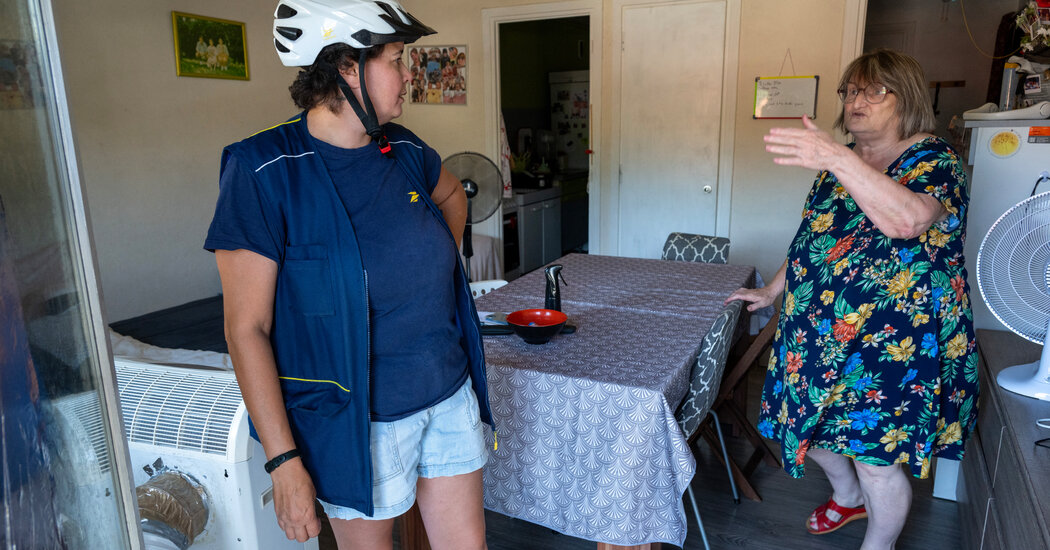
When Harmony Simon, a postal worker in Aix-les-Bains, a lakeside town in southeastern France, rang the bell of a retiree’s apartment on a scorching recent morning, she wasn’t there to deliver the mail.
She was there to check that the retired woman, Martine Combe, 68, who suffers from diabetes and asthma, hadn’t succumbed to heat stroke.
After Ms. Combe let her inside, Ms. Simon, 41, rushed to inspect the windows, which her host had covered with peeling bits of aluminum foil. It was a makeshift, tenuous solution to repel the sun, and Ms. Simon had an alternative to suggest.
“You know, in my apartment I’ve attached survival blankets” to the windows, she told Ms. Combe, referring to the shiny wraps that runners drape themselves in after marathons. “It’s brought the temperature down by four degrees,” she added.
It was advice that Ms. Combe needed. With no air conditioning, the temperature in this cramped apartment, which has large windows overlooking the lake, had recently risen as high as 36 degrees Celsius, or 97 degrees Fahrenheit, Ms. Combe told her visitor. “Staying locked up in there all afternoon is tough,” she added.
The exchange was not a one-off. Ms. Simon was there as part of a countrywide emergency policy introduced in June by Prime Minister Sébastien Lecornu, when a brutal heat wave hit France, breaking several heat records. All postal workers are now encouraged to not only deliver the mail, but also to check on older people.
“Through their daily rounds, postal workers are often the only ones who have regular contact with elderly or isolated individuals,” Mr. Lecornu said in a letter to mayors listing measures and recommendations to face the heat.
All French cities keep a register of vulnerable residents who have asked to be contacted during hot periods, but those lists are hard to keep updated, and cities are not always able to make sure all interested parties have signed up. With its network of 65,000 workers embedded in their local communities, the postal service could help to find people not registered with local authorities, Mr. Lecornu said.
Much like the rest of Europe — the fastest-warming continent, and the one with the oldest average population — France has endured a series of heat waves since the start of the summer. According to a provisional estimate by Santé Publique France, the national public health agency, nearly 6,000 people died as a result of the most severe one in June, of whom two-thirds were aged 75 and older.
There was a particularly sharp increase in deaths at home, raising concerns about older and sick people living on their own.
It’s a segment of the population that Ms. Simon, the postal worker, knows well. “Some of them, well, unfortunately, they see just us,” she said as she sorted through the mail at the post office before the start of her round.
‘I Suffer From Loneliness’
For years, Ms. Simon and her colleagues have regularly checked on people who have registered with the municipal social services. Under the new policy, she is now required to detect at-risk individuals who may not be on the city’s radar.
The first woman she visited that day was Elvire Bertagnolio, 95, who lives alone on the fifth floor of a modern building near the train station.
Ms. Bertagnolio was grateful for the company. “It does me good to see young people, at my age,” she said.
She had not left her apartment in months, she said, and rarely gets visitors except for her son, Charles, who lives hundreds of miles away. “I suffer from loneliness,” she said.
The heat, too, has been hard to bear. “At 95, you don’t feel the same as when you’re 50,” she said from her couch, sitting next to the open windows and the spinning fan.
Her cat, she said, has been a comfort — and a reliable thermometer. “When he doesn’t move from under the bed, it’s a sign that it’s really hot,” she said, chuckling.
Ms. Bertagnolio first visited the region a decade ago for surgery and fell in love with its mountainous surroundings. Like many retirees, she soon decided to move to Aix-les-Bains, a spa town known for its peaceful lake and thermal baths.
That influx has made this the fastest-aging place in the region, according to the town’s mayor, Renaud Beretti, who said that at least 13 percent of the town’s 30,000 residents were over 75.
“So we need to be especially vigilant,” Mr. Beretti said.
This year, the town has opened the air-conditioned lobby of a cultural center in the afternoons, offering residents a place to cool off with fresh drinks, games and concerts.
Postal workers help flag those who can’t make it there.
“We know there are people who live in isolation,” the mayor said. “And that’s where ‘La Poste’ has an advantage, to be able to walk through the door and gain knowledge that we couldn’t otherwise have.”
‘A Bit Like Our Psychologists’
With the decline of paper mail, the postal service has had to reinvent itself with new offerings, including delivering food for a fee. Checking up on older people is a logical outgrowth of that service — and has turned some postal workers into de facto medics. Fares Seffari, 32, a postal worker in Vénissieux, a suburb of Lyon, said he recently had to care for a resident who seemed about to faint.
“She was in really bad shape,” he said. “I stayed there until her son arrived.”
During periods of intense heat, Mr. Seffari said, he made sure his customers were eating properly. He also gave them additional advice, he said: “Keep a bottle of water right next to you, keep hydrating constantly.”
Despite the heat, Ms. Simon said she won’t stop cycling across the city’s streets. “It’s part of the job,” she said before approaching her last drop-in of the morning.
“It’s quite pretty,” she said, after letting herself into an apartment building with a skeleton key that gives her access to most buildings in town. This was one of the few in town that she had never visited, she said.
She was here to see Gilberte Milano, 88, who ushered her into a small apartment with closed shutters.
“As long as God doesn’t want me, I’ll stay,” said Ms. Milano, pointing a finger to the sky. She manages well enough on her own, she said, going on long morning walks, and watching the Tour de France in the afternoon.
But she also sometimes feels overwhelmed by deep anxiety, and appreciates the postal workers’ visits, she confided to Ms. Simon. Postal workers, she said, are “a bit like our psychologists.”
Still, she made sure Ms. Simon was doing OK, too.
“Maybe you’d like something to drink?” she asked Ms. Simon with a smile. “You must be thirsty!”
-(1).jpeg "WEF vs SOB Match Prediction – Who will win today’s The Hundred Men’s match? | CricTracker")
