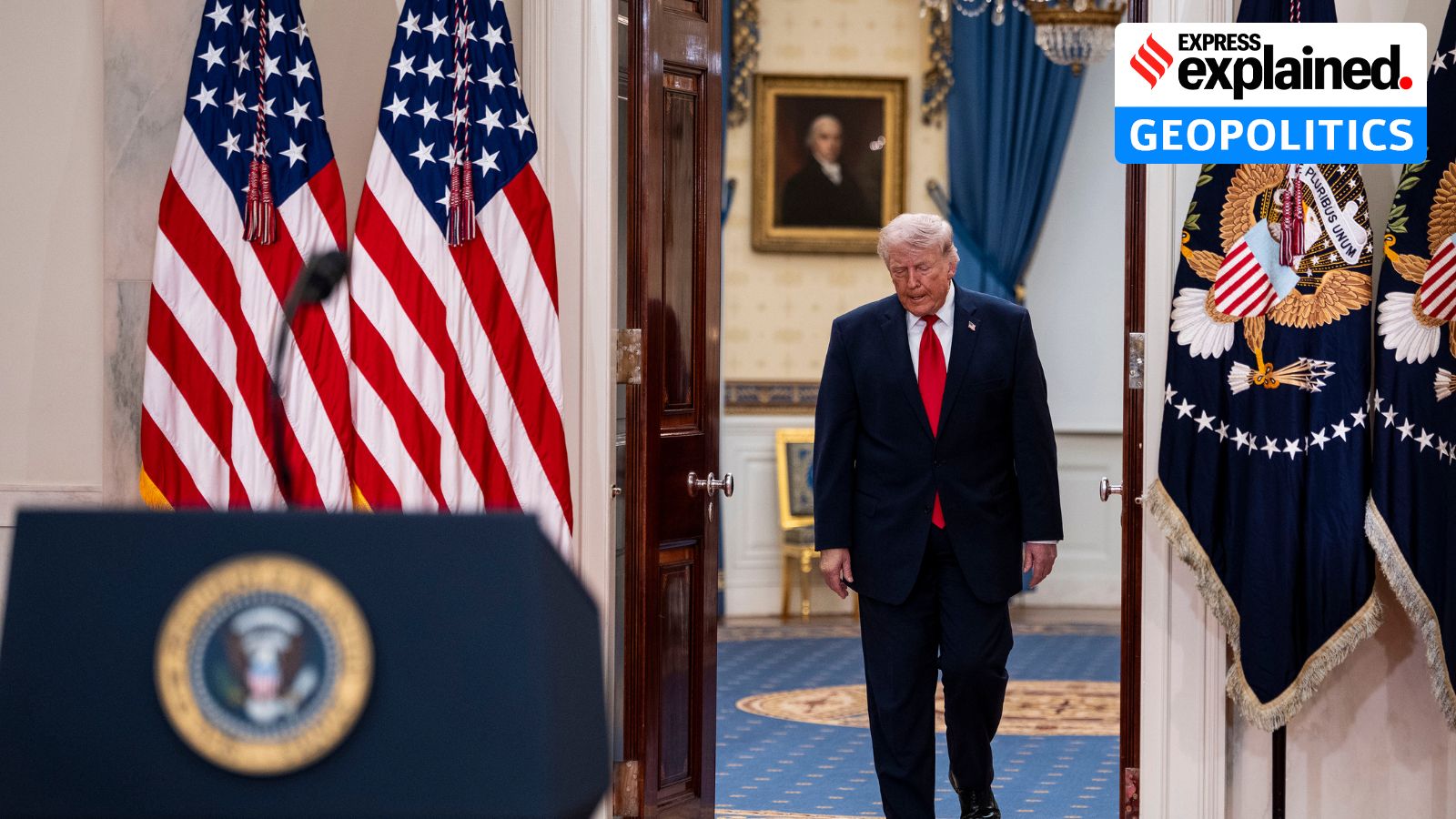
US President Donald Trump Friday said he would soon make a “final determination” on a proposed deal to extend the ceasefire with Iran, though the two countries still appeared to differ on significant issues that have been central to the conflict.
Key among these issues is Iran’s nuclear programme. The US has opposed Iran’s nuclear programme for around three decades now, frequently claiming that Tehran was very close to building a bomb.
During the course of the current conflict, too, Trump and his administration have repeatedly stated that Iran cannot be allowed to make a nuclear weapon and must completely discontinue its enrichment of uranium. The US president, in a Truth Social post on Friday, also wanted Iran’s uranium to be “unearthed” and destroyed.
Iran, however, has consistently maintained that its nuclear programme is only meant for civilian purposes. It has denied that it wants to build a bomb.
The US claimed to have “obliterated” Iran’s nuclear capabilities during its June 2025 strikes, but a large part of the highly enriched uranium it amassed is thought to have survived. Now, amid a fragile ceasefire, this remains the biggest US concern ahead of the nuclear talks that are supposed to follow any truce deal.
Here’s a look at how nuclear enrichment works and how Iran’s nuclear programme is placed.
What is uranium enrichment?
Uranium is the most common fissile material to make electricity in civilian reactors or to power nuclear weapons.
Story continues below this ad
Natural uranium is not very fissile — meaning its nucleus cannot easily be broken down to produce energy and sustain a chain reaction. This is because more than 99% of naturally occurring uranium is made up of uranium (U-238), a slightly heavier isotope of the element.
This is where enrichment comes in. It refers to a process that increases the concentration of the slightly lighter uranium-235 (U235) isotope within the natural uranium sample. This isotope is much more fissile and, therefore, has industrial applicability
This enrichment happens using centrifuges, which have a small footprint.
An enrichment level between 3% and 5% is generally enough for nuclear stations to generate electricity. Uranium is classified as highly enriched at 20% purity. Nuclear weapons, however, require enrichment levels of 90% or more of U235. The reactors that power US nuclear submarines reportedly use fuel enriched beyond 90%.
Story continues below this ad
As the enrichment level of uranium increases, it becomes exponentially easier to enrich further. Even at 90%, however, it takes more steps to produce the core of a bomb. When it is enriched, the uranium is in gas form. It must then be turned into metal for use in a weapon.
How much has Iran enriched its uranium?
According to a Reuters report citing International Atomic Energy Agency estimates, Iran had these amounts when the first Israeli bombs fell on June 13, 2025:
- – 440.9 kg enriched to up to 60%
- – 184.1 kg enriched to up to 20%
- – 6,024.4 kg enriched to up to 5%
- – 2,391.1 kg enriched to up to 2%
Iran has said it has capped its enrichment of nuclear weapons at 60% and was not aiming to enrich it to weapons-grade purity of 90%.
But there is little use for uranium enriched to intermediate levels between the 3-5% range and the 90% level. In fact, there is no civilian use for any uranium enriched beyond 20%.
Story continues below this ad
This is why the US is worried mostly about the 60% enriched uranium. It is enough to produce about 10 weapons if further enriched to 90%.
According to an International Atomic Energy Agency (IAEA) yardstick, the amount at 60% is enough, if enriched further, for 10 nuclear weapons. But it is not known how much of this stockpile survives. IAEA chief Rafael Grossi has said his agency believes “a bit more than 200 kg” of the 60% stock is stored at a tunnel complex in Isfahan that appears to have been largely unharmed by the June attacks. Some was also at the Natanz nuclear site, he said.
The challenges during the negotiations
The key question for the US ahead of the latest nuclear talks is whether it can persuade Iran to accept terms similar to the 2015 nuclear deal with the Obama administration and other world powers. Under that agreement, Iran capped uranium enrichment at 3.67% and accepted UN inspections in exchange for the sanctions relief. Trump, however, tore up the deal in 2018, saying it failed to address Iran’s ballistic missile programme and support for regional militant groups.
Before the 2026 war, however, Tehran had signalled a willingness to go even further. According to Omani Foreign Minister Badr al-Busaidi, Tehran had agreed to stop stockpiling nuclear material, down-blend its existing 60% enriched uranium into reactor fuel, and allow US inspectors access to its nuclear facilities.
Story continues below this ad
Yet the US went ahead with its attack on the country. And now it finds itself at a much weaker bargaining position. Iran may have been battered militarily, but it has effectively weaponised its second biggest trump card, the Strait of Hormuz, to choke global energy flows and trigger one of the world’s worst oil shocks.
For all of Trump’s sabre-rattling, the flows through the strait remain at a trickle despite a fragile ceasefire. Iran is now looking to use this Hormuz leverage to force a dilution of US demands and gain a series of concessions such as guarantees against further attacks, unfreezing of Iranian assets, sanctions relief — and, crucially, recognition of US rights to Iranian enrichment.
While a ceasefire agreement is said to be close, differences remain. Trump has said Iran would have to end its chokehold on the Strait of Hormuz and dismantle its capacity to make a nuclear weapon — two conditions that Tehran has not agreed to.
Can there be a way forward?
It is unlikely that Iran will give up all of its nuclear material. According to a Reuters report citing sources, Iran’s supreme leader issued a directive that the 60% material should not be sent abroad.
Story continues below this ad
Iranian sources said Tehran might agree to send half of it to a third country, receiving uranium enriched to 5% in return, and dilute the other half inside Iran.
This third country could be Kazakhstan. IAEA’s Grossi told the Financial Times that the Central Asian country has indicated a willingness to take Iran’s stockpile of uranium enriched close to weapons-grade levels if Washington and Tehran reach a deal.
This is something Iran had done in the past. Under the 2015 deal and a precursor to it, Iran’s stocks of uranium enriched to up to 20% were diluted or turned into reactor fuel plates and shipped out of the country. Moving nuclear material like highly enriched uranium internationally is a sensitive but relatively routine procedure.
With inputs from Reuters