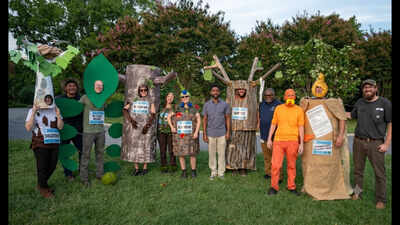
For 52 years, Baltimore had the Chanticleer pear, also known as the callery pear, as its official city tree. That changed last month after the city selected the tulip poplar as its new official tree, replacing a species whose sale was banned in Maryland earlier this year.The change was announced in an unusual way at Cylburn Arboretum. According to The Baltimore Banner, six native tree species from the Baltimore area competed for the title, with forestry staff dressed in elaborate tree costumes and racing around a track as hundreds of residents watched.The six finalists were the tulip poplar, American sycamore, blackgum, bald cypress, bitternut hickory and overcup oak. Residents had voted for their preferred tree during a months-long competition organised by Baltimore City Recreation and Parks.The public vote had already decided the winner, but the final announcement came through a footrace. Mayor Brandon Scott, who had described the contest as Baltimore’s “biggest race of the year,” started the event as the costumed trees ran for the finish line.
Tulip poplar wins the race
The American sycamore and bitternut hickory made strong starts, while the tall tulip poplar was near the back of the field. The bitternut hickory was shown carrying and dribbling a nut like a football.The race took another turn when a costumed callery pear suddenly appeared from a thicket and disrupted the contestants. The audience jeered the invasive pear as it eventually fell to the ground.The tulip poplar then tried to speed up in the final stretch but tripped over its own roots and collapsed. The American sycamore, played by forest ecologist Megan Carr, helped the fallen competitor get back on his feet.The tulip poplar soon recovered and overtook its helper before reaching the finish line. It crossed the tape about two and a half minutes after the race began, giving the species the title of Baltimore’s new official tree.Assistant chief forester Brendon Brown played the winning tulip poplar. After the race, he thanked the audience and Baltimore parks while speaking to an urban forester dressed as the Lorax, the Dr Seuss character who speaks for the forest.“I owe it all to my midwood,” Brown said, referring to a tree classification he had only recently discovered. He also thanked the fans and Baltimore parks, saying they support countless wildlife species.
Why the pear was replaced
The callery pear had been Baltimore’s official tree since 1974, when former mayor William Donald Schaefer selected it because of its striking white blossoms and hardiness in city streets.But the tree later became associated with invasive growth. Maryland banned its sale earlier this year, ending its place as Baltimore’s official tree after more than five decades.Brown said he had actually voted for the blackgum rather than the tulip poplar. “I voted for blackgum,” he said. Still, he said the tulip poplar had several advantages. It is among the most common and tallest trees in many Baltimore parks.Megan Carr, who took part in the race dressed as an American sycamore, did not vote for the species she portrayed or for any of the other finalists. “How can you choose?” she said. “They are six wonderful trees.”
A new tree for Baltimore
Not everyone at the event was happy about the change. Urban forester and certified nature therapy guide Teddy Martello dressed as the callery pear and defended the species. He described supporters of the native trees as “fascists” and said the pear had been unfairly criticised.Mayor Scott, however, showed little regret about removing Schaefer’s choice from its position. “That’s basically what my job has been since the day I got here,” Scott said. “Undoing all the bad things that they thought were good.”The tree contest was held during the summer gathering for TreeBaltimore, an initiative that has worked for two decades to increase the city’s tree canopy to 40%. Recent estimates, however, put Baltimore’s tree canopy at less than 28%.Urban forester Fred Chalfant, who attended the event dressed as the Lorax, had supported the overcup oak for the official tree title. He also praised the tulip poplar and said he was pleased by the public response. “I’m really excited about the turnout today and the enthusiasm for trees in Baltimore City,” Chalfant said.