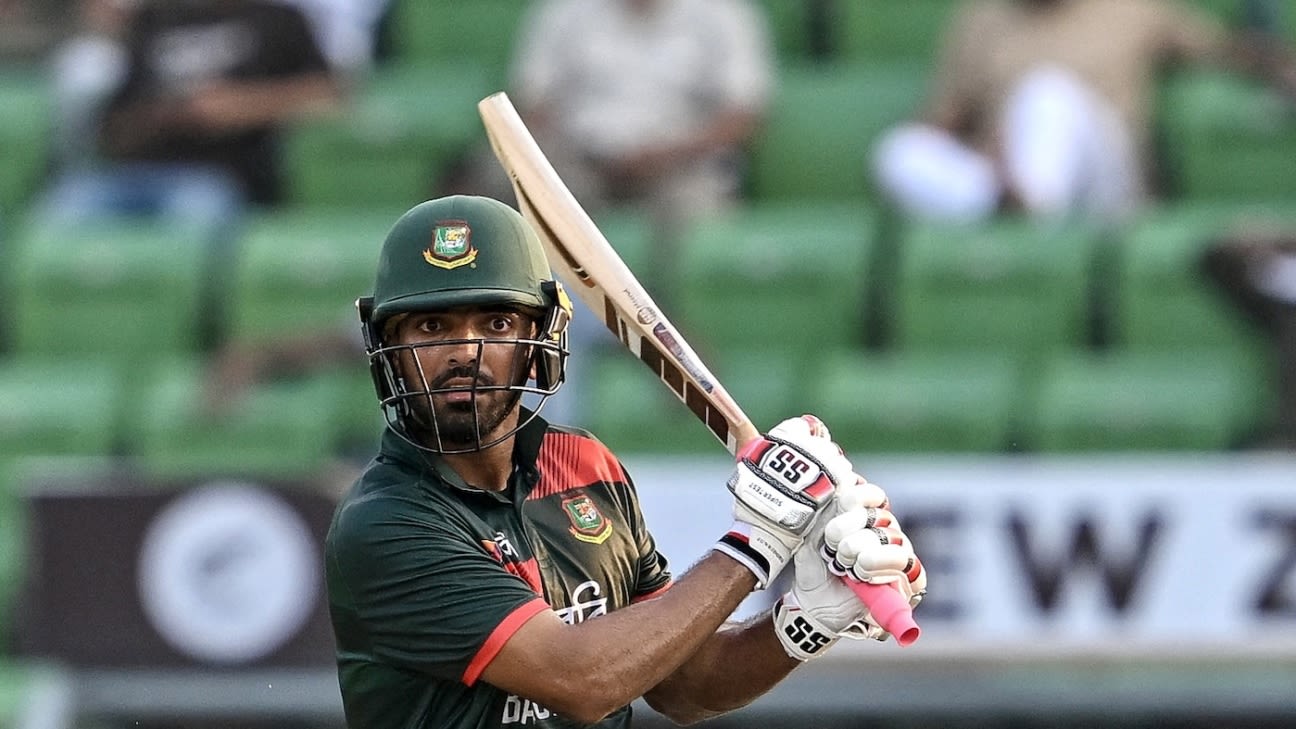
The two of them added 52 runs in 13.1 overs with just the single boundary between them. Afif made 27 off 59 balls while Hridoy contributed 24 to the partnership. Bangladesh’s required run-rate rose from 5.13 when the pair got together in the 28th over, to 7.11 when Afif got out in the 41st.
“I think the wicket was a bit challenging right from the start. But we lost our wickets at the wrong times. If I could have carried my innings a bit longer… it would have been easier,” Saif said after the game. “It [the pitch] was a bit uneven. But I don’t think there’s any way to escape by using that excuse. It was a bit easier for a set batsman, but a bit tough for a new batsman. So I think… we needed to adjust.
“As a batsman, of course, I will always want a true wicket. But at the end of the day, how the wicket is actually behaving and how much I am able to adjust to it, that’s what’s important. In the Pakistan series, as you saw, they were true wickets. The wicket here was good too… but I think we could have adapted a bit better.”
Bangladesh’s middle-order batting hasn’t been proactive in the last 12 months, with coach Phil Simmons recently pointing out that most of them were top-order batters in domestic cricket. The adjustment (or lack thereof) has been central to their problems, and there is scrutiny on Afif and Mehidy in particular. And Najmul Hossain Shanto’s recent dip in form hasn’t helped either.