

Lining up has become an essential feature for democracy in India: for food rations, for registration in a government scheme, to vote. In West Bengal, queues in front of local government offices are becoming more frequent.

Within days of millions of residents standing in lines for the special intensive revision (SIR), trying to prove themselves as genuine voters, youths in West Bengal started standing in queues again, from Sunday, February 15.
By February 17, the line has grown longer. Thousands have assembled at the Banglar Yuba Saathi registration camp at Geetanjali Stadium in the eastern part of Kolkata. Anjali Shaw (25) is sorting out her documents at the registration camp. “It would have been better if we got jobs instead. Considering the condition of the job market there is not much hope, both at the State and national level. But this money is a huge help for now,” she says. Anjali is a graduate and used to work in a private company, but lost her job.
On February 5, West Bengal Finance Minister Chandrima Bhattacharya tabled the budget for the year 2026-27 in the State Assembly. The budget, months before the West Bengal Assembly poll, announced the new cash incentive for the unemployed youths of West Bengal, called the Banglar Yuba Sathi.
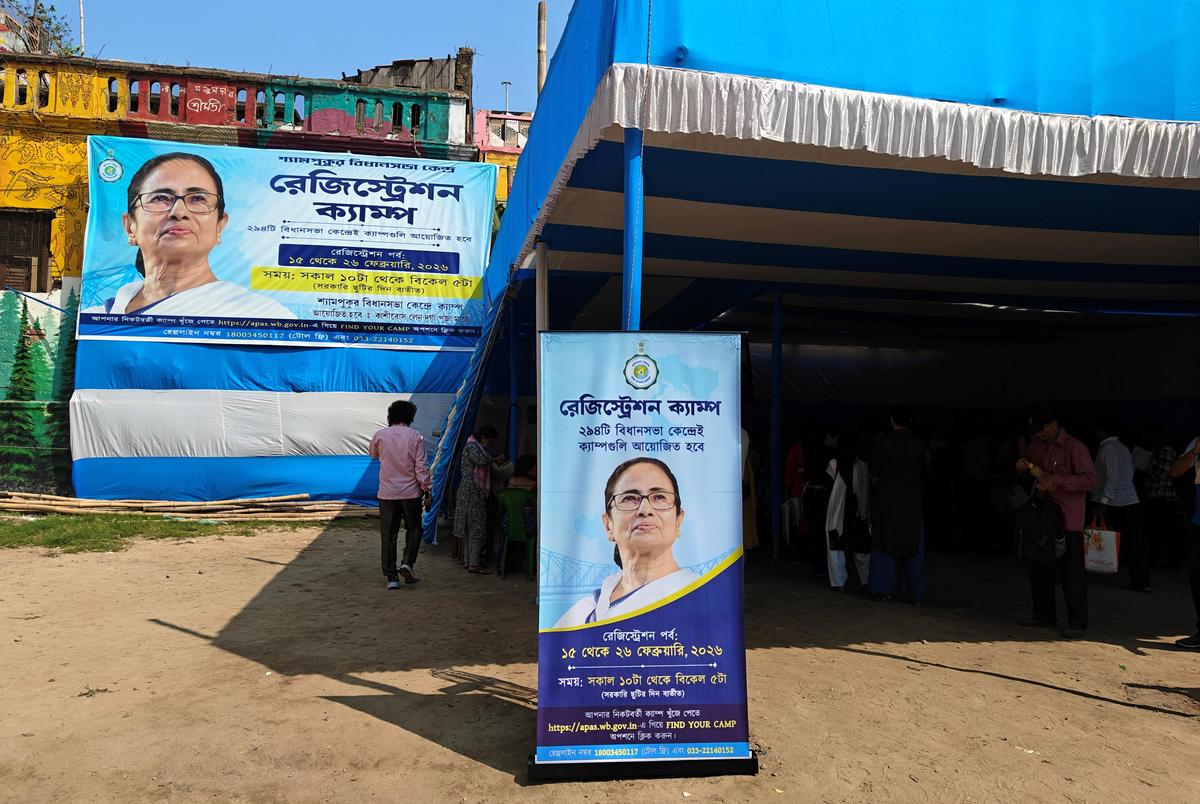
A Yuva Saathi registration centre at North Kolkatas Kasi Bose Lane.
| Photo Credit:
Shrabana Chatterjee
“Under this Scheme, those between 21 and 40 years who have passed Madhyamik (class 10), are unemployed, and not covered under any social security scheme of the government, other than educational benefit or scholarship, shall be entitled to monthly assistance of ₹1,500 till they get employment or up to 5 years, whichever is earlier,” the Finance Minister said in the State Assembly amidst cheers by the MLAs of the Treasury Benches.

In line for money
On the very first day the camp was set up, about 2 lakh people filled in the forms, say government sources. By the end of a week the number of youths registering for the scheme is in millions. There are graduates, postgraduates, even those with MBA degrees.
“My brother does ad hoc work. He does not have any regular income even though he is a graduate,” says Suman Mondal who is helping his brother fill out the Yuva Saathi registration form at Geetanjali Stadium.
In the Mondal family, Suman’s wife and mother also get a monthly allowance of ₹1,500 each under the West Bengal Lakshmir Bhandar scheme, which is a direct cash transfer social welfare scheme for women. They hope that the cumulative ₹4,500 will help ease life in their household.
The State government has made an additional allocation of ₹5,000 crore in the budget for the scheme. While the scheme was scheduled to be rolled out from August 15, Chief Minister Mamata Banerjee directed that camps be set up across the State from mid-February and the first instalment of cash under the scheme be credited in accounts on April 1.
Some women and men were also accompanied by their parents at the registration centre. “Who likes to stand in line and collect benefits from an unemployment scheme? But that is the reality,” says a father who waits in line at another Yuva Saathi centre on behalf of his son.
Sampa Bhattacharya, a mother of a 20-year-old college student standing in line says, “Everybody in our locality is coming here to stand in lines and get their share in the scheme. I get Lakshmir Bhandar, my daughter does not. So, this is good for her.”
The registration camp of Banglar Yuva Saathi in north Kolkata’s Kasi Bose Lane is located at a smaller venue than the Geetanjali stadium, yet the number lining up is disproportionate to the location.
Along with the Yuva Sathi Registration desk, the authorities have also set up a Lakshmir Bhandar registration camp. This is a cash incentive scheme for women below 60 years in West Bengal. Announcements are made over loudspeakers asking anyone who has “still not registered with Lakshmir Bhandar” to “easily sign up at the local desk”. Women scurry to get ahead in the line.
Political moves
Local Trinamool Congress MLA and Minister for Industries and Women and Child Development Sashi Panja has been regular at the camp to ensure that people can register for the unemployment allowance without any hassle.
“A lot of people are saying this is a political move. But we are not forcing anyone to take it or register. It is voluntary. We have seen a huge response till now. Thousands are coming in each day to register,” Panja says.
Leader of the Opposition in West Bengal Assembly Suvendu Adhikari described the sight of people queuing up for unemployment allowance a “horrendous sight” and said that the Trinamool Congress government was not in favour of creation of jobs.
The BJP leader added that the new Banglar Yuba Sathi would face the same fate as the Yuva Shree scheme launched in 2013 to provide allowances and jobs to 17 lakh applicants. Adhikari said that the scheme had effectively been terminated, with no funds allocated since the 2017-18 financial year.
Yuva Sathi is not the first cash incentive scheme started by the Trinamool Congress. Five years ago, before the 2021 Assembly polls Chief Minister Mamata Banerjee announced the Lakshmir Bhandar scheme.
In the budget presented on February 5, 2026, Ms. Bhattacharya increased the monthly allowance under the Scheme by ₹500 per month. Now women from the general category will get ₹1,500 per month and from the reserved category ₹1,700 after the increase.
Describing the scheme as the brainchild of Chief Minister Banerjee, she said that the scheme will cover 2.42 crore women, which is almost half of the entire population od women in West Bengal. The hike in Lakshmir Bhandar will put a yearly burden of ₹15,000 crore on the State exchequer.
Economist Abhirup Sarkar says that economic development has different connotations for different classes of people. “For the poor and the underprivileged, it means two square meals a day, adequate and clean water supply, painless travel on village roads, electricity, free education, easily accessible low-cost health services and, if possible, a house which the family can call its own,” he says. These are seen as development. “If, in addition, there is a cash transfer, however small, there is a feeling of comfort and even empowerment,” says Sarkar, explaining how welfare schemes work.
Contracting police jobs
Despite the enthusiasm over the new cash incentive scheme, the budget for 2026-27 did not put much emphasis on creation of jobs.
Ms. Bhattacharya, however, did announce a hike of ₹1,000 in the wages of contractual staff. “There are more than 1.25 lakh civic volunteers, village police, and green police workers in the State who are doing a commendable job in helping the Police Administration. To acknowledge their contribution, I am happy to propose an increase in their monthly remuneration by ₹1,000,” she said.
This raised concerns about whether the police were going towards an increased contractual force. After the rape and murder of a doctor at Kolkata’s R.G. Kar Hospital and Medical College on August 9, 2024, the accused and later convict was found to be a civic police volunteer who had easy access to the hospital.
The Supreme Court had fumed over such recruitment and on October 15, 2024, while hearing the case, had directed the West Bengal government to come clean on the “source of authority” by which civic volunteers like accused Sanjay Roy in the R.G. Kar rape and murder case was employed, especially in sensitive areas such as schools and hospitals.
A Bench of the then Chief Justice of India D.Y. Chandrachud, said employing political acolytes and sympathisers as ‘civic volunteers’ could be a “nice process of conferring political patronage on people who are totally unverified”.
However, these jobs offer some sustenance to people. A civic police volunteer from State’s Jhargram district (who did not want to be named) says that the ₹10,000 salary he earns at the end of each month does not sustain their family. When he started work in 2013, he used to earn ₹2,800.
“Most civic volunteers in our district have to do something on the side. We have small patches of land to grow vegetables, otherwise we won’t have money to put food on the plate with such a small salary,” he adds. He works 27-28 days a month and gets only 14 days of casual leave in a year. There is no money to save for medical emergencies or to put away for retirement, or his children’s higher education.
He is embarrassed that his wife and mother get money from Lakshmir Bhandar to run their household. “We are helpless. I am not proud that we accept free cash from the government. But what else do we have? Back in the day if one member in the family had a government job, the rest of the family lived a regular middle-class life,” he says.
Sanjoy Poria, State president of the West Bengal Civic Police Association (WBCPA) says that in 2013, civic police volunteers had led a movement to demand better work conditions, minimum wages, medical insurance, and recognition as permanent workers. But in 2014 he and many like him faced suspension for allegedly conducting “politically motivated” protests against the State. To this day, Poria still remains under suspension. He now runs his own ambulance service in Paschim Medinipur district’s Keshpur area.
“We had written to every political party; no one ever came to help us. Once they cracked down on us, the movement fizzled out. Do you see any civic volunteers demanding better work conditions or better pay? The movement has been killed. We were asking for very basic workers’ rights,” Poria adds. Several civic and village police volunteers spoke on the condition of anonymity that with agricultural wages declining to ₹300 a day and sometimes even less, the only option they had was to migrate to metropolitan cities in other States, for work.
While engagement of local civic police volunteers has come in handy for the West Bengal government in managing conflict in areas affected by Left wing extremism, there are often reports of civic police volunteers being used by the ruling political party in local elections and illegal activities like extortion. The involvement of civic police personnel in the death of a student leader, Anish Khan, in February 2022, had also created an outrage.
Biswanath Chakraborty, professor of political science at Rabindra Bharati University, says that the civic volunteers have provided a political footing to the Trinamool Congress. “There is no proper process for appointment of such personnel. This makes the local Trinamool Congress leadership appoint personnel who will be loyal to them,” Chakraborty says.
“A civic volunteer has no police authority,” says retired IPS officer Nazrul Islam. He refers to Sanjay Roy, the convict in the R.G. Kar Hospital rape and murder. Roy had a police motorbike and accommodation, which is not part of the emoluments of this cadre.
Government jobs in West Bengal have taken a hit after the school recruitment scam and municipal recruitment scam, which has meant re-examination, hence a postponement of work. At the time people, mostly the youth, were lining up for the cash-for-unemployment scheme, there were protests on the streets of Kolkata demanding permanent jobs.