
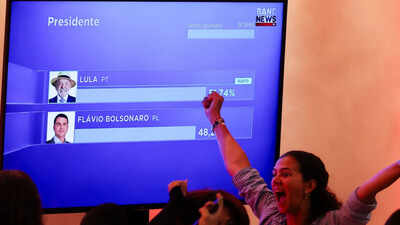
Brazil’s president Luiz Inácio Lula da Silva was re-elected after defeating conservative challenger Flávio Bolsonaro in Sunday’s presidential runoff, the country’s electoral authority announced, keeping Latin America’s largest economy under left-wing leadership.With more than 78% of votes counted, Lula was leading with 51.21% against Bolsonaro’s 48.79%, according to Reuters’ live election coverage. Pollster Datafolha projected Lula to win before the electoral authority confirmed his victory.The result is a setback for US President Donald Trump’s allies in Latin America. A Bolsonaro victory would have marked a rightward shift in Brazil, the region’s most populous country and largest economy, while Lula’s win leaves Brazil and Mexico with left-of-centre leaders.Flávio Bolsonaro, a senator and son of imprisoned former president Jair Bolsonaro, had campaigned on closer ties with Washington and promised to secure better deals with the Trump administration. Lula had criticised US policies towards Brazil, including tariffs on Brazilian exports and the designation of drug-trafficking groups as foreign terrorist organisations.The contest pitted two sharply polarised political camps against each other, with differences spanning relations with the United States, crime, climate policy and social welfare. Lula, who previously governed Brazil from 2003 to 2010, had sought an unprecedented fourth term.
Lula supporters celebrate victory
Lula supporters celebrated as the results showed him pulling ahead. Reuters reported World Cup-like scenes in Rio de Janeiro’s Laranjeiras neighbourhood, where people gathered in bars to follow the count and began singing as Lula overtook Bolsonaro.In downtown São Paulo, supporters at a nightclub cheered the news of Lula’s projected win.“I’ve been optimistic about Lula winning since the first round, even with Flávio in the lead,” Lucas dos Santos, a 29-year-old biomedical scientist, told Reuters.Julia Bueno, a 28-year-old technology worker, said she had attended a rally for Lula on Saturday and wanted to be near Avenida Paulista so she could join celebrations as soon as his victory was announced.“I was at the Saturday rally, and it was so moving. Seeing him right in front of us was an indescribable feeling,” she told Reuters.
Supreme Court extends voting by two hours
Voting was extended nationwide by two hours after Supreme Court Justice Cristiano Zanin issued an order shortly after polls were due to close. Both candidates had sought extensions in some areas, but for different reasons: Lula cited problems with buses transporting voters in nine states, while Bolsonaro pointed to heavy rain in the south.The order raised logistical concerns because some polling stations had already closed. In Brasilia, volunteers overseeing the count debated whether they needed to remain after the announcement. At a polling station in Rio de Janeiro, voting machines had been switched off and could not be restarted, according to the Associated Press.Bolsonaro had led Lula by more than 2.2 million votes in the first round earlier this month. More than 33 million of Brazil’s nearly 160 million voters had not turned out.The runoff was a rematch between two political forces that have divided the country. Lula defeated Jair Bolsonaro by the narrowest margin since Brazil’s return to democracy in 1985 in the previous presidential election four years ago.
Cost of living and security shape campaign
Lula faced a difficult re-election battle amid voter concerns over rising living costs and crime. Bolsonaro made a tough-on-crime platform central to his campaign and promised to lower food prices, while Lula offered costly incentives in an effort to win over undecided voters.Both camps have faced corruption allegations involving allies and family members. Bolsonaro has been implicated in a sprawling scandal, while Lula spent more than a year in prison after corruption convictions that were later annulled.As Bolsonaro voted at a school in Rio de Janeiro, supporters shouted, “Lula, thief, your place is in prison,” while Lula’s supporters chanted in his favour.“The time of real change has arrived,” Bolsonaro said before the result. “Brazil can’t go on for another four years on its current trajectory.”Lula’s supporters said they backed him because of his record of supporting marginalised communities and reducing poverty.“Lula is a man of the people and he knows what it’s like to be poor,” Luzia da Souza, who runs a bar in Rio de Janeiro, told AP. “I find it impossible not to vote for him.”Anderson Falcão, a 43-year-old journalist in Brasilia, said he was concerned about Bolsonaro’s long-term political vision, which he described as “exclusionary”.“It’s a project that harms the less fortunate, harms the worker, women, the forest, the Amazon,” he said.Bolsonaro supporters, many wearing Brazil’s yellow and green jerseys, said they wanted change. Fabianne Borges Santoro, a 45-year-old physiotherapist in Rio de Janeiro, said prices were high and taxes too steep. She added that she had previously voted for Lula’s party but now associated it with corruption.
Trump administration looms over election
The Trump administration’s approach to Brazil became a central issue in the campaign. Lula criticised Trump over tariffs imposed on Brazilian exports and the US designation of drug-trafficking groups as foreign terrorist organisations. Experts said the measures may have been intended to portray Lula as weak on crime.Flávio Bolsonaro highlighted his ties to the White House and argued that Brazil needed better deals with the Trump administration, including in the rare-earth minerals sector. Brazil estimates that it holds deposits of up to 21 million tonnes, second only to China. Bolsonaro denied receiving assistance from the US government.Trump said on Sunday that he was following the election but declined to endorse either candidate.