
In a major shift aimed at strengthening analytical learning, the Central Board of Secondary Education (CBSE) has introduced a two-level structure for Mathematics and Science, making room for advanced, higher-order assessments alongside standard compulsory exams from the academic session 2026-27. The move comes as part of the board’s newly released curriculum for Classes 9 to 12, which places Mathematics and Science at the core of developing logical reasoning, precision, and problem-solving skills among students.
Two-Level Structure Explained
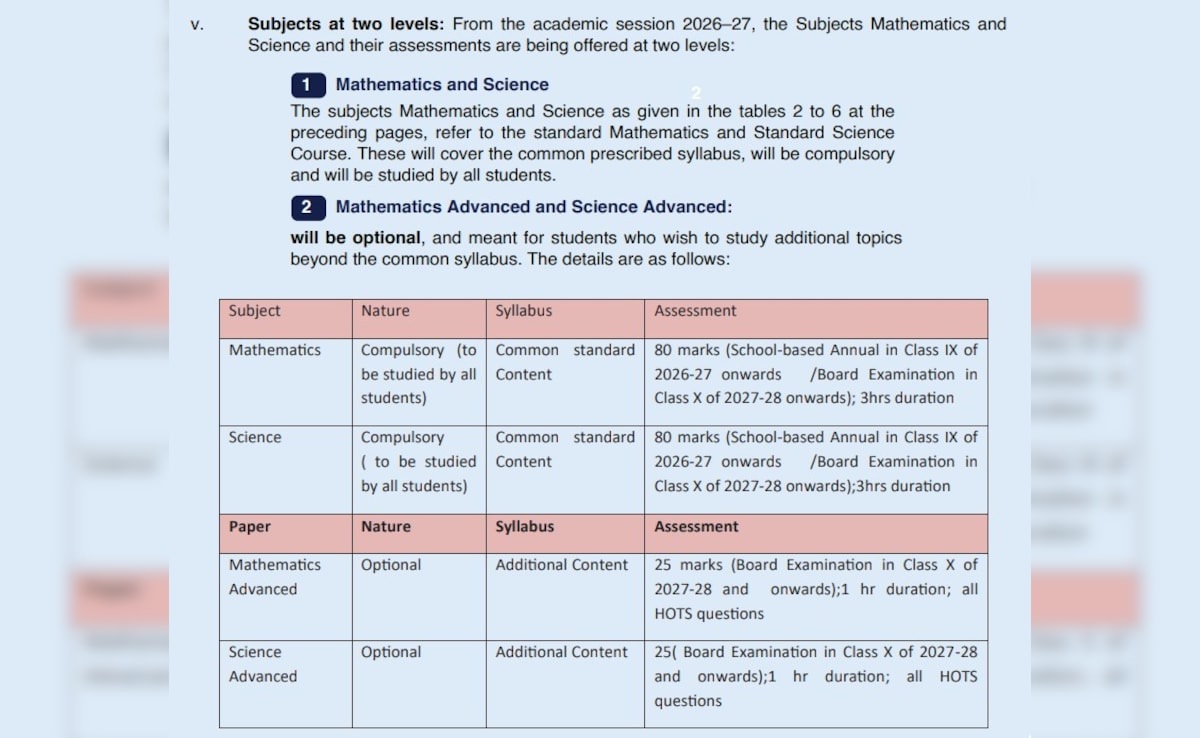
Under the revised framework, all students will study standard Mathematics and Science, covering a common syllabus and appearing for a compulsory 80-mark examination (3 hours). This will be conducted as a school-based annual exam in Class 9 from 2026-27 and as a board exam in Class 10 from 2027-28.
In addition, students can opt for Mathematics Advanced and/or Science Advanced, designed for those seeking deeper conceptual engagement. These optional papers will:
- Carry 25 marks each
- Be of 1-hour duration
- Focus entirely on Higher Order Thinking Skills (HOTS)
- Flexible Choice for Students
- Students will have the flexibility to choose:
- No advanced subject
- Only Mathematics Advanced
- Only Science Advanced
- Both Mathematics and Science Advanced
Importantly, while all students must appear for the standard exam, only those opting for advanced levels will take the additional paper.
Marksheet and Evaluation
Students securing 50% or more in the Advanced exam will have a note indicating successful completion of the advanced level in their marksheet. However, these marks will not be added to the overall aggregate score. If a student does not meet the qualifying threshold, no mention of the advanced level will be made.
The two-level structure will apply only to the theory component. Internal assessments of 20 marks in Class 10 will continue unchanged.
End of Mathematics Basic-Standard Divide
The board has also announced the discontinuation of the existing Mathematics Basic and Standard system from 2026-27 onwards. However, Class 10 students in the 2026-27 session will continue under the current scheme.
Focus On Conceptual Learning
CBSE has emphasised that Mathematics education at the secondary stage is critical for building clarity of thought and logical reasoning. The revised curriculum strengthens foundations in:
- Number systems
- Algebra
- Geometry and mensuration
- Statistics and probability
It also encourages students to engage in mathematical reasoning, pattern recognition, and real-world problem modelling.
Alignment with NEP 2020 Vision
The board said the changes align with the vision of the National Curriculum Framework for School Education (NCFSE) 2023, which views Mathematics not merely as procedural knowledge but as a disciplined way of thinking that fosters rationality and autonomy.
The curriculum also highlights connections of Mathematics with science, technology, economics, and everyday life, aiming to make learning more relevant and application-driven, in line with the goals of the National Education Policy (NEP) 2020.
Pass Criteria Adjustment
CBSE has also clarified that if a student fails in one of the three compulsory subjects-Mathematics, Science, or Social Science-but passes in an optional subject, the optional subject may replace the failed subject for result computation, as per existing norms.