5 min readJul 23, 2026 09:34 PM IST
Sri Lankan-American UCLA artistic gymnast Tiana Sumanasekara went viral earlier this summer at the NCAA Regionals, linking the ballad ‘Tujhe Dekha Toh’ with the upbeat ‘Sheila Ki Jawani’ before moving into the dramatic ‘Dola Re Dola’, earning a career-high score of 9.95. Bollywood hits have always carried the rhythm that elevates a competitive floor exercise routine, pepping it up as flying gymnasts go in search of perfection.
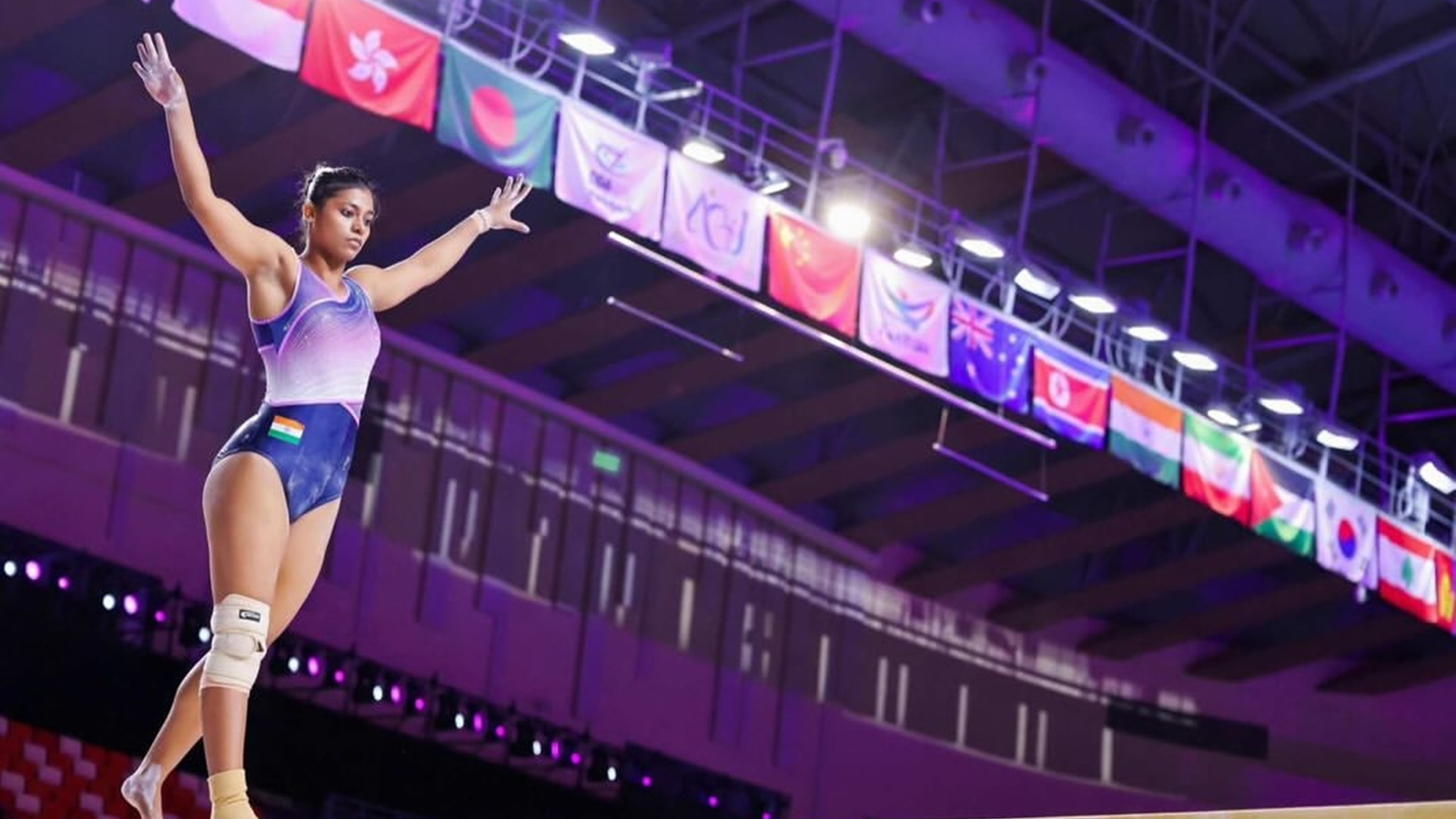
At the Glasgow Commonwealth Games over the coming weekend, India’s own Protistha Samanta and Eshita Rewale will again lean on Bollywood hits as they compete in the All Around and Team qualifications, hoping to advance to the individual apparatus finals. While Protistha has chosen the lilting ‘Dil Toh Pagal Hai’ Dance of Envy, composed by Uttam Singh, Eshita was keen on Indian classical instrumentation and picked ‘Mere Dholna’ (Ami Je Tomar, Version 1) by music composer Pritam, the song to which Monjulika dances in Bhool Bhulaiyaa, for her 90-second routine.

India’s finest gymnast on the floor, Nishka Agarwal of Hyderabad, will instead opt for Gabriel Saban’s ‘Golden Cage’, a title symphony by artist Noe Zagroun. It’s a western classical piece that suits her elements and lines, which are less balletic and more in the realm of trance and suspense.
Medal hope Pranati Nayak will not feature on the All Around list in Glasgow, and hence will not perform the floor exercise. It was Nayak, though, the three-time Asian Championship medallist and World Cup winner, who had borrowed the ‘Ek Tha Tiger’ banger ‘Mashallah’ by Shreya Ghosal for her routine at the Tokyo Olympics.
India last won a Commonwealth Games medal in gymnastics at Glasgow, when Dipa Karmakar rolled out her Produnova on the vault.
But at this edition, even as the Indians chase a vault medal, effort has also gone into improving floor scores. Marking by judges for the floor routine changed after the 2024 Olympics, with a share of the points now devoted exclusively to choreography and dance: a fraction less about acrobatics, more about presentation. Or, as India’s first World Cup medallist, Aruna Reddy, puts it: “It’s not what lines and elements of the routine you perform in those 90 seconds, it’s how.”
Bollywood music, and even Indian classical, as with Rewale’s choice of a sitar, tabla and ghungroo-heavy piece, lends itself beautifully to storytelling. “In those 90 seconds, you’re now expected to show a story, reveal a character in each line. You are marked for expression,” says Reddy, who guided Hyderabad gymnast Nishka in her early years. “Her routine isn’t flowing, it’s more suspense,” she says, explaining the staccato music.
Story continues below this ad
Mumbai gymnast Eshita had insisted on showcasing an Indian classical piece when she trained at the Prabodhankar Thackeray complex and at Infinity in Pune. A natural tumbler with a strong double tuck back pike, Eshita’s coach, Vishal Katakdound, trained her by watching French gymnastics videos, but would also visit the Andheri Sports Complex, requesting rhythmic gymnast Vandita Raval to help with choreography. “Indian music helps bring artistry to acrobatic routines. It’s our culture,” Katakdound explained.
Indian gymnasts have traditionally struggled on the floor because, though they were good acrobats, the choreography tended to be sub-par; no Indian female floor gymnast has done well internationally. So this time, a 20-day camp in London brought in South Essex Gym Club Level 4 coach and choreographer Nicole Beckford to prepare the Indian lines.
Manoj Rana, who coaches Nishka, explains: “India has good judges who know where to deduct points. But we have no coaches who can help our girls with choreography. Artistry is missing. The music will help.”
Ruby Evans is the big name on floor at Glasgow. So Rana took floor specialist Nishka to Kazakhstan last month, where she worked with renowned coach Andrei Levit, who smoothed out the edges and gave her the confidence to attempt a 5.3-difficulty routine, against a world-best of around 5.6, built on his hyper-speciality: the twists.
Story continues below this ad
Nishka is considered prodigious on the four-twist, the only Indian performing it. Indian coaches say she is one of the best twisters in the world, alongside her jumps and turns.
“She has very good orientation and control of her body,” Reddy explains. “Double saltos and twisting are crucial because you can connect immediately into the next line, giving you extra scores,” she adds.
Indian gymnastics has come a long way from the 90s, when the Parvati Khan retro track ‘Jimmy Jimmy Aaja Aaja’ was chosen for a floor routine. The 90s and 2000s Bollywood playlist, including the title track of Taal, that got a rollicking reception at NCAA is only the start. This weekend, India will own its DTPH and Bhool Bhulaiyaa bangers, and back them up with a twisting specialist.