The city of love, of numerous museums and art houses, of the Louvre and the Eiffel Tower, was poor for a footballing monument. France as a nation excelled, stacked World Cups and European Championship, produced artistic footballers as the artists and writers that made Paris their spiritual and literal home.
Among Europe’s top five, French clubs have been the least successful, collecting a grand sum of three Champions League trophies. Paris or Monaco, Lille or Marseille did not inspire the awe of Milan or Madrid, Manchester or Munich, Amsterdam or Liverpool. Its congested banlieues raised great footballers, among them Thierry Henry and N’golo Kante; Kylian Mbappe and William Saliba helm the new wave of talent, but not a club that conquered Europe.
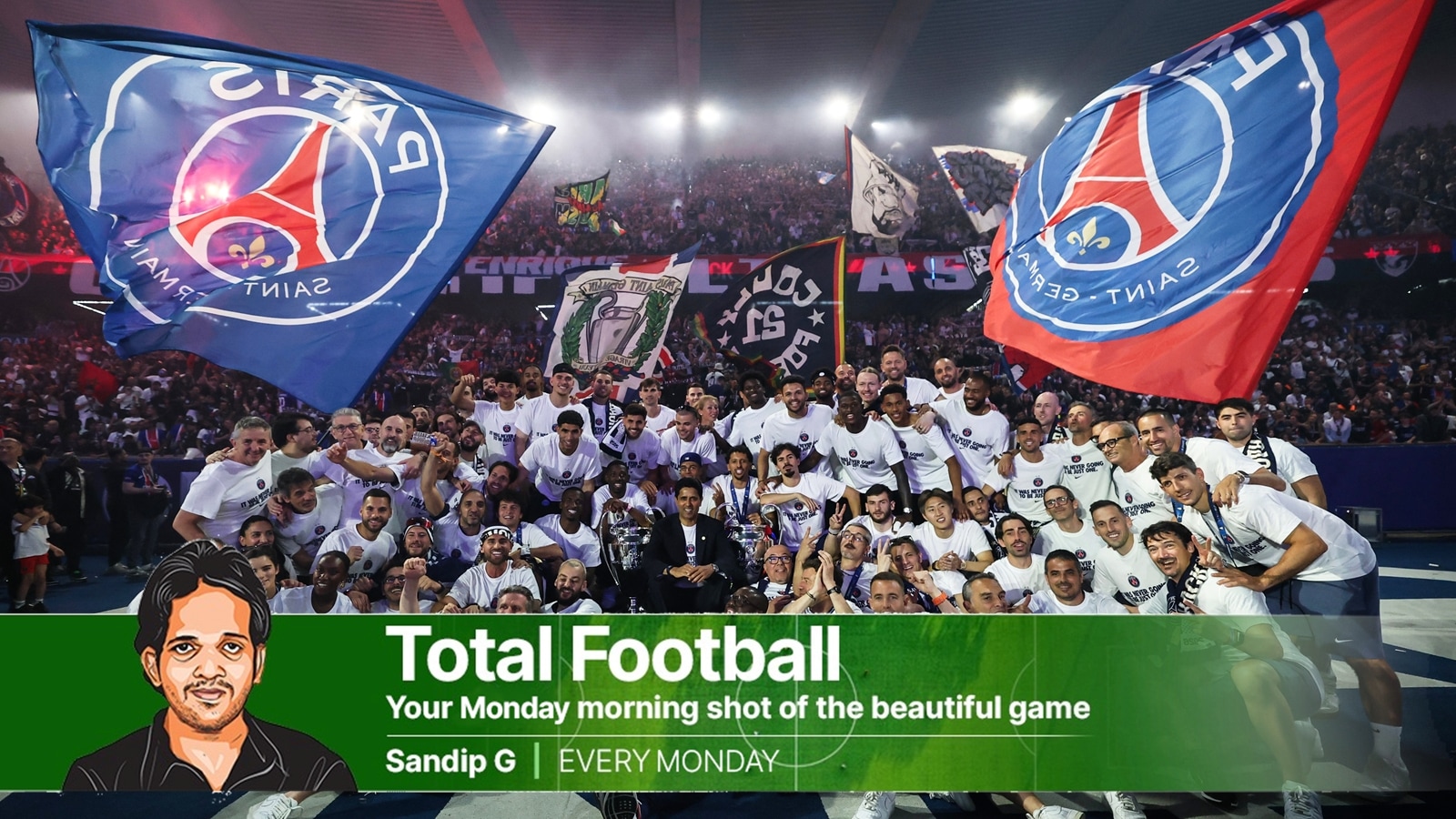
But by retaining their European crown, a feat only managed by Real Madrid in the Champions League era, PSG have furnished Paris a footballing identity it never owned. Across different eras, numerous clubs had blossomed and withered in the city — most notably Racing Club de France, for whom turned up the French writer Albert Camus — but none could capture the global consciousness as PSG has.
The club that once languished in the bottom half of Ligue One, that had collected only two titles before the Qatari takeover, is already the identity of French football, arguably the most liked and followed French club outside the country.
PSG went through several cycles of derision and mocking; they were called upstarts and nouveau riche, “monarchs of farmer’s league”; ridiculed for their wanton spending, which in hindsight was a sharp business model to build a fan-base, summon global attention, before getting to the real deal of building a dynastic team.
The evolution is fascinating — first a refuge of ageing stalwarts, next of superstars with gigabyte-egos that rebelled mutually but spiked their social media followers, surged their advertisement revenues and bolstered jersey sales, and now a collection of exquisite footballers who dazzle individually and function collectively.
The transformation was frighteningly rapid; it was only three seasons ago that Luis Enrique took over and transformed the club’s culture and made them emperors of Europe.
Story continues below this ad
His PSG are the strongest club in Europe; in winning and defending the title, they toppled all the English clubs they could lay their hands on, upended the royalty of Spain, Italy and Germany. They are also the most exhilarating band, capable of turning on flair without forsaking control, skilled at out-muscling and outlasting their rivals without being excessively physical.
Arsenal were an immovable 11-man mountain, so they didn’t look to blast the mountain straightaway, but dug passes across it to reach the summit. Enrique’s men could carnage defences with their speed and skill; they could bolt teams out of games too. The rearguard against Bayern Munich in the return leg after the 5-4 cliffhanger encapsulated the dexterity in tweaking their game based on context and opponent.
Full of confidence
In the final too, they did not attack Arsenal like a rash, but chose prudent aggression. After conceding the lead, it could have been tempting with their firepower to barrage the Gunners’ goalmouth. But they didn’t, reflecting their innate belief to wrestle back control.
The individual quality is magnificent. It’s difficult to find a more balanced front three than Ousmane Dembele, Desire Doue and Khvicha Kvaratskhelia, a beguiling trifecta that could walk on water and tight defensive spaces, could shoot and pass through impossible angles. All three rotate their roles and positions, press and defend, and do these with a self-implosive ego.
Story continues below this ad
Enrique, an elder-brotherly manager, was firm in benching forwards who did not defend. He had a frank chat with Mbappe, who, for all his wondrous gifts, was shy to track back. He told him: “I’ve read that you like Michael Jordan. Michael Jordan grabbed all his team-mates by the balls and defended like a son of a b****. You’ve got to give that example, first as a person and as a player, to go and defend.”
The French striker’s habits didn’t change, and he was shown the door next season. His first two transfer windows saw massive clearouts and incomings.
The midfield trio stretch the limits of positional fluidity. Fabian Ruiz, Vitinha and Joao Neves smoothly interchange their roles. The full-backs are quick, progressive, yet defensively strong. They bomb upfield, but fizz back when defending. Both Achraf Hakimi and Nuno Mendes offer genuine goal threats.
Hakimi, sometimes, slots in as extra midfielder to offer Doue, or whoever is manning the right flank with underlapping runs. Only the centre-backs have a defined space in Enrique’s shape-shifting occupation of space.
Story continues below this ad
In the past, Enrique has emphasised control, but he has embraced chaos too.
“Every year, I have less and less control,” he said a few weeks ago. “We need to be constantly changing. In modern football, you need to have a bit less control in order to surprise your opponents.”
The domination could last years. The average age of the squad is only 25.8. Only two of them are 30 or over. Kvaratskhelia could be crowned the best footballer in the world.
And Enrique, the true architect of the PSG dynasty, deserves to be mentioned in the same sentence as Pep Guardiola and Jurgen Klopp as a modern-day managerial great. And his PSG has given the city of love, museum and art houses, a glittering football monument too.