On Sunday, US President Donald Trump announced that a US Air Force (USAF) officer whose fighter jet was shot down by Iran’s military had been rescued by US Special Operations forces. This followed a frantic two-day search-and-rescue mission: a race between American and Iranian forces with the life of the stranded airman, a weapon systems officer, at stake.
The fighter shot down on Friday was an F-15E Strike Eagle, a two-seater jet with a pilot and a weapons systems officer. While both airmen ejected from the cockpit safely and the pilot was quickly rescued, the two-day mission to retrieve the other officer involved commandos going deep into Iranian territory.

The rescue assumed greater significance considering Iran’s history of hostage-taking (in the present case, a prisoner of war) from the time of the 1979 Islamic Revolution. Before the airman was rescued, Iran had announced a reward for his capture.
But one ought to remember that the roots of the US’s present-day successful rescue missions arguably lie in a past failure from 1980, codenamed Operation Eagle Claw.
The Iran hostage crisis
Following the Islamic Revolution that overthrew the monarchist Shah of Iran, the clerical regime led by Ayatollah Ruhollah Khomeini had assumed power in February 1979. Given that the deposed Shah had been a US ally, there was considerable anti-American sentiment in Iran at the time. By March, the US had managed to evacuate most Americans from the country except for a minimal staff at its embassy in Tehran and some corporate headquarters.
But the US’s decision that October to allow the exiled Shah to seek cancer treatment there incensed many Iranians. That anger resulted in the storming of the US embassy and other offices by some 3,000 Iranian students on November 4, 1979, taking 66 Americans hostage. By mid-November, 13 Americans had been released but 53 remained in Iranian custody.
The then US President, Jimmy Carter, sought their release by diplomatic means but when none bore fruit, he authorised a military rescue operation in April 1980.
Story continues below this ad
Operation Eagle Claw
Even as negotiations to secure the hostages’ release continued, American military commanders kept working on a possible rescue mission. Since the US military had never conducted an operation of this nature in an unfamiliar geography, this required five months of intensive planning and training (November 1979-April 1980) involving personnel from all service branches as well as the US’s foreign intelligence service, the Central Intelligence Agency (CIA).
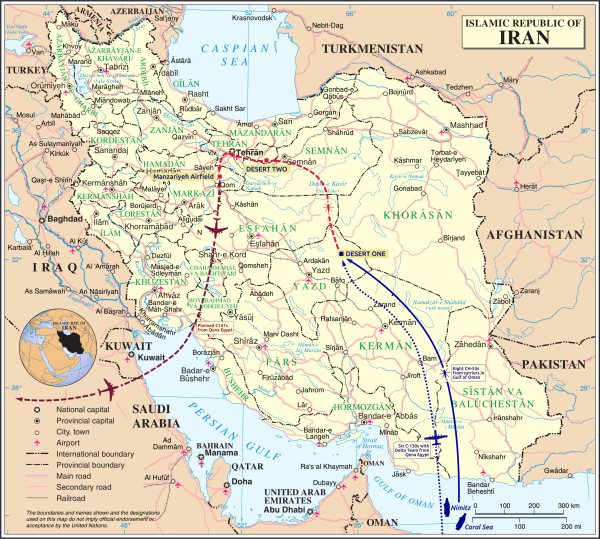 How Operation Eagle Claw was to unfold on April 24 and 25, 1980. Photo: Wikimedia Commons
Called Operation Eagle Claw, the rescue mission was to be conducted over two nights (April 24 and 25) and involved the following five phases.
- On the first night, six USAF C-130s (specialised transport aircraft) — three carrying assault troops (called the Delta Force) and three serving as fuel transport — would depart from Masirah Island in Oman to a remote spot 200 miles (320 km) southeast of Tehran, codenamed Desert One. The assault team comprised 120 Delta operators, 12 Rangers, and 15 Iranian and American Persian-speakers.
- Here, the assault troops would link up with eight RH-53D helicopters incoming from the aircraft carrier USS Nimitz, which was already stationed in the Gulf of Oman. After refuelling, the helicopters would fly the Delta Force to a mountainous location 65 miles (105 km) from Tehran, codenamed Desert Two, where the assault troops would go into hiding.
- The second night — the night of the rescue operation — would see CIA agents already inside Iran bring trucks to Desert Two. From there, they would depart towards the US embassy. While the main assault force would storm the embassy to rescue the hostages, other troops would disable power supply to the area to slow down any Iranian response. Additional aircraft would be deployed over Tehran to provide supporting fire.
- The rescued hostages would then be taken to a nearby football stadium across the street (Shahid Shiroudi Stadium), where the RH-53Ds would load them and carry them to the Manzariyeh Airfield, approximately 60 miles (97 km) southwest of Tehran.
- Finally, US Army Rangers would seize control of the Manzariyeh Airfield in the meantime and await the arrival of several C-141s (strategic airlift planes). Once the helicopters would arrive there, the C-141s would fly the rescued hostages out of Iran to friendly territory.
Operation Eagle Claw, which was approved by President Carter on April 16, 1980, following five months of stalled negotiations, was a complex operation that needed each phase to be executed right. Any departure from the plan could lead to its unravelling.
What went wrong
Basically, everything. Only the first phase went according to plan. Three weeks before the landing of the C-130s, a USAF officer had undertaken a covert operation, wherein he surveyed the Desert One site and installed remotely operated infrared lights and an electronic flash to mark a potential airstrip for pilots.
Story continues below this ad
Although the first C-130 carrying an assault team somehow managed to land safely, things started falling apart almost right after. First, a passenger bus approaching on the highway bisecting the Desert One site was forced to stop and its 40-odd passengers detained. Later, when a fuel truck coming down the highway did not stop, the Americans set it on fire using a light anti-tank weapon, which also illuminated the surrounding area. The remaining C-130s arrived soon thereafter.
But the RH-53 helicopters from USS Nimitz ran into a severe dust storm (called a haboob), experiencing reduced visibility. Of the eight choppers, two returned to the aircraft carrier following technical issues while the other six reached Desert One after a delay of 60-90 minutes. There, one more RH-53 broke down owing to hydraulic problems.
Given only five helicopters were fit to fly the rest of the operation, differences arose amongst the operational commanders on the ground. Following an intense stalemate that lasted for close to two and a half hours, the mission was finally aborted after a directive from Carter himself.
But the worst was yet to happen. On their way out, one RH-53 rammed into a fuel-laden C-130, leading to both aircraft exploding and killing eight: five airmen aboard the plane and three marines inside the helicopter. The remaining RH-53s were left behind, with onfield commanders telling the remaining troops to promptly board the C-130s and evacuate.
Story continues below this ad
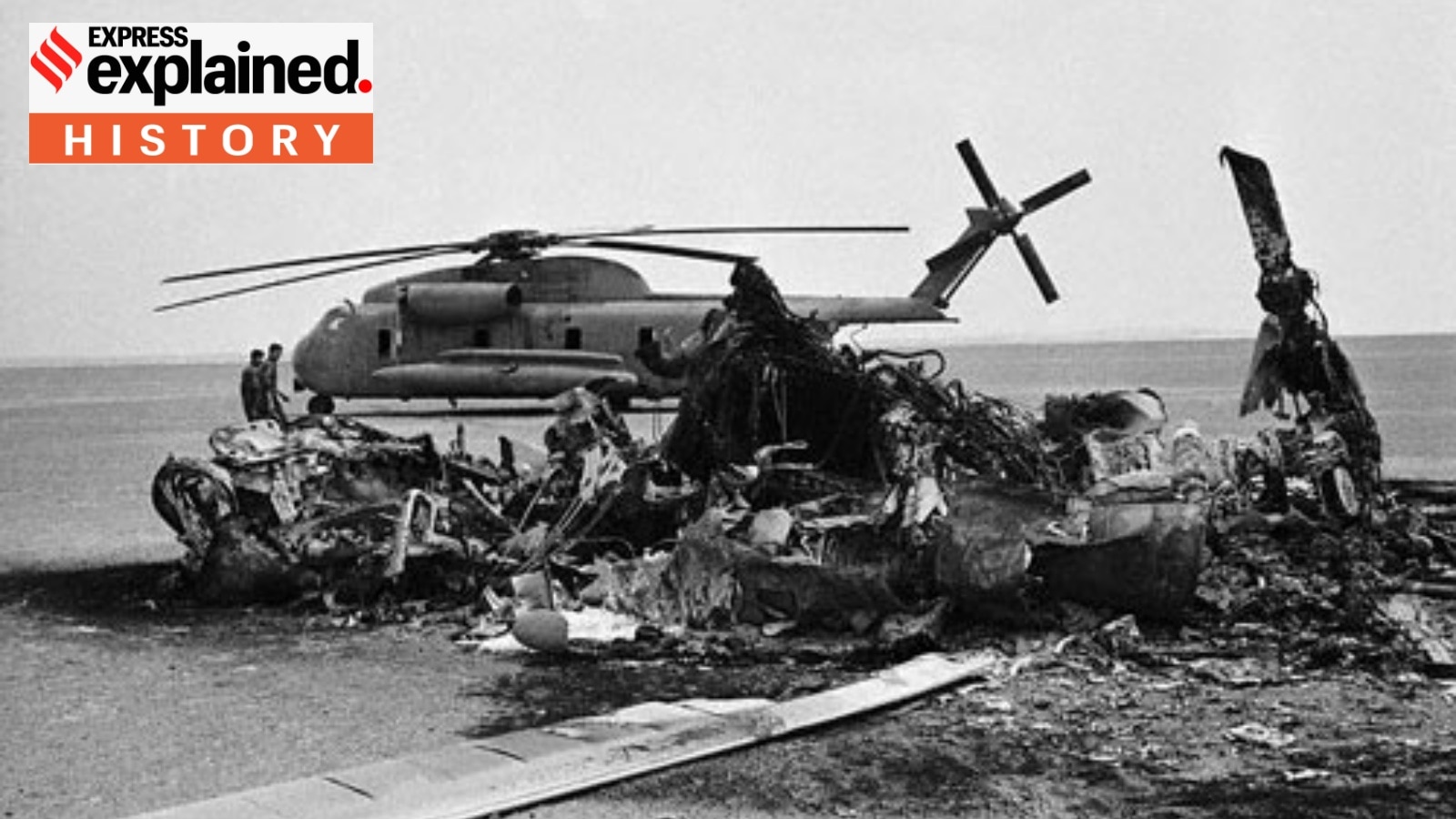
The next day, the White House announced the failed mission. On its part, the Iranian government broadcast visuals of the wreckage at Desert One to the world, and ensured that the hostages were scattered throughout Iran to prevent a similar subsequent operation.
Lessons and legacy
Even though Operation Eagle Claw failed, the events of April 24, 1980, fundamentally transformed the way the US conducted special operations thereon.
In a ceremony last year commemorating 45 years of the operation, Air Force Colonel Jeff McMaster, deputy commander of the 27th Special Operations Wing, said that the operation led to the Holloway Report, an investigation into Eagle Claw’s failures commissioned by the Joint Chiefs of Staff. The Holloway Report highlighted deficiencies in mission planning, command and control, and inter-service coordination.
“The report had a profound impact on the US military and would eventually lead to the creation of a unified special operations command, known today as United States Special Operations Command (USSOCOM),” he said. USSOCOM, which became operational on April 16, 1987, now has special operations forces from each service branch under its control.
Story continues below this ad
The botched operation is also said to have cost Jimmy Carter his presidency, losing his return bid to Republican candidate Ronald Reagan. Even though Carter continued to secure the return of the hostages, it finally happened after Iran released them on January 20, 1981 — the last day of his term — ending a 444-day-long crisis.