5 min readMar 29, 2026 08:49 AM IST
There are more earthy orbits than the famous ones that went around Mars, where cost-effective Indian technology is shining – like the flight trajectory of a badminton shuttle, dropping around the lines.
Machine Learning engineers from India have received the go-ahead from Badminton World Federation to deploy the indigenously developed Stupa Instant Review System (IRS), as it lines up in the line review space, alongside giant Hawkeye, at global events. The five-year-old company based out of Delhi’s IT hub successfully built a system capable of making line decisions in under 20 to 30 seconds with over 99% accuracy – a primary BWF certification requirement.
Stupa, led by one of India’s top female innovation brains, Megha Gambhir, delivered decisions in roughly 12 to 22 seconds. “We are actively working to crunch that down to under 10 seconds,” she says, proud of going toe-to-toe with Hawkeye, and even exceeding the legendary sports tech with a more economical, cost-efficient, accurate, and lightweight solution.
Badminton, which is set to expand its draws for Super 1000s in 2027, and already runs 155 matches over 4-8 courts across 5-7 days on average in a tournament, needed to bring every match under referral ambits. Even today, non-TV side courts are at the mercy of luck and human effort to get all line decisions, pat. Hawk-Eye charges roughly $5,000 to $7,000 per day, per court, while the Stupa solution brings down costs to around $1,000 to $1,500 per day, per court. The difference — easily 60% to 70% less.
While AI helped immensely, it needed human resilience. “It’s relatively easy to hit 80% accuracy, but the journey from 80% to 90%, then 95%, and finally 99% is the hardest. We had the first draft ready in six months, but it took us another year to weed out all the edge cases and cross that 99% threshold,” she recalls.
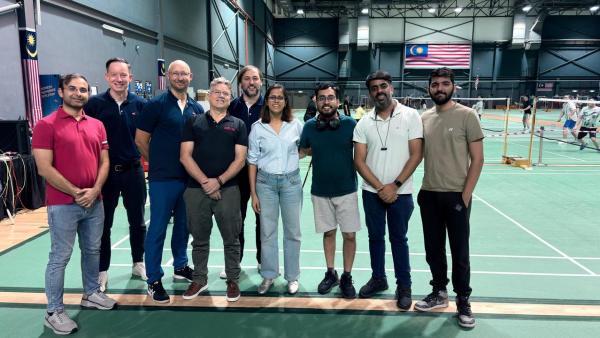 Stupa, led by one of India’s top female innovation brains, Megha Gambhir, delivers decisions in roughly 12 to 22 seconds. (Special Arrangement)
Effectively, older systems relied purely on camera Frames Per Second and computer vision. “With that approach, if a frame drops or a player occludes the camera’s view, the system misses the shuttle. Because those systems need two cameras to see the object simultaneously to gauge depth, any missed frame creates a high likelihood of incorrect results,” Megha explains.
By leveraging ML models, STUPA didn’t just track; they would predict and project, which lowered dependency on heavy setups. Remote capabilities mean fully automated officiating, like in tennis and recently announced at Wimbledon, is on the anvil in badminton, too.
Story continues below this ad
But the white bird in badminton is uniquely devilish. “A shuttlecock behaves very differently from a pickleball or a tennis ball due to its material. We had to dive deeply into the physics behind it—understanding the material tension and the exact pressure it creates when hitting the ground. For example, a drop shot lands with less pressure, while a fast smash sliding across the floor alters the angle, force, and size of the impact spot. We had to analyse the specific physics and tensions of these objects to accurately trace their footprint on the ground, and we built our solution around those precise physical drivers,” Megha explains.
The process could be frustrating. “There was this one day I literally cried. We were showcasing the system to the BWF during a critical test. They had liked our earlier demos, but during this event, our main system’s motherboard suddenly stopped working right in front of them. The team had been prepping for 14 days, and at that moment, our motivation completely dropped. Another time, the system shifted its spot identification by a single centimetre. We spent a week figuring out the cause, which turned out to be a minor discrepancy in the pixel ratio of the frame versus reality,” she says of over 10,000 shots tested to reach 99% accuracy to weed out all the edge cases they could gather.
Oftentimes, the tech is the easier part. Being an Indian innovator comes with perception challenges. “European clients weren’t always open to using an Indian company. It took years to build trust. I’ve had CEOs and general secretaries of foreign federations tell me that they initially had reservations about an Indian company delivering these solutions, but working with us completely changed their impression of India. I’m not saying I carry the whole image of India, but changing those perceptions is an awesome feeling,” she says.
Sports tech tends to be a very parochial, protected space in Europe. “At times, they paid much higher to their local companies over a cost-efficient Indian company just to promote their own. It took a while to break through that barrier using our tech quality. Second, I’ve had people be surprised by our professionalism and that we speak good English. The US and Australia were fairly open, but Europe had many reservations,” she says.
Story continues below this ad
With over 30 global partnerships, largely in Europe, signed on three-to-five-year contracts, it’s akin to winning sport tech’s equivalent of the All England.

© IE Online Media Services Pvt Ltd