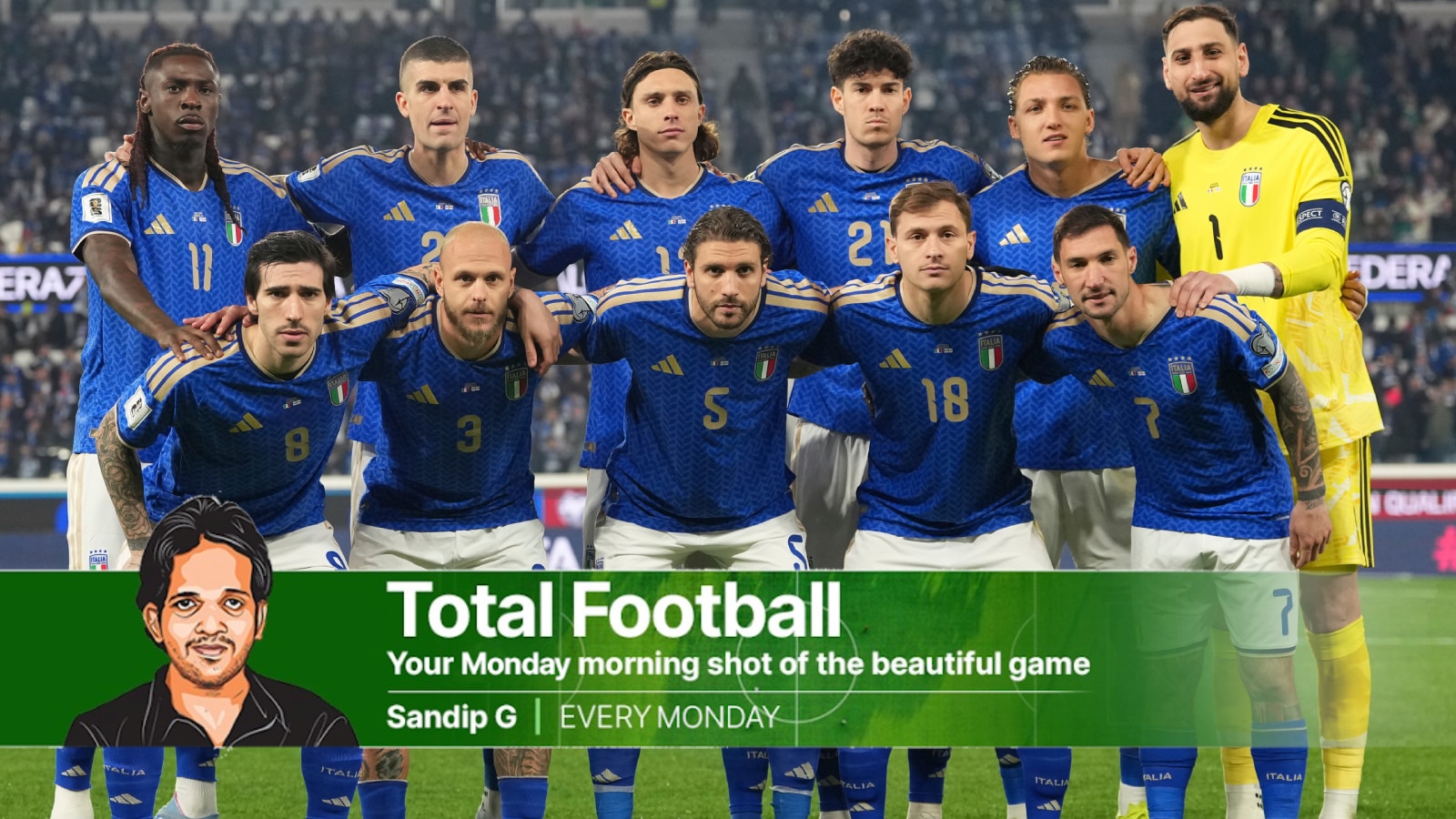
For Italy to end their World Cup exile, they need to slay the ‘dragon’ in the ‘dragon’s nest’ and beat the ‘curse’.
Dragon is the name Bosnia and Herzegovina football team goes by, a wink to the legendary 19th century general Husein Kapetan Gradascevic – called the ‘Dragon of Bosnia’ – and Dragon’s Nest is their terrifying home arena called Bilino Polje Stadium in Zenica. The ‘curse’ was that foreign teams always lost here, though post 2015, it has ceased to be a fortress.
Only 9,000 spectators would watch the play-off, a number that could squeeze into one stand of Milan’s San Siro stadium, which could hold close to 80,000 spectators.
But the visitors would not be pleased to know the reason why the arena, which resembles a postcard from the 1980s, will be half-empty. The stadium is serving a sanction after local supporters assaulted Romania’s fans, hurled abuses and blew firecrackers. Romania’s players confided that they never played in a more hostile or noisy atmosphere.
The stands almost hug the ground; the technical area is a rectangular patch and there are no athletics tracks like in Italian stadiums. Fans during the Romania game hoisted posters like ‘Welcome to Death Row’, ‘There is no escape from here’, and most fearfully ‘We will kill you.’ Former footballer Miralem Pjanic, friends to many in Juventus and Roma, filed a warning: “Watch out, Italy – playing in Bosnia isn’t easy for anyone.” The 9,000 fans could make Italy feel as though there are 90,000 in the stands.
Crowds, both home and away, have incensed Italy. The reason they played Northern Ireland at Atalanta’s home ground in Bergamo rather than in Rome, Naples or Milan was that the crowds are less volatile, that the traditional arenas bring more pressure and nervousness, given the weight of history. “It’s close-knit and small,” coach Gennaro Gattuso would say about the chosen venue.
Later, after beating Northern Ireland, Italy admitted that they did feel the burden of history. “We saw monsters,” midfielder and goal-scorer Sandro Tonali admitted.
Story continues below this ad
“I have a nation on my back,” Gattuso admitted. “This is the biggest game of my career.”
The Bosnia game would be bigger. The ghosts of the past would assume more defined shapes. Their teeth would gnash; the eyes would breathe fire. The past foibles would recur in their minds; the fear of failure could consume them.
Gennaro Gattuso had said before that he would flee the country if Italy failed to qualify for the third time. (AP Photo)
The media has ratcheted up the suffocation. “Make the children dream,” screamed Gazzetta dello Sport, a nod to the new generation that has not watched the sparkling blue jerseys sparkle under the World Cup sun. “Do it for them,” exhorted Corriere dello Sport.
Demons and nightmares
Gattuso had been dealing with sleep disorders. He had said before that he would flee the country if Italy failed to qualify for the third time.
Story continues below this ad
The opposition coaches would play mind games. “I don’t think there’s a single player who scares us. This team does not have a (Alessandro) Del Piero or a (Francesco) Totti,” Northern Ireland’s gaffer Michael O’Neill said.
Bosnia’s counterpart Sergej Barbarez is too dignified a coach to summon the past. A diligent forward in his prime, who plied his trade in the Bundesliga, he exudes a statesman-like persona. Thick beard, shaved head and a man of measured words.
“A great team and a great challenge for us,” he rated Italy. In his playing days, he pleaded with referees to abandon a World Cup qualifying game against bitter rivals Serbia and Montenegro because of the violence that had erupted in the stands. He is such a popular figure that there is a street named after him in his hometown Mostar, a city 120 km from the capital Sarajevo.
The 54-year-old has forged a young and resilient group. What they lack in talent, they make up with structural rigour. Their average height is 1.85m and they are efficient headers. The average age is 26, despite the presence of 40-year-old figurehead Edin Dzeko, his country’s all-time most-capped player (147 appearances) and top scorer (73 goals).
Story continues below this ad
Like most sides from the Balkans, they are a hard tackling side with robust physicality. Through quick recovery and vertical passes, they swiftly turn defensive situations into offensive ones. In their previous game, they out-muscled Wales, a far more technically-gifted team that couldn’t handle Bosnia’s sturdiness.
Dzeko is a familiar face for most Italian footballers. He has had spells with three Serie A clubs, the longest at Roma (six years). Two other Bosnian players feature in Serie A, Sead Kolasinac (Atalanta) and Tarik Muharemovic (Sassuolo). Winger Kerim Alajbegovic, only 18, is among the hottest young talents in the world and could wreak havoc on the flanks.
Nonetheless, Italy start hot favourites to end their World Cup wilderness. So they were last time, when they entered the qualifiers as European champions and squandered a raft of opportunities to qualify even before the play-offs.
In that sense, Italy’s biggest enemy is Italy itself, the burdensome past, the fear of failure and the sheer thought of missing another World Cup. And they have to slay the Dragon in the Dragon’s Nest and steer away from the curse that felled several European giants.