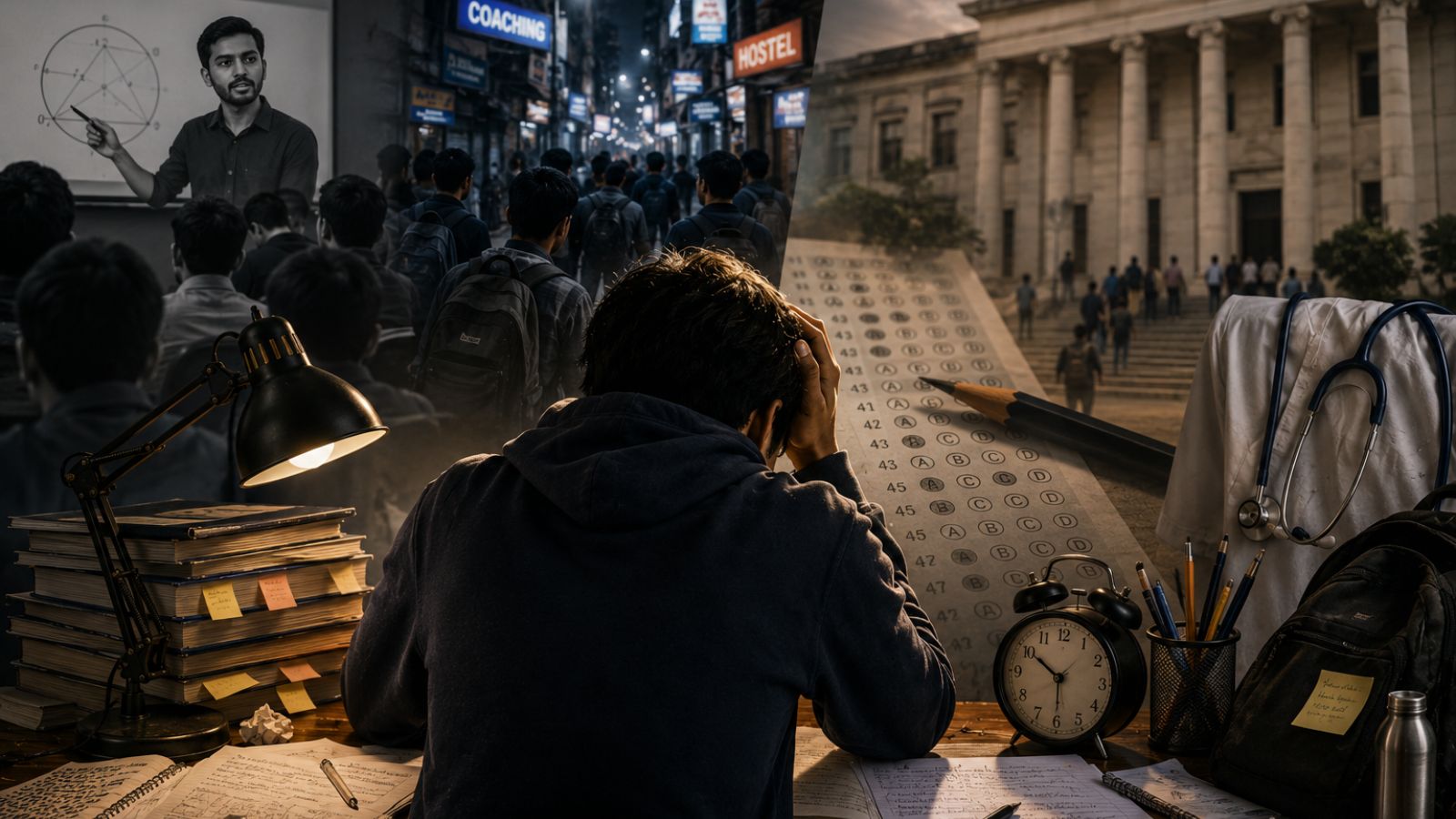
Amidst all the heated discussions the NEET paper leak sparked and the subsequent scramble toward the June 21 re-examination, I was reminded of my own life as an aspirant in Kota.
It was 2019. Kota Factory had just released and a sixteen-year-old me had moved to the biggest coaching hub of the country. I remember following Jeetu bhaiya’s 21-day rule religiously and feeling virtuous about isolating myself, staying up late at night, and even breaking down with stress over my preparation. Being appreciated for my struggle is what kept me going. But when hard work didn’t pay off the way I expected it to, I blamed myself while everyone hushingly labelled my efforts insincere.
The NEET fiasco came as a revelation to me. I wondered what more I could possibly have done to beat the odds. Is qualifying to become a doctor or an engineer supposed to be this hard? Is it fair competition when you’re up against a system that is already broken and corrupt? And somewhere along the way, has popular culture, in its obsession with the glory of “cracking it,” placed a burden on these adolescent aspirants that wasn’t theirs to carry?
A broken sieve that only lets money through
For all the rhetoric about merit, these competitive exams have become less an eligibility test and more a sieve that filters out those who can afford to endure its costs.
In the case of NEET, at 3%, the selection rate takes a brutal dip. Lakhs of students, especially those from low-income, rural, or government-school backgrounds, are elbowed out not due to lack of aptitude but because the system that channels them into medicine is skewed toward money, coaching access, and uneven infrastructure.
And after government seats are filled, wallet size decides who gets to be a doctor. The eligibility for private seats falls down to a near-zero percentile only to fill vacant seats. The demand is money, not marks.
Story continues below this ad
Dr. Sakthirajan Ramanathan and Dr. Sundaresan Chellamuthu note that physical infrastructure, faculty strength, and patient-care exposure primarily shape the quality of young doctors, not a gate-pass exam.
Moreover, while many countries place weight on consistent academic records, candidates in India come from varying school standards. Yet, a single high-stakes performance in a three-hour test remains the only way to qualify.
Triyogi Mishra, known to his students as TNM sir, a senior Chemistry faculty member at Unacademy, Kota, says, “Taking a single exam that happens once a year for three hours is the biggest mistake. Why does the selection process not include 12th grade percentage? Why does it not give more than one attempt in a year to select the best out of two or three?”
The exam, thus, demands a particular kind of training. Teaching the test becomes more significant than overall learning, and coaching becomes an inevitable necessity. This splits aspirants into two groups: a handful of well-resourced students trained to get through, and a larger, economically weaker segment already disadvantaged by the absence of quality education and training.
Realising through her first attempt that without coaching, clearing NEET is practically an unachievable dream, twenty-year-old Apoorva Pandey had to take a second drop year after her first attempt. “A student does not fight this competition alone. Their parents and siblings take the test with them all year, saving money, ignoring relatives’ taunts, and taking loans,” she says.
Story continues below this ad
For families like hers, preparing for an exam like NEET means draining savings, taking loans, or sacrificing another child’s education. The rescheduling of the exam doubles the burden rather than giving a second chance.
“I met students who scored 650, 670 in their exam. Just a few days ago, we had lunch parties with them. They were very sad because they’ve lost their momentum,” Mishra shares. “They had sold their books, their notes, left Kota and had gone to their hometowns.”
For these students, a re-exam means buying another month of practice and another attempt, apart from losing almost everything they put into the last year. But the paper leak only exposed a burden that already existed. Students paying for loopholes within the system has become normalised.
The aspirant genre and the politics of blame
This is where culture comes in. The aspirant genre, beginning with shows like Kota Factory and films such as Super 30, frames competition as a personal battle of virtue. The one who suffers the longest is seen as the most deserving.
Story continues below this ad
Often based on real-life cases, these narratives showcase how individual struggle alone leads to success.
However, one often fails to recognise the many unrewarded cases behind the triumphant one they see. As a result, exceptional victories became the standard, while structural inequality became a hurdle students were simply expected to overcome.
Moreover, by individualising success and failure, the genre transforms systemic problems into personal shortcomings. Romanticising aspirants as heroes, and blaming them for losing, is far more convenient than questioning a system that was never designed to absorb them.
Indian exam culture increasingly confuses endurance with merit. Burnout becomes proof of sincerity, while failure becomes evidence of moral weakness.
Story continues below this ad
Cinema did not alone glorify students’ struggle; it amplified it to the point of social acceptance. When we treat burnout as the only legitimate way to clear an exam, we normalise unfair competition and the policies that create the need for it in the first place.
I do not deny the aspirant genre its emotional truth. For many, those late nights and sacrifices did produce opportunities. But extreme endurance should not be the norm. And definitely not a policy.
The exam can be redone. The system cannot. That is, until we decide to care about healthcare in India beyond individual triumphs, and treat the paper leak not just as a scandal to be punished, but as a symptom to be cured.
(The author is an intern with The Indian Express)