For the past nine months, Liberia has used its experiences of prolonged armed conflict to serve as a principled voice in United Nations debates about the humanitarian consequences of a number of the most intractable geopolitical crises – from Gaza and Sudan to Ukraine and Iran.
Yet, hidden beneath this virtuous veneer lies a troubling contradiction. As my country prepares to assume the rotating presidency of the UN Security Council (UNSC) in December as a non-permanent member, it is flouting our Constitution and contravening UN conventions by hosting deportees expelled from the United States.
A year before its current charm offensive across the Atlantic – where a delegation led by the president is now courting American lawmakers in Washington and broadcasting its peace and security agenda at UN General Assembly convenings in New York – Liberia signed an agreement on September 10, 2025 with the Trump administration to accommodate an undisclosed number of third-country nationals deported from the US.
Since January 2025, the Trump administration has struck deportation agreements with 35 countries, almost a third of them in Africa, to receive foreigners whose US immigration statuses range from regularised (and legal) to protected from removal. Liberia’s cooperation is one of the largest and has proved particularly controversial.
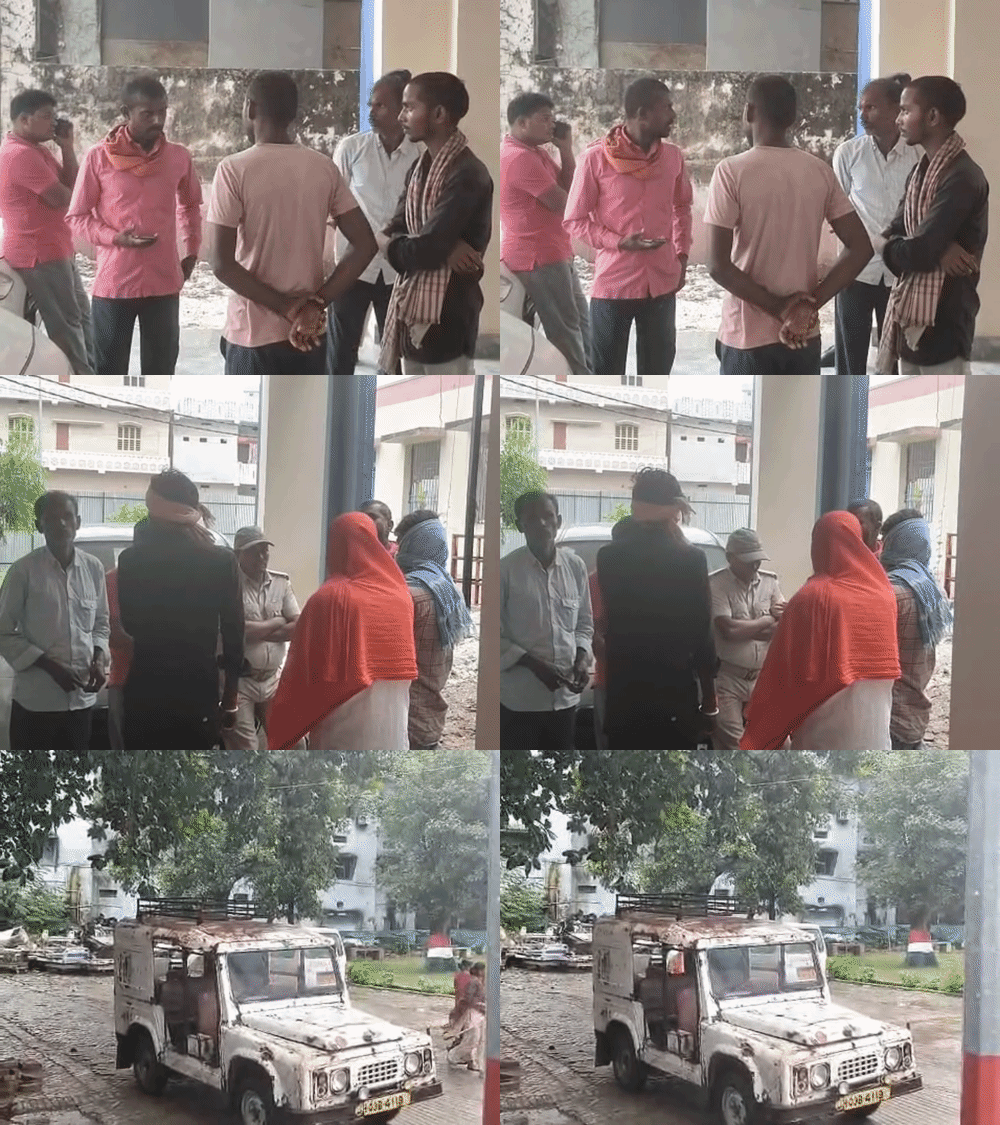
Late last month, the first 20 of an expected 1,200 deportees arrived in a widely reported – and condemned – handover at Roberts International Airport (RIA). In a dramatic turn of events, the six who refused to disembark were whisked off to Equatorial Guinea under opaque terms. For those still in Liberia, it is equally unclear who they are, why they were deported, where they will reside, whether they are free to leave, and what legal standing they possess.
Although the agreement between Monrovia and Washington is skimpy on the details, it remains politically fraught, ethically suspect and illegal. Deportations without due process, and involving cruel and inhumane treatment, contravene principles within the Universal Declaration of Human Rights. Consenting to host third-country nationals without legislative approval breaches Article 34(f) of Liberia’s Constitution.
Several deportees who landed at RIA on August 20 said they had been detained in the US without due process, contrary to articles 8 and 10 of the Universal Declaration of Human Rights, which guarantee the right to an “effective remedy” and a “fair and public hearing” before an independent court or tribunal. They also said they had been chained during the flight to Liberia, treatment that may violate Article 5, which states that “no one shall be subjected to torture or to cruel, inhuman or degrading treatment or punishment”.
Other UN agreements which may have been flouted include the 1967 Protocol Relating to the Status of Refugees, the Convention against Torture and Other Cruel, Inhuman or Degrading Treatment or Punishment, and the International Covenant on Civil and Political Rights, to which both Liberia and the US are parties.
On the home front, Liberia’s Constitution states plainly that any “treaties, conventions and such other international agreements negotiated or signed on behalf of the Republic” must be ratified by the National Legislature. Our Legislature neither deliberated on nor approved the agreement to host third-country nationals, which was unilaterally authorised by the executive. On that basis, implementing the agreement without legislative approval is unconstitutional.
By accepting mostly Black and brown deportees under such questionable arrangements, Liberia is complicit in executing “make America white again”-era expulsions that would shame its founding mothers and fathers who fled 19th-century chattel slavery and racial discrimination in the US. This small West African country – once a 21st-century poster child for post-war stability – has undercut any credibility it might wield in UNSC deliberations going forward. So, what exactly do Liberian policymakers in the executive branch of government hope to gain?
What’s in It for Liberia?
As a scholar who researches migration to/from/within Liberia, I was naturally curious about the terms, conditions and implications of Liberia’s bilateral agreement with the US. An official press release issued two days before the first batch of deportees was expected turned my curiosity into suspicion. It spins the agreement as a “humanitarian” arrangement for the “dignified, safe and orderly transfer” of non-criminals removed from the US. It also claims that although Liberia had “not demanded or received any compensation or promise of reward”, “support” would be available for managing the programme and strengthening migration management.
The word “support” deliberately muddles the truth. Why would a low-income country agree to host up to 1,200 third-country nationals without monetary incentives when the Trump administration previously paid five foreign governments more than $32m collectively to accept roughly 300 deportees? Nothing added up, so I went looking for answers.
I encountered evasion at every turn. The minister of foreign affairs said she could not share the agreement with me because it was “at the level of the National Security Council”. Instead, she forwarded me the press release I had already read – and doubted – as a consolation. The president’s national security adviser feigned ignorance. The National Security Agency director admitted he had the agreement and would get back to me. I am still awaiting his response. And Liberia’s then minister of justice, who has since assumed the role of acting minister of defence, declared haughtily that the agreement remained classified because it was entered into with a “foreign country”.
Despite these policymakers’ lack of transparency, I discovered the agreement hidden in plain sight on the US State Department website. It raised alarm not only because of what it says, but also because of what it leaves out, particularly the legitimacy of expelling third-country nationals whose protection claims in the US are pending, as well as rewarding a foreign government [Liberia] for facilitating this. If The New York Times’ August 21 story is anything to go by, Trump administration officials agreed to pay Liberia $5m for accepting deportees. Not only does this contradict claims of receiving no “compensation or promise of reward”, but remuneration also violates Article 34(f) of Liberia’s Constitution because it was not approved by the National Legislature.
Other questions loom. How was the $5m negotiated and by whom? What exactly does funding cover? How are resources being channelled if not through Liberia’s budget? Who manages the money? How are expenses monitored and reported? These questions are particularly salient because, if New York Times compensation figures are accurate, the amount allocated for Liberia is significantly less than what other governments have collected for accepting fewer deportees. Rwanda, for example, received $7.5m to accept just seven people.
A century of bad deals
My country has a long track record of signing dubious deals with the US. Most recently, the US-Liberia Bilateral Health Cooperation Memorandum of Understanding was signed last December. In exchange for more than $124m in planned “assistance” from the Trump administration, Liberia handed over access to its citizens’ health data without our permission. Similar aid pacts have been rejected or resisted by several other African governments. Although Liberia’s government has never publicly released the memorandum of understanding, one could argue that it too violates Article 34(f) of the Constitution since legislative approval was not granted.
Exactly a century ago – in 1926 – Liberia finalised another agreement with the US that undermined its sovereignty. Heavily indebted and desperate to ward off French and British colonisers, it accepted under duress a $5m loan from the Finance Corporation of America, a private subsidiary of US-based Firestone Tyre and Rubber Company. This was in exchange for signing a 99-year lease of 404,700 hectares (one million acres), enabling Firestone to extract unprocessed rubber at a measly six cents per acre. Loan terms authorised the US president to appoint Americans as administrators of Liberia’s finances, and forbade Liberia from borrowing without Firestone’s written consent. This set into motion an enduring legacy of US resource extraction from which Liberia has never recovered.
If Liberia is to assume its rightful place as Africa’s first independent Black republic – and a post-war “success story” at that – it must cancel bilateral agreements with the US that weaken its autonomy, violate national laws and erode citizens’ trust. It must actively pursue “positive peace”, the absence of structural violence, in the corridors of power both at home and abroad.
The views expressed in this article are the author’s own and do not necessarily reflect Al Jazeera’s editorial stance.