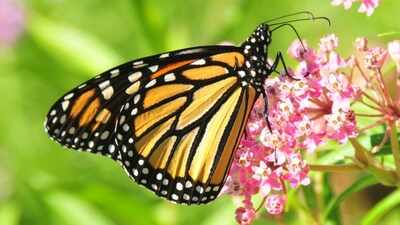
Picture this: Every autumn, one of nature’s most extraordinary journeys begins with a creature weighing less than even a gram! Millions of monarch butterflies, light as a feather, take to the skies across North America, travelling thousands of miles from their summer breeding grounds towards overwintering forests in Mexico. Some eastern monarchs can even travel up to 3,000 miles (about 4,800 km) during the migration. Quite an astonishing distance for an insect whose wings can fit comfortably across the palm of a hand!Then again, Monarch butterflies are famous for this epic migration, but lately, their story is tinged with real concern. In 2022, the International Union for Conservation of Nature (IUCN) declared the migratory monarch butterfly Endangered. Habitat loss, pesticides, climate change, and ruined wintering forests have slashed their numbers. Those in the west have been hit especially hard. At the heart of their world sits milkweed, which is a plant that’s toxic to most creatures, but critical for monarchs.
Why do monarch butterflies need milkweed?
For monarchs, milkweed isn’t just food; it’s the only option. Female monarchs lay eggs exclusively on milkweed. Caterpillars hatch, then chomp down on nothing but milkweed leaves. The plant is loaded with cardiac glycosides, which are basically chemical toxins. For most animals, these compounds spell trouble.But monarch caterpillars have evolved immunity. They eat the leaves and store some of the poisonous molecules in their bodies. When a caterpillar matures into a butterfly, that toxicity remains, offering a shield against predators. The monarch’s bold orange-and-black coloring acts as a warning: “Eat me, and you’ll regret it.” Predators learn fast and usually steer clear.So, what poisons most animals serves as a nursery, a food source, and a chemical defense for monarchs.
How can a butterfly travel 3,000 miles?
This is something amazing and almost unbelievable about the butterflies: the monarch migration isn’t completed by a single butterfly!The eastern population heads south from Canada and the US, aiming for the central forests of Mexico. The trip is long: sometimes over 3,000 miles. Monarchs can cover 70–75 miles in a day, depending on the weather.The spring migration north breaks up into generations. Butterflies arriving in Mexico reproduce, die, then the next generation flies north, repeating the process. So, each butterfly does just a stretch of the journey.Then, in autumn, you get the “super generation.” This batch lives for up to eight months—much longer than the usual four-week lifespan. These butterflies hold off on breeding, stock up on energy, and make the whole journey south. Monarchs seem to time their travel using cues like day length and temperature.
Why are monarchs at risk?
It’s not just fewer butterflies that are at risk of extinction; whole landscapes that monarchs rely on are disappearing.The IUCN ties their decline to the loss of milkweed, habitat destruction, pesticides, and climate shifts. Farms and herbicides wipe out milkweed, so there’s no place to lay eggs or feed caterpillars. Logging in Mexico’s overwintering forests, plus California’s, wrecks the butterflies’ refuge.As for climate change, it complicates everything. Drought stunts milkweed, extreme weather knocks out butterflies, migration gets out of sync, and food sources aren’t ready.The numbers on the western population are jaw-dropping. From the 1980s to 2021, they dropped roughly 99.9%: from millions down to barely 2,000 in the winter count.
Are monarchs officially protected?
It’s complicated. The IUCN marks the migratory monarch as Endangered, but the US hasn’t finalized federal protections. As of September 2026, they’re still being considered for listing as “threatened” under the Endangered Species Act. The main threats, like habitat loss, climate change, and insecticides, are clear, but official action is still in the works.However, one doesn’t have to wait for a law to help. Preserving wild habitat, growing native milkweed, keeping nectar-rich flowers available, and cutting out unnecessary pesticides make a big difference.