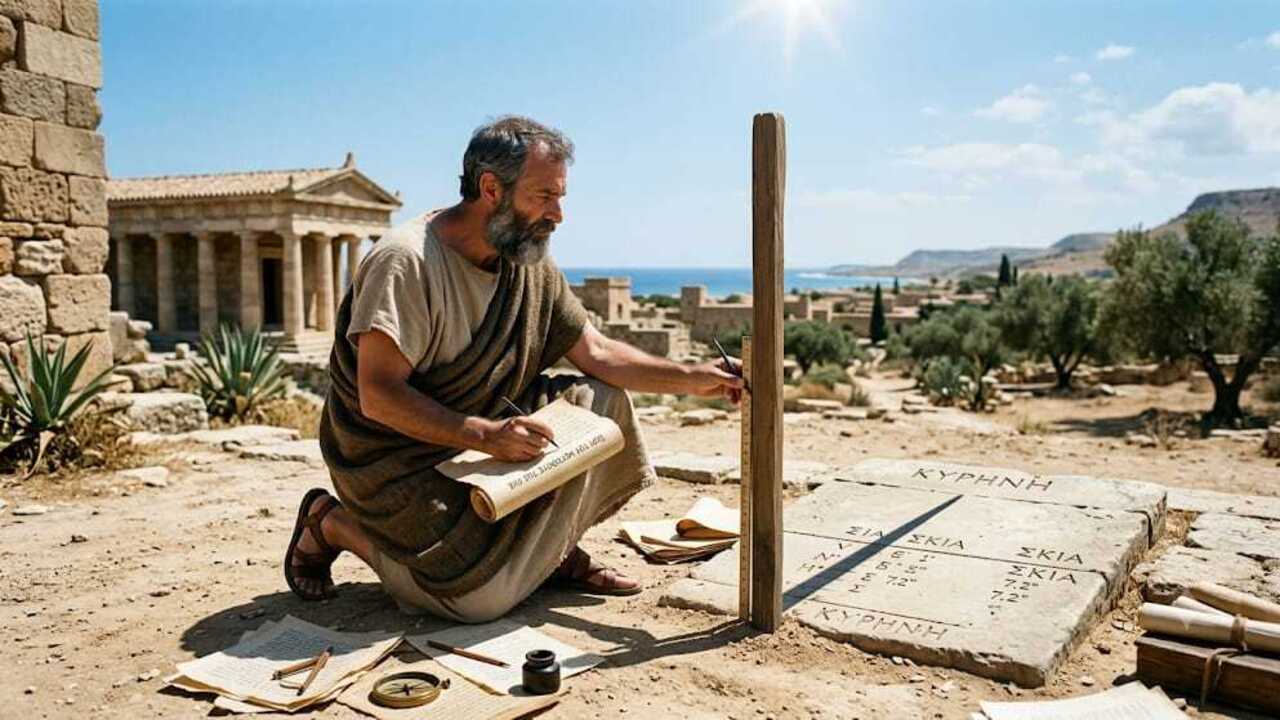
More than 2,200 years before satellites, GPS and space missions revealed the Earth’s true size, an ancient Greek scholar calculated the planet’s circumference using nothing more than a stick, sunlight and basic geometry. Around 240 BCE, Eratosthenes, the chief librarian of the Library of Alexandria, carried out one of history’s most brilliant scientific experiments. By comparing the lengths of shadows in two Egyptian cities, he produced an estimate of the Earth’s circumference that came astonishingly close to the modern measurement, proving that careful observation and mathematics could unlock the secrets of the natural world.
How did an ancient Greek scholar calculate the planet’s circumference
According to the American Physical Society, Eratosthenes had heard that in Syene (modern-day Aswan) on the summer solstice, the Sun stood directly overhead at noon. At that moment, sunlight reached the bottom of deep wells, and upright objects cast virtually no shadow.Curious whether the same was true elsewhere, he observed the Sun in Alexandria, around 800 kilometres to the north, at the exact same time. Unlike in Syene, a vertical stick there cast a noticeable shadow. Measuring the angle between the stick and its shadow, he found it to be about 7.2 degrees.This simple difference revealed that the Earth’s surface was curved. If the planet had been flat, both cities would have experienced the Sun at the same angle.
How a simple calculation measured an entire planet
Eratosthenes knew the approximate distance between Alexandria and Syene, estimated at about 5,000 stadia by professional surveyors who travelled the route.He realised that the 7.2-degree angle represented one-fiftieth of a complete circle because 7.2 × 50 equals 360 degrees. If the distance between the two cities was one-fiftieth of the Earth’s circumference, multiplying 5,000 by 50 gave a total circumference of about 250,000 stadia. He later refined the figure to 252,000 stadia, making it easier to divide into degrees.Even though the length of the stadium used by Eratosthenes was not consistent, historians have taken it into account and calculated the length to be somewhere between 39,000 and 40,000 kilometres. The true circumference of the Earth’s equator is 40,075 kilometres.
Why Eratosthenes’ experiment remains a scientific masterpiece
The success of Eratosthenes’ calculation depended on careful observation, logical reasoning and a sound understanding of geometry rather than advanced technology. His method assumed that sunlight reaches the Earth in nearly parallel rays and that the Earth is spherical, ideas that proved correct.While small inaccuracies arose because Alexandria and Syene are not perfectly aligned north to south and the exact distance between them was only an estimate, the result remains one of the greatest scientific achievements of the ancient world.More than 2,200 years ago, the sizes of the Earth were calculated using satellites to astounding accuracy. However, the contributions of Eratosthenes continue to be revered even today as an eternal lesson of how one can use curiosity, observation, and math to unravel mankind’s greatest secrets.