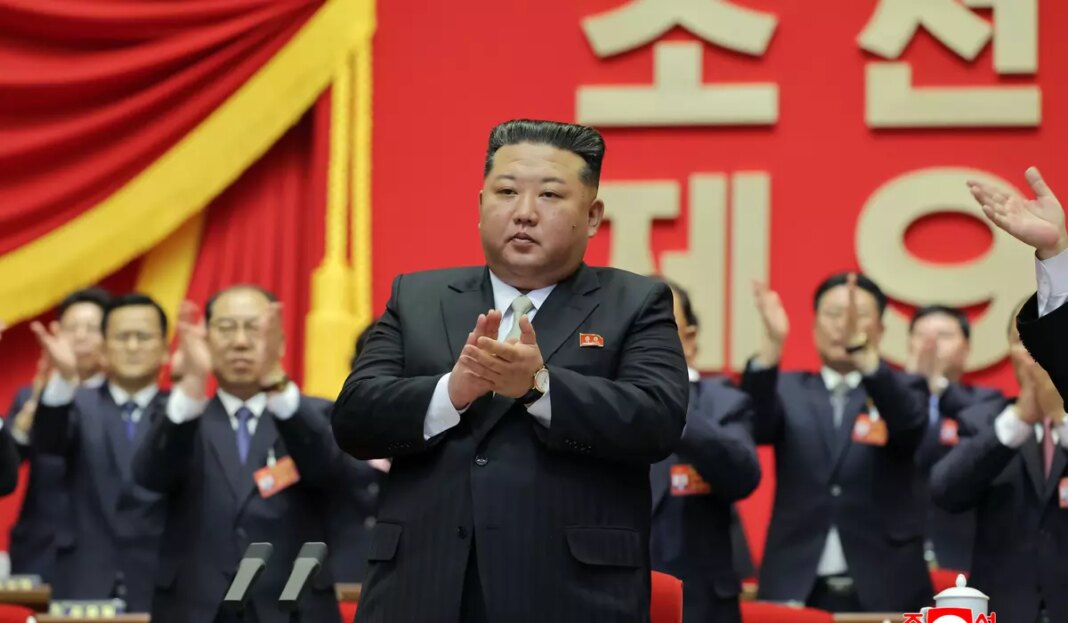

SEOUL, South Korea — As conflict rages in the Middle East, one nation likely to be taking careful notes about embattled Iran’s capacity to sustain resistance against America is North Korea.
Tehran and Pyongyang are both postured against Washington and have long had tight strategic relations. North Korea has supplied Iran with ballistic missiles, missile-construction facilities and fortified underground infrastructure.
However, Iran has no proven nuclear capability. North Korea went critical in 2006 and has continued to test ever-larger devices, expand delivery systems and even enshrine nuclear status into its constitution.
Pundits note the dire fate of nations that abandoned weapons of mass destruction, such as Libya and Ukraine, or those that lacked them, such as Iraq and Iran.
Noted American intellectual Francis Fukuyama endorsed an article titled “North Korea was right about nuclear weapons” on X on March 10.
Kim Jong-un, defying pressure from the global community, and at terrible economic cost to its populace, sharpened his “sacred sword,” nuclear arms, as the ultimate deterrent.
“North Korea is not Iran. Pyongyang has nukes; Tehran does not,” wrote Moon Chung-in, a high-profile South Korean academic with wide experience of North Korea, in the Hankyoreh newspaper. “North Korea has between 50 and 100 nuclear warheads, as well as ballistic missiles capable of striking South Korea, Japan, Guam and even the U.S. mainland.”
He added, “No wonder the U.S. treads more carefully with the North.”
Yet Mr. Kim remains unsatisfied. Pyongyang is working to diversify delivery systems, adding atomic underwater drones, as well as nuclear-capable submarines and warships, to its missile armory.
It is also bolstering conventional defenses.
Its army’s special operations and artillery arms have gained up-to-the-minute combat experience fighting with Russia against Ukraine.
New weapons continue to roll out: In recent weeks, state TV has shown Mr. Kim’s teenage daughter firing sniper rifles and driving a new class of tank.
North Korea’s intense focus on security suggests Mr. Kim’s strategists will be closely following Iran’s resistance strategies.
One is use of economic warfare to counter superior firepower, via closure of the Strait of Hormuz. That raises global energy prices and inflation, pressuring Washington to cease fire.
Another is devolving command-and-control down through political and military hierarchies, enabling sustained fightback regardless of multiple “decapitations” of Iranian leadership.
Why Kim can’t mirror Iranian resistance methods
North Korea does not dominate any strategic maritime choke point. But manufacturing powerhouses Japan and South Korea — key nodes in global supply chains — lie in range of its missiles.
Any strike on either is unlikely, given implicit risks.
“They can hit South Korea and Japan and U.S. bases all over,” said Bruce Bechtol, a North Korea watcher at Angelo State University in Texas. “The issue for them would be, they can get those things off, but we would go after them with a vengeance and there would be no doubt that the end state would be a unified Korea.”
Devolved command would upgrade deterrence. But it would be challenging to implement, given Pyongyang’s Kim-centric leadership structure.
“There is no ‘No. 2’ in North Korea,” said Shin Kyoung-soo, a retired South Korean general, noting that in the run-up to the 2019 Kim-Trump summit, North Korean negotiators were not permitted to even use the word “denuclearization,” which was reserved for Mr. Kim.
“No. 2 could be a member of Kim’s family, but he or she could be challenged by the military,” Mr. Shin added.
The military is distrusted.
“For decades, North Korean leaders have deliberately avoided granting operational authority or independent decision-making power … they have always feared that devolved command could become a pathway to rebellion,” said Lee Hyun-seung, a North Korean defector who served in the army and worked in business prior to escaping in 2014.
“In the past, even the direction of artillery barrels was not allowed to point toward Pyongyang,” Mr. Lee said.
Military coups have been rumored.
North Korean alumni of the elite Soviet Frunze Military Academy were suspected of plotting and are believed to have been executed in 1994.
There are also indications of a coup fomenting inside the army’s 9th Corps in 1996 and 1997: It was quashed by airborne units, its officers executed, its HQ disbanded.
And the current Mr. Kim had his uncle, Jang Son-thaek, executed for murky reasons in 2013. It is believed Mr. Jang, a longtime regime power player, had built up an alternative power structure, complete with his personal militia.
Embedded in-army security protocols indicate institutional distrust.
“Each unit has multiple key decision-makers: the corps commander, political commissar, chief of staff, organization director, propaganda director, and security director,” said Mr. Lee. “They monitor one another and are required to report daily on the situation in their units.”
Stating his disbelief in “real, principled loyalty” in North Korea, he suggested Iranian resistance is motivated by a different force.
“For them, loyalty to God likely matters more than loyalty to any individual supreme leader,” Mr. Lee said.
’Dead hand’ difficulties
A different protocol, that bypasses human risk, is “dead hand.”
Adopted by Cold War-era Moscow and dubbed “Perimeter,” this automated system guaranteed a second strike if top leadership were killed.
Details of Perimeter’s automated workings remain secret, but in recent years, it has been speculated that artificial intelligence could offer a “dead brain” to “dead hand.”
North Korea wrote a de facto dead hand protocol into law in 2022. It stipulates that if Kim is incapacitated, a nuclear counterstrike will automatically be launched against the origin of the strike, and the government that ordered it.
Details of systemization are unknown.
“How they plan to accomplish that is unclear…but the point of putting that clause in the law appears to be to dispel the notion that decapitation will neutralize North Korea’s nuclear threat,” said Jenny Town, director of specialist North Korea information resource 38 North.
Some are dubious.
“This is less a system of devolved command than an automatic nuclear retaliation mechanism aimed at protecting the supreme leader,” Mr. Lee said. “Even if an AI-based or otherwise automated retaliation system were created, some human actors would still need access to the code and the system itself.”
That, again, raises the trust problem.
“If someone has access rights to the automated retaliation system, they would also, in theory, have the ability to alter that code or system,” he said, noting that the system, for Mr. Kim, “cannot be considered fully safe.”
Yet even if North Korea cannot replicate Iran’s methodologies, Ms. Town reckons any war of choice against North Korea is too risky to contemplate.
“Possessing nuclear weapons, demonstrating a range of delivery system capabilities, publicizing a low nuclear use threshold and emphasizing the continued expansion of WMD capabilities raises the stakes of war,” she said. “It is highly unlikely Kim Jong Un worries too much about being next.”