There was a time when the Aam Aadmi Party was not just a political party; it was an emotion, an uprising, a moral assertion against a system perceived as corrupt. It rose from the dust of Ramlila Maidan, powered by the movement led by Anna Hazare, with Arvind Kejriwal as its most visible face.
But this is also where the story begins to turn interestingly, and somewhat ironically.
Because a movement that set out to “change the system” slowly began to resemble the very system it once opposed.
The first cracks appeared early. As activism transitioned into politics, the paths of Anna Hazare and Arvind Kejriwal diverged. The simplicity of protest gave way to the strategy of power. Allies like Baba Ramdev drifted apart. The language of moral absolutism softened into the grammar of political convenience.
And then came the first big irony — in politics, “never” often quietly becomes “sometimes.”
The same Indian National Congress that was fiercely attacked became the very support system for forming a government. Leaders once targeted for imprisonment-Sonia Gandhi, Lalu Prasad Yadav, Mulayam Singh Yadav-suddenly became part of the political ecosystem AAP learned to navigate.
And the contradictions didn’t stop there.
At one point, sharp criticism of MK Stalin — and later, public camaraderie. The shift wasn’t subtle; it was symptomatic of a larger transformation. A party that once claimed to be “different” was beginning to look very familiar.
AAP’s politics developed a peculiar rhythm — storms of allegations, followed by silences of resolution.
Big accusations were made against powerful figures, yet rarely pursued to their logical legal conclusions. And in the two cases that did escalate, against Nitin Gadkari and Arun Jaitley, public apologies marked an unexpected end.
This was a party that promised “evidence-backed anti-corruption,” but often concluded with “apology-backed closure.”
Then came power-and with it, scrutiny.
Governance in Delhi was packaged through narratives like mohalla clinics and education reforms, yet these too attracted criticism and counterclaims. The promise to transform the Yamuna River into something like the Thames gradually became a rhetorical fixture rather than a visible transformation.
On pollution, the blame game evolved, initially directed at Punjab, and later, when Punjab came under AAP’s control, redirected elsewhere.
The problem remained.
Only the excuse changed geography.
Meanwhile, allegations of corruption began to surface-liquor policy controversies, administrative questions, and the now widely discussed “Sheesh Mahal” narrative, which stood in stark contrast to the party’s original image of austerity and simplicity.
And then came the internal story-arguably the most revealing chapter.
A party that once championed internal democracy saw the steady exit or marginalisation of prominent voices. Yogendra Yadav and Ashutosh were among the early exits. Later, tensions involving figures like Swati Maliwal added to the narrative.
This is not unusual in politics, but here, it carried a sharper irony. Because this was the same party that had criticised others for “high command culture.”
A pattern began to emerge: any leader who grew too prominent risked becoming inconvenient for Arvind Kejriwal.
And in that pattern, AAP began to resemble the very political structures it once opposed.
Perhaps the most striking irony of all is this: a movement that began as a rebellion against “political drama” slowly turned into a continuous performance of it.
Protests against its own government.
Allegations without closure.
Promises extended with every election cycle.
The line between governance and theatrics blurred.
Today, the question is not just where the Aam Aadmi Party stands. The deeper question is-what happened to the idea it once represented? And this is where the story approaches its most decisive phase.
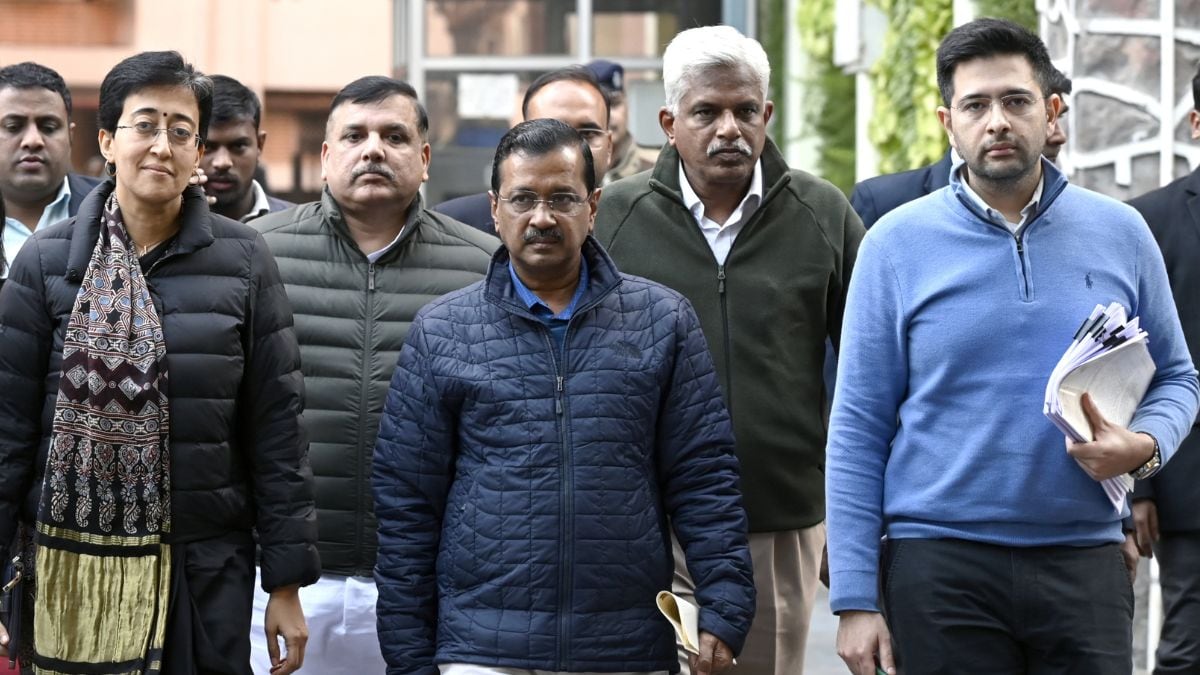
Recent developments involving Raghav Chadha, Swati Maliwal, and Harbhajan Singh, along with reports of multiple MPs distancing themselves or exiting the party, signal something deeper than routine political churn.
And perhaps that is the sharpest conclusion of this journey.
A movement born against corruption now finds itself battling questions of credibility.
And if this trajectory continues, history may not remember it as a bold political experiment — but as an unfinished promise.
A promise whose final chapter is being written not in victories, but in exits.
The departure of Raghav Chadha may well be the last nail in the coffin of the political movement Arvind Kejriwal once built.
(Shantanu Gupta is the biographer of Uttar Pradesh Chief Minister Yogi Adityanath)
Disclaimer: These are the personal opinions of the author