

Deepak Choudhary, managing director of the event company Eva Live, who has been organising concerts around the world for more than a decade, had a sold-out A R Rahman show in Abu Dhabi on January 23, in the massive Etihad Arena that was packed to capacity with almost 20,000 people.
Just two people from his company organised the whole event, Choudhary told The Indian Express. “For a similar concert in Delhi, I would need 200 people,” he said. There is no comparison between Delhi – and India – and many other places on the ease-of-organising-concerts index. “But”, Choudhary said, “there has been a positive change in the attitude of the government recently.”

The 2025-26 events season that is winding down now has been Delhi’s most eventful ever. There was international popstar Travis Scott, Himesh Reshammiya on his Cap Mania Tour, and Indian-Canadian rapper Karan Aujla. American rapper Kanye West and Colombian singer-songwriter Shakira were also scheduled to perform at Jawaharlal Nehru Stadium, but the concerts have been postponed in the wake of the ongoing West Asian conflict.
Since it came to power in Delhi a year ago, the government of Chief Minister Rekha Gupta has worked to attract major international and homegrown artists as part of a strategy to grow the Capital’s concert economy and its many positive spillover effects. Delhi-NCR is currently India’s second largest concert market, hosting close to 17% of the concerts and live events in the country — half of what Mumbai does.
The size of the pie is significant – India’s concert economy was valued at Rs 20,861 crore last year, and the number is expected to double by 2030. The imperative of harnessing the vast untapped potential of India’s live entertainment sector has been underlined at the highest levels of the government – last year, Prime Minister Narendra Modi himself emphasised its role as a driver of employment, investment, tourism, and India’s cultural and global influence. The Centre subsequently formed a Joint Working Group with state and industry representatives to work on shaping and building India’s concert economy.
The Indian Express spoke to a number of stakeholders in the concert ecosystem to understand the national capital’s ambition for a larger share of this pie – and the hurdles that it must overcome along the way.
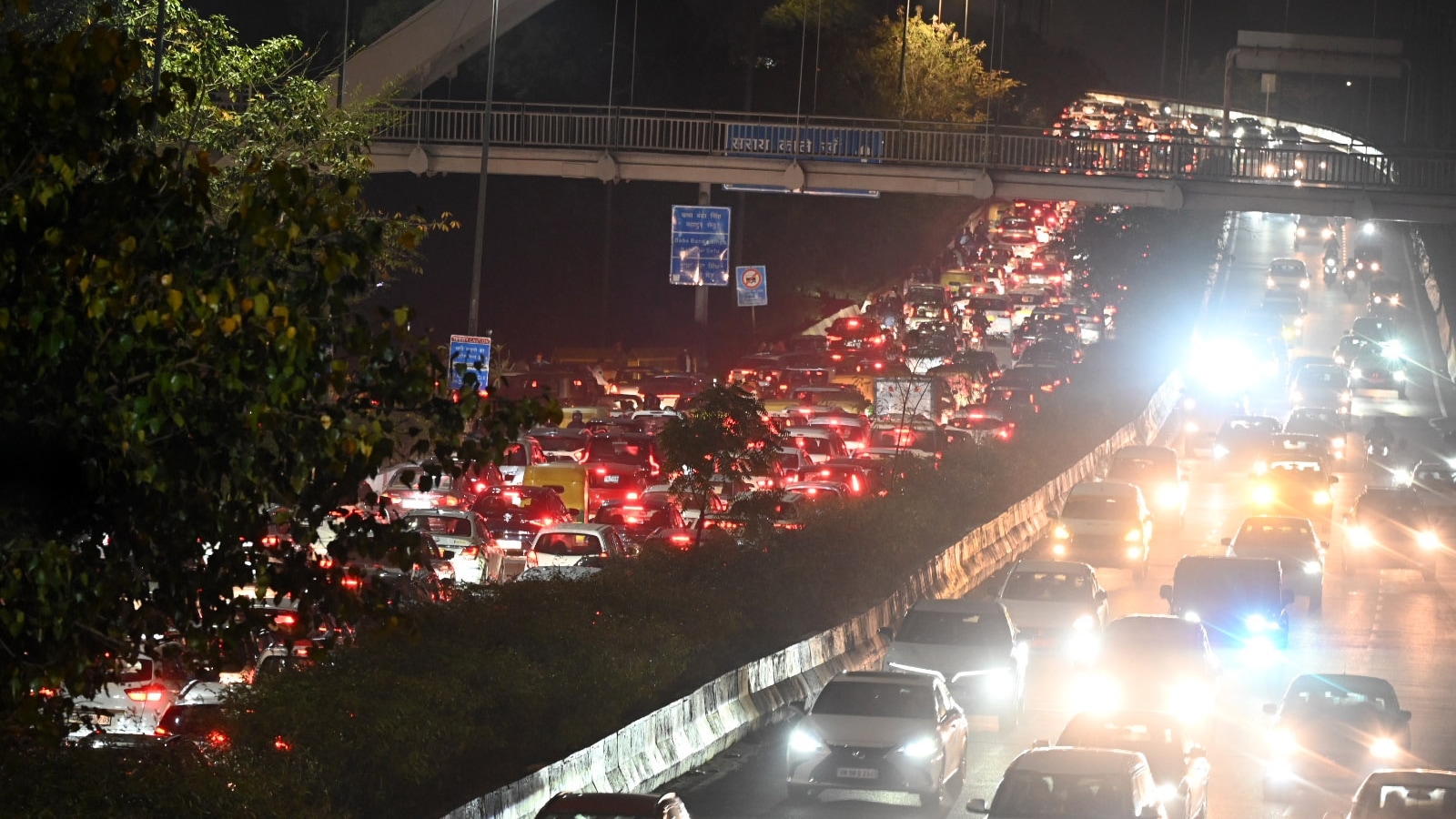 Aujla’s concert in the city was marred by chaos, mismanagement, and terrible traffic jams on roads around the venue. (Express photo by Tashi Tobgyal)
A SWOT analysis
Story continues below this ad
In the race to attract artists, Delhi starts with a number of advantages over other cities, industry executives say. Infrastructure and connectivity are big pluses – Delhi has the country’s largest airport, and a new one outside the Capital that promises to be even bigger, is scheduled to open this year; its Metro network is India’s most widespread and expanding continuously.
The city has a host of venues – the 60,000-seat Jawaharlal Nehru Stadium is the biggest, and the Indira Gandhi Arena can take in 15,000 guests. “Mumbai does not have these venues. The DY Patil Stadium can accommodate 50,000 people, but it’s far out in Navi Mumbai and difficult to reach for many in the city; as for indoor venues, the biggest is NSCI Dome with a capacity of 7,000-8,000,” Choudhary said.
Delhi also has several smaller venues such as the Talkatora Stadium, the Major Dhyan Chand National Stadium, and the K D Jadhav Wrestling Stadium. It also has the largest urban audience in the country. With Delhi’s population projected to reach 36 million by 2030, Delhi-NCR is poised to become the world’s largest urban settlement sprawl.
But the venues in India’s Capital lag far behind those in global cities such as London or Paris. Most of them were not built for music events, said Manish Mavani, Director at Sound & Light Professionals, the company that handled the light, sound, pyro, and other technical works for the Travis Scott and Sunidhi Chauhan concerts at JLN on October 18 and December 27 respectively, and the Rahman music concert and Zakir Khan comedy show at IG Arena on December 20 and November 2 respectively.
Story continues below this ad
“These venues were designed for sport, and a lot of the material that was used, including wood and plastic, does not bounce sound well. Not all the venue ceilings can support rigs for lighting, so fresh structures have to be erected at places like IG Arena,” Mavani said.
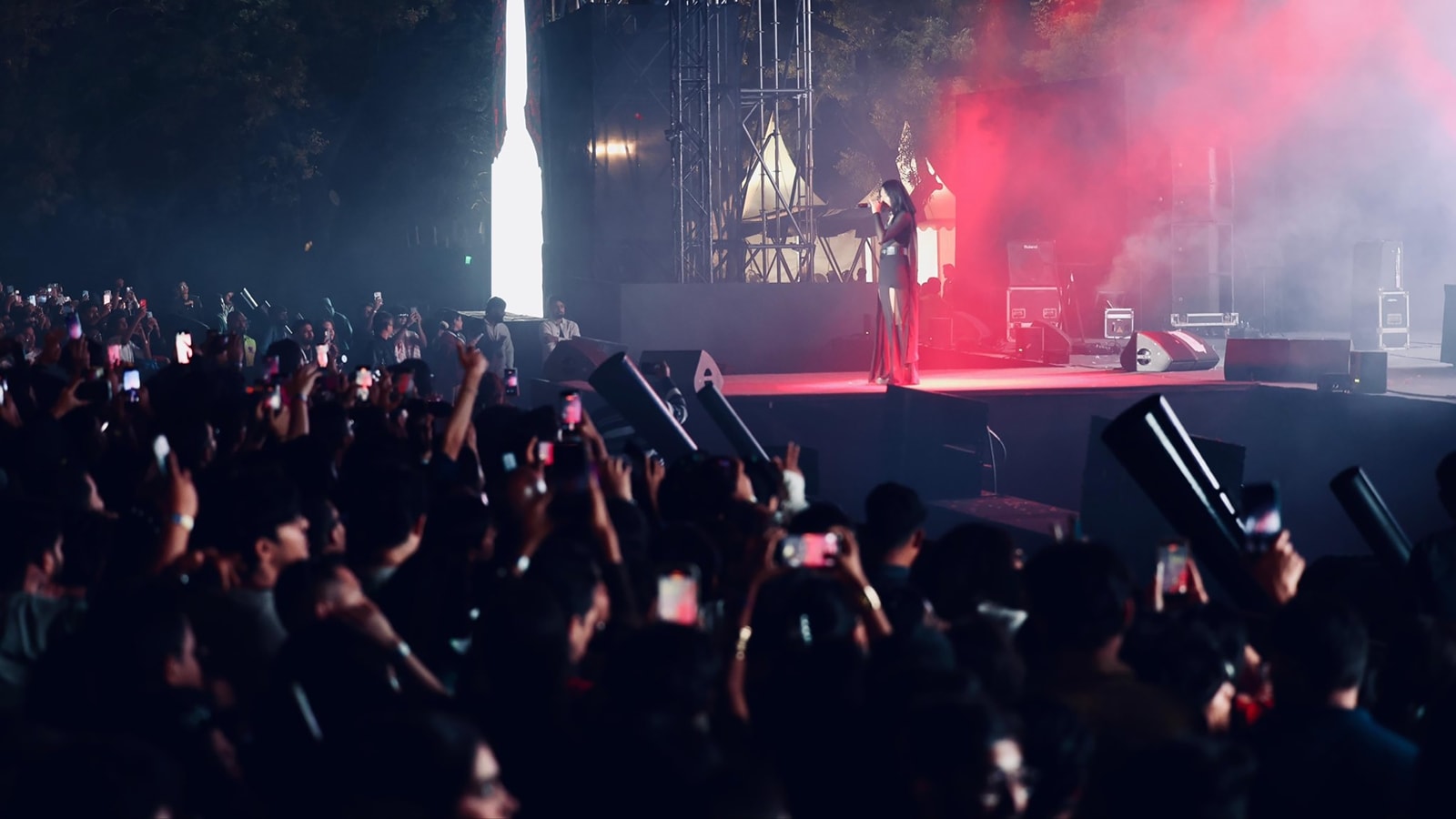 Delhi hosts around 5-10 small events and 1 big event every weekend during the 6-month event season.
The absence of purpose-built concert venues means organisers have to make significant investments in temporary infrastructure and customisation, said Mohit Bijlani, founder of Team Innovation, a Mumbai-based event management company that organised the Karan Aujla concert at JLN on February 28.
A major concern that has been raised repeatedly is about the failures of planning for huge crowds and the subsequent chaos inside the venues and outside. Mumbai does a much better job in this respect, said 24-year-old musician Arjun Pratap Chauhan, who attended singer-guitarist John Mayer’s maiden show in India at the Mahalaxmi Racecourse on February 11.
“The entry experience was seamless… Compare that to Delhi, where there is a complete lack of planning. There are not enough parking spaces, so people park on the roads leading up to the stadium. Traffic jams stretch for kilometres,” Chauhan said.
Story continues below this ad
A Delhi Police officer said that the situation won’t improve if people do not follow traffic advisories and travel in private vehicles. “There is not enough parking at the venues. People bring their cars and park them on the side of roads, creating bottlenecks, which have cascading effects over long stretches.”
Also, unlike in Mumbai, concerts in Delhi are often overcrowded, and the crowds unruly. “I reached well before time for the Karan Aujla concert, but there was still a traffic jam. People had to walk for 3 km to reach the venue. There was a huge traffic snarl while exiting as well,” said Yash Jain (24), the founder of a startup. There were several complaints about poor crowd management at the concert, which was attended by 70,000 people, and saw several scuffles.
Then, said a Delhi government official, there was the problem of fragmented approvals and regulatory rigidities that lead to losses of tourism revenue. Organisers have to take permissions from multiple agencies such as the Municipal Corporation of Delhi, the Delhi Police and the Delhi Traffic Police, which leads to delays.
The safety of women is a huge problem across the cities in NCR. Women have repeatedly complained of sexual harassment – something that usually does not happen in cities like Mumbai, Bengaluru and Pune. Finding clean washrooms is also often very difficult at many of these events.
Story continues below this ad
Another concern raised by the industry is about liquor licensing. An organiser who has worked with three of India’s top ticketing and urban entertainment businesses said it is difficult to have liquor served at the main playing track of stadiums in Delhi.
“Getting the permissions is a difficult task. For Diljit Dosanjh’s concert [in October 2024], for example, they were able to get it done (have liquor sold in the field), but not everyone manages to. There should be a uniform policy,” said the organiser who declined to be identified.
Choudhary of Eva Live said that many liquor brands, which are also major sponsors, are hesitant to come to Delhi. This is in many cases because of specific concerns regarding Delhi’s liquor policy. “I cannot have Corona as a sponsor when their beer cannot be found on the shelves of the Capital’s retail stores, for example,” Choudhary said.
Finally, there is Delhi’s infamous “VIP culture”, and the demand for free passes from various authorities. “The quotas of free passes are fixed. While authorities in Mumbai want 5% of tickets for free, in Delhi, they may want 15%,” Choudhary said. This is a huge disincentive for organisers – in a Rs-10-crore event, a crore and a half is lost in the ticketing itself.
Steps taken, way forward
Story continues below this ad
The Delhi government has been vocal about wanting to make the city the centre of India’s live entertainment and concert economy; it has said that it wants Delhi to become the “creative capital” of the country.
In October last year, CM Gupta had announced more than 30 major cultural events over the next 80 days, and had said that Delhi’s concert economy was expected to reach Rs 2,500-3,000 crore in the coming years. The government, Gupta said, will “develop new world-class event venues equipped with state-of-the-art facilities, where lakhs of people can attend concerts and cultural programs together”.
After it emerged that high stadium rentals were an issue, in October last year, the Sports Authority of India (SAI) made it cheaper to host events at its venues, by 40-50%. The cost of booking JLN Stadium’s main arena for non-sports events has been cut from Rs 50 lakh to Rs 25 lakh per day. For the IG Sports Complex, the Rs 20-lakh cost, including electricity and other charges, has been revised to Rs 16 lakh. A spokesperson for SAI said that there has been a significant surge in the number of concerts being held at its stadiums after the rentals were reduced.
Delhi also has many heritage sites and monuments that can be used to host events, if they are opened up by the government, Choudhary said.
Story continues below this ad
“In the short term, the focus needs to be on making the process faster and more predictable. A true single-window clearance system with defined timelines would significantly improve ease of doing business,” said Bijlani. He said that standardising permission fees across departments and having clear, consistent policies on sound limits and curfews would remove ambiguity.
CM Gupta has already promised a single-window system for event permission, security, and logistics.
In several cities, the government provides some funding in the form of sponsorships, in the expectation of larger benefits from hosting the concerts. D Karthikeyan, General Manager at the Delhi Tourism and Transport Development Corporation said: “We too have given funding for some concerts, depending on the number of attendees, which ranges from a few lakhs to a crore [of rupees].”
Some positive outcomes are visible, industry executives say.
“Our partnership with Delhi entered a new chapter with Travis Scott’s Circus Maximus World Tour – a multi-agency framework, a unified command centre and one of the largest production builds the country has seen. What we were able to achieve would simply not have been possible without the unwavering support of Delhi government, Delhi Tourism, Delhi Police, the Department of Art, Culture and Languages and the civic authorities,” said Naman Pugalia, Chief Business Officer, Live Events, BookMyShow.
Story continues below this ad
Jaideep Ahuja, MD of Ahuja Residencies and former Chairman of CII Delhi, said: “Such events create demand across multiple segments, from short stays for attendees to longer stays for crews, artists, and teams. This has a multiplier effect, benefiting not just hotels and serviced apartments but also transport providers, food businesses, and MSMEs.”
This point was illustrated by Coldplay’s mega concert in Ahmedabad last year, which produced earnings of Rs 641 crore across multiple industries, and Rs 72 crore in GST for the government.
Whether Delhi can emerge as a leading live events hub will depend on how quickly it can fix its structural and regulatory gaps.
With inputs from Abhimanyu Hazarika and Gayathri Mani
***
Cost break-up
- 40-60% on artist fees : roughly 2/3rds for an international artist
- 15-25% on production, logistics, stage
- 10-15% on cost of venu
- 10-20% on marketing
Revenue sources
- Artist cost: Should be recovered from ticketing
- Rest: From sponsorships and food & beverages
Coldplay numbers (Ahmedabad concert in Jan 2025)
- 2.2 lakh attendees across 2 days
- Rs 641 crore economic impact across multiple industries
- Rs 392 crore direct economic impact on Ahmedabad
- Rs 72 crore contribution in GST revenue to government: For every Rs 100 spent on a ticket, attendees contributed an additional Rs 585 towards services like hospitality, travel, and local shopping and dining, creating a ripple effect.
(Sources: Interviews, BookMyShow, EY-Parthenon Report)
+++++
(Market share of concerts and live events)
- Mumbai-33%
- Delhi-17%
- Bengaluru-10%
- Rest-40%