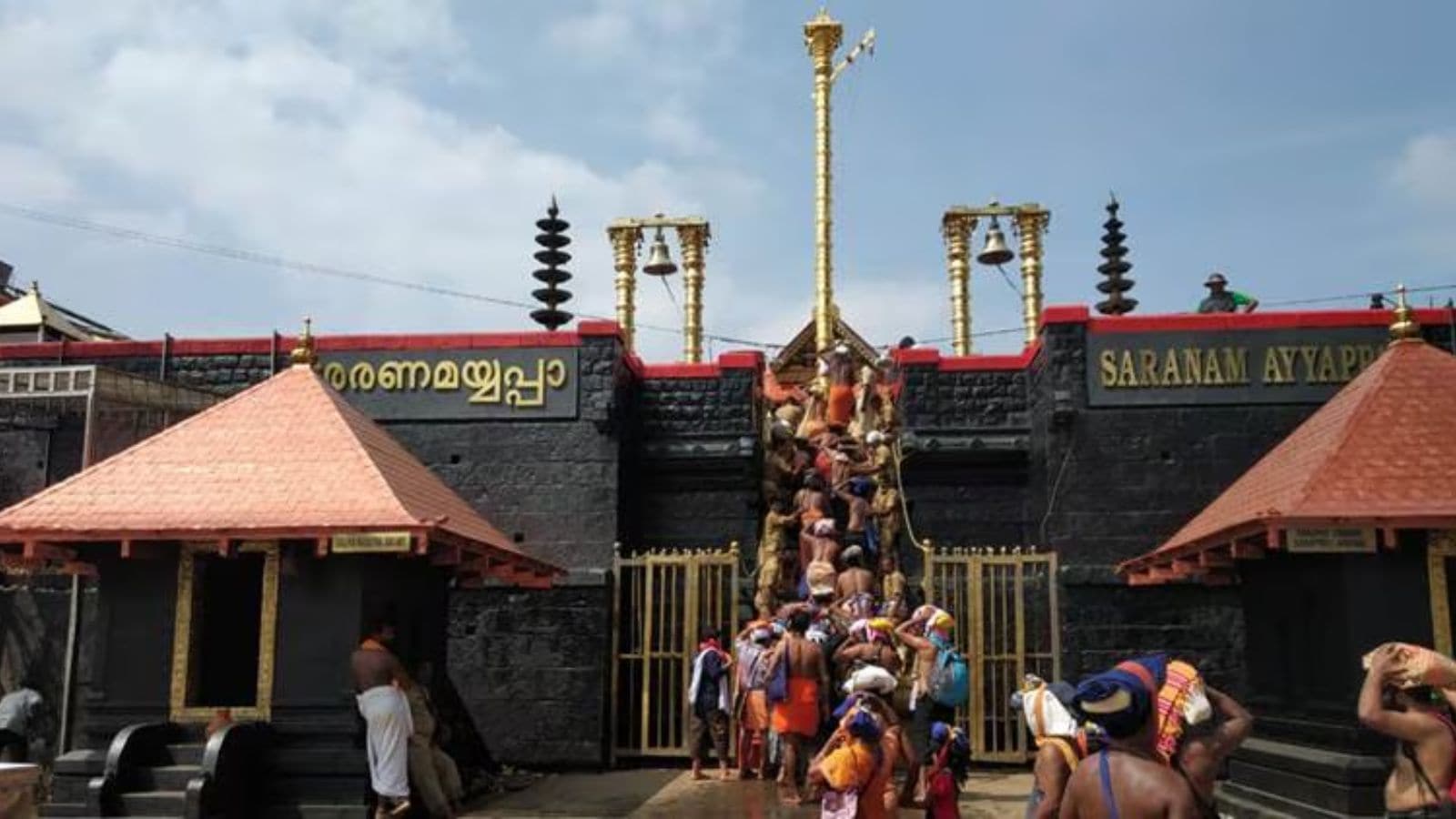
Sabarimala Reference Hearing From Supreme Court Today Live Updates: The Supreme Court will continue hearing the Sabarimala case today. This is the twelfth day of this hearing.
The case concerns discrimination against women in places of worship, including the Sabarimala temple, and the scope of religious freedom under the Constitution.

What happened in the last hearing?
Story continues below this ad
The Supreme Court, in the last hearing on Tuesday, said that the religious practice will not “extend” to the “exclusion” of certain castes. “That is not religion, neither is it religious practice,” Justice Nagarathna said.
The court responded when the senior advocate Darius Khambata said that religion is to be tested under the Constitution. “Is it moral under our Constitution? For example, what if a religious practice is casteist?” he said.
The apex court today also rapped the Young Lawyers Association, advising them to work for the welfare of the bar and the younger members.
The apex court questioned the objective of filing the present PIL from the counsel of the Young Lawyer Association and also asked if the deity has a “belief” or “conscience”.
“Now, we want to know why you filed this PIL at all? What was it that you wanted to achieve? What does it come out of it?” Justice Nagarathna added.
Previously, the Supreme Court was hearing the submission of senior advocate Jaising, who also noted that Shabari was a woman who offered berries to Shri Ram.
She concluded last day’s submission saying,” I am also a Shabari. You are keeping me out. That is the end of the story.”
Previously, the Supreme Court also emphasised the uniqueness of our nation: “diversity” is our strength.
“We are strong because we are diverse, and diversity is our strength, and to bring about a recognition of the diversity in denominations, Article 26 (b) protects it. By giving such protection, there is also a unity developed in the country,” the court added.
Justice Nagarathna previously questioned how a person in north India can claim the right of entry to a temple in the south when senior advocate Indira Jaising was arguing that the exclusion of women aged 10–50 violates.
The Supreme Court, on day 9 of the hearing, previously clarified that the state can “step in” when religious activities affect public order, such as blocking roads, noting that such acts cannot be justified as part of religious practice. It further observed that while autonomy in matters of worship is protected, only activities of a religious nature fall within that protection.
“Apart from that, if a secular activity is also getting affected, then the state can step in. There has to be a balance,” Justice Nagarathna said.
On the eighth day of the hearing, the Supreme Court cautioned on sharing information from “WhatsApp university” when one th counsels, senior advocate Neeraj Kishan Kaul, cited the words of politician Shashi Tharoor from an article published in The Indian Express-“When the gavel falls on matters of deep-seated belief, it must do so with an awareness of the limitations of legal logic.”
Justice Nagarathna responded with this caution when Kaul contended that there is never any harm in all humility.
“If knowledge and wisdom come from any source, any country, any university, it should be welcome,” he added.
The Chief Justice of India then further added that the court respects all eminent persons, but personal opinions are “personal opinions”.
Nine-judge bench: Chief Justice of India Surya Kant will preside over the bench, which will include Justices B V Nagarathna, M M Sundresh, Ahsanuddin Amanullah, Aravind Kumar, Augustine George Masih, Prasanna B Varale, R Mahadevan and Joymalya Bagchi.
Questions for consideration: There are seven questions for consideration before the court:
- What is the scope and ambit of the right to freedom of religion under Article 25 of the Constitution of India?
- What is the interplay between the rights of persons under Article 25 of the Constitution and the rights of religious denominations under Article 26?
- Whether the rights of a religious denomination under Article 26 of the Constitution are subject to other provisions of Part III of the Constitution, apart from public order, morality and health?
- What is the scope and extent of the word ‘morality’ under Articles 25 and 26 of the Constitution, and whether it is meant to include constitutional morality?
- What is the scope and extent of judicial review of a religious practice under Article 25 of the Constitution?
- What is the meaning of the expression “Sections of Hindus” occurring in Article 25 (2) (b) of the Constitution?
- Whether a person not belonging to a religious denomination or religious group can question a practice of that religious denomination or religious group by filing a PIL?